

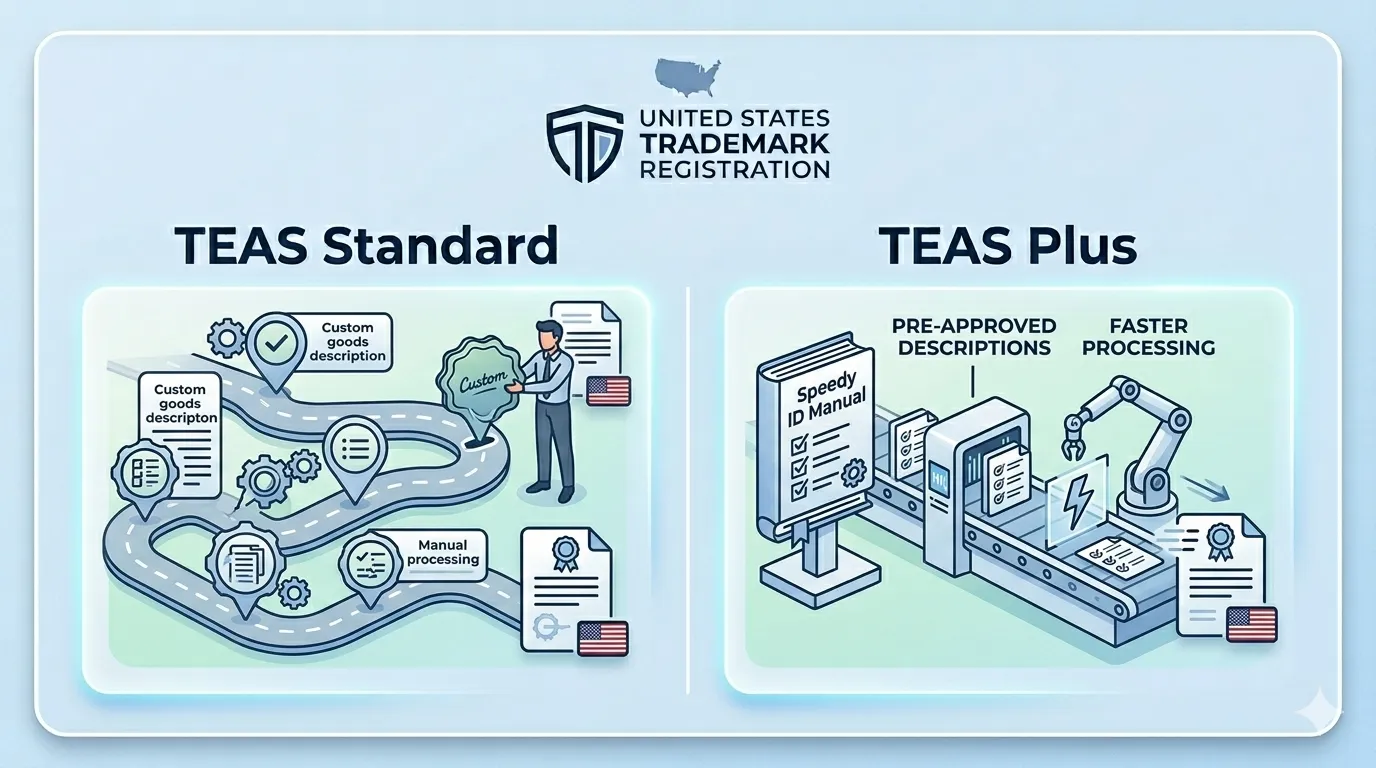
Which application form should you use when filing your trademark with the USPTO, TEAS Plus or TEAS Standard? That question trips up far more applicants than it should, mostly because most of the answers floating around online focus on the fee difference and miss the more important distinctions entirely. The filing fee gap is real, but it isn’t the real story.
What TEAS Stands For?
TEAS is the Trademark Electronic Application System, the USPTO’s online platform for submitting trademark applications. Both TEAS Plus and TEAS Standard are filed through the same system, and both lead to the same type of federal trademark application. The difference lies in the requirements attached to each form, and those requirements directly affect how smoothly your application moves through the examination process.
The Fee Difference
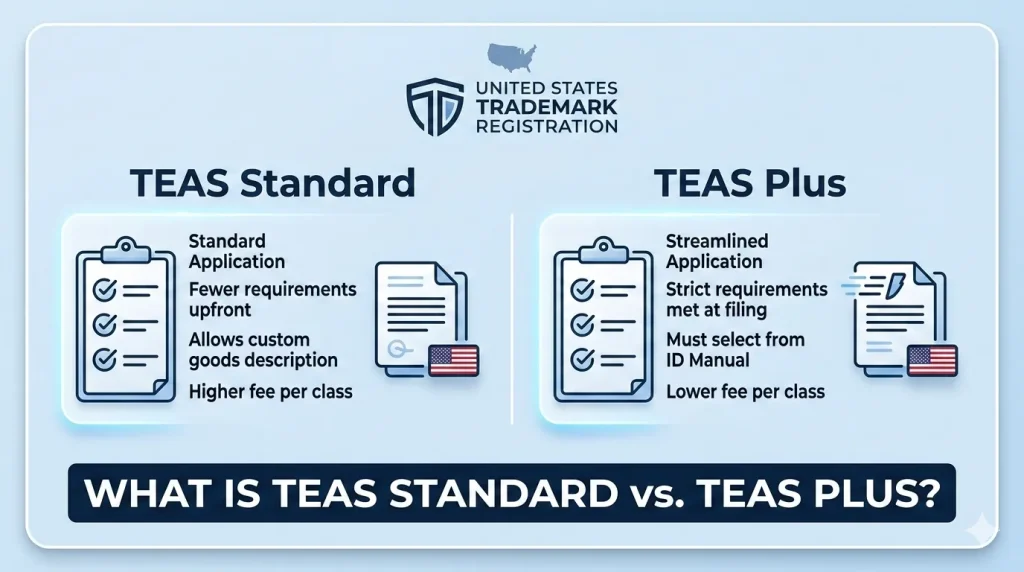
TEAS Plus costs $250 per class. TEAS Standard costs $350 per class. For a single-class filing, that’s a $100 difference. For a business filing in three classes, it’s $300. The fee difference is real, and it matters to applicants working with tight budgets, but it’s the last thing you should make your decision on.
What TEAS Plus Require?
TEAS Plus comes with a stricter set of upfront requirements. To qualify, your application must meet specific requirements. You must use the USPTO’s pre-approved identifications of goods and services from the ID Manual. You must authorize email communication with the USPTO. Your application must also be complete at the time of filing, with no missing elements.
The ID manual requirement is the one that creates friction. The USPTO maintains a searchable database of pre-approved descriptions for goods and services. If your product or service fits neatly into one of those descriptions, TEAS Plus works well for you. If your offering is specialized, niche, or difficult to categorize using the pre-approved language, forcing it into an ID Manual description can misrepresent what you actually sell.
Filing TEAS Plus with an inaccurate description just to save $100 per class is a trade-off that often backfires. It usually creates problems during the examination. If an examiner flags a description mismatch, they issue an office action. Responding to an office action takes time. Depending on how the issue is resolved, it can cost far more than the $100 you saved on the filing fee.
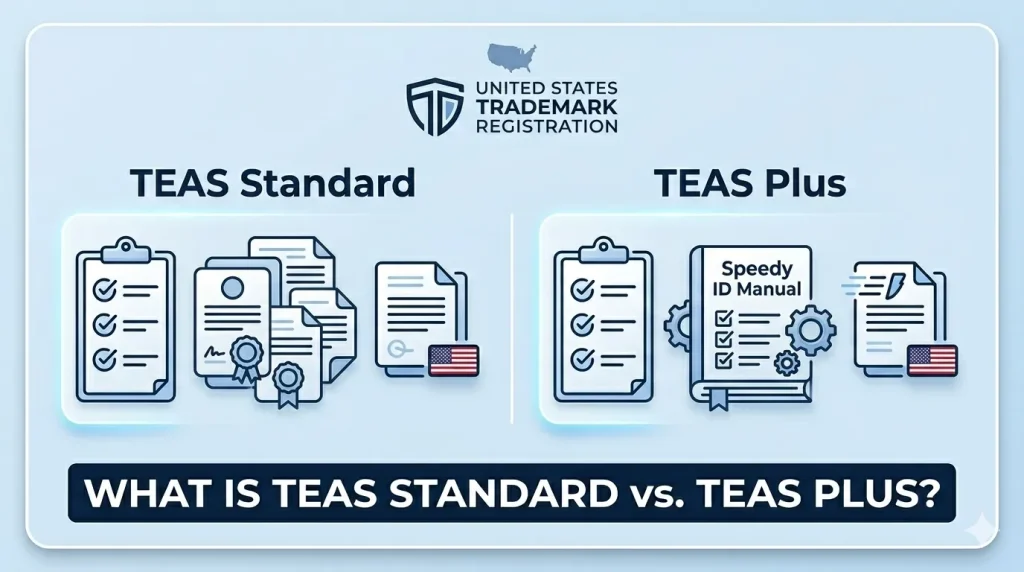
What TEAS Standard Allows?
TEAS Standard gives you more flexibility in how you describe your goods and services. You’re not restricted to the ID manual. You can write a custom description that accurately captures what your brand does and what it sells. That flexibility is worth significantly more than $100 in many situations.
Custom descriptions allow you to be precise. Precision matters during examination because a description that clearly matches your actual use is less likely to trigger an office action regarding the identification of goods and services. TEAS Standard also lets you submit certain elements of your application after the initial filing, which TEAS Plus does not allow.
Who Should File TEAS Plus?
TEAS Plus works well when your goods or services match cleanly with existing ID Manual entries. Common product categories, such as standard clothing items, widely recognized food and beverage types, and straightforward retail services, usually have usable ID Manual descriptions. If you’re filing for a well-established type of product and the pre-approved language fits accurately, TEAS Plus is a reasonable choice. In this case, the lower fee is a genuine benefit.
Online trademark services professionals can quickly determine whether your specific offering fits the ID Manual accurately. That determination should happen before you choose your form, not after you’ve filed and discovered the description doesn’t hold up during examination.
Who Should File TEAS Standard
Any business with a specialized product should consider the TEAS Standard. The same applies to services that don’t fit neatly into standard categories. Offerings that span multiple classes also benefit from this form. The $100 per class premium allows you the flexibility to describe your goods and services accurately. Accurate descriptions are the foundation of a smooth examination process.
Technology companies, professional services firms, and businesses in emerging industries almost always benefit from this flexibility. At USTML, our trademark application services include a thorough assessment. We determine which form best suits your specific filing before preparing anything.
The Compliance Requirement People Miss
There’s a compliance requirement attached to TEAS Plus that catches applicants off guard. If your TEAS Plus application fails to meet the eligibility requirements at filing, if any element is missing, if the description doesn’t match the ID Manual, or if other conditions aren’t satisfied, the USPTO downgrades your application to TEAS Standard automatically. When that happens, you pay the higher fee anyway.
You saved nothing; your application may have a description that doesn’t accurately reflect your business, and you’ve introduced a complication into the examination process. Filing TEAS Standard intentionally with a well-crafted description eliminates this risk.
The Bigger Picture
Choosing between TEAS Plus and TEAS Standard is one decision within a larger federal trademark filing strategy. The form you choose affects your description; your description affects the examination process, and the examination process affects whether your mark reaches registration on a reasonable timeline or gets mired in office actions.
USPTO filing services handled by experienced professionals approach this decision as part of a complete filing strategy. At USTML, we evaluate your goods and services, assess the ID Manual options available to you, and recommend the form that positions your application for the cleanest path through examination. Our trademark filing experts have navigated both paths across hundreds of filings. We know which choice serves different business types best, and we make that recommendation clearly before a single fee gets paid.
Both forms use the same trademark engine and reach the same outcome when filed correctly. The difference is in how much flexibility you need, how well-defined your goods and services are, and how important it is to describe your brand accurately from day one.
Not sure which filing form fits your application? Our team assesses your business and handles the entire filing process from start to finish. Begin with us and let us recommend the right path before you file.
Frequently Asked Questions
Is TEAS Plus better than TEAS Standard?
Neither is universally better. TEAS Plus is the right choice when your goods or services match the USPTO’s pre-approved ID Manual descriptions accurately. TEAS Standard is better when you need flexibility to write a custom description that precisely reflects what your brand sells or does.
What happens if my TEAS Plus application doesn’t qualify?
The USPTO will downgrade your application to TEAS Standard and charge you the higher filing fee. You’ll end up paying more than if you had filed TEAS Standard intentionally, and your application may have description issues that require correction.
Can I switch from TEAS Plus to TEAS Standard after filing?
The USPTO can downgrade a TEAS Plus application to TEAS Standard if it doesn’t meet the requirements, but you cannot voluntarily switch after submission. Choosing the right form before filing is essential.
How long does it take for either TEAS application to be examined?
Both TEAS Plus and TEAS Standard applications go through the same examination process and face the same general timeline. As of 2024, the USPTO’s initial examination typically begins eight to twelve months after filing for most applications.
Does filing TEAS Plus speed up my trademark registration?
No. TEAS Plus does not receive faster examination than TEAS Standard. Both forms move through the same USPTO examination queue on the same timeline. The fee difference reflects the compliance requirements, not the examination speed.