

You finally found the perfect business name. The domain is available. Your logo is designed. Your LLC has been approved by the state. Everything appears to be moving in the right direction. Then someone asks a question: “Have you filed for trademark registration?” For many business owners, that is the moment confusion begins.
One of the most common misconceptions among entrepreneurs is the belief that an approved LLC name automatically means the brand name is protected. Others assume that if they own the domain name, nobody else can claim the brand. Some believe a state business registration gives them nationwide rights.
Unfortunately, none of those assumptions are necessarily true.
This misunderstanding has forced countless businesses into expensive rebrands, legal disputes, and trademark conflicts that could have been avoided with proper planning from the beginning.
If you are launching a new business, expanding an existing one, or evaluating whether your brand is truly protected, understanding the relationship between your LLC name and your trademark is essential.
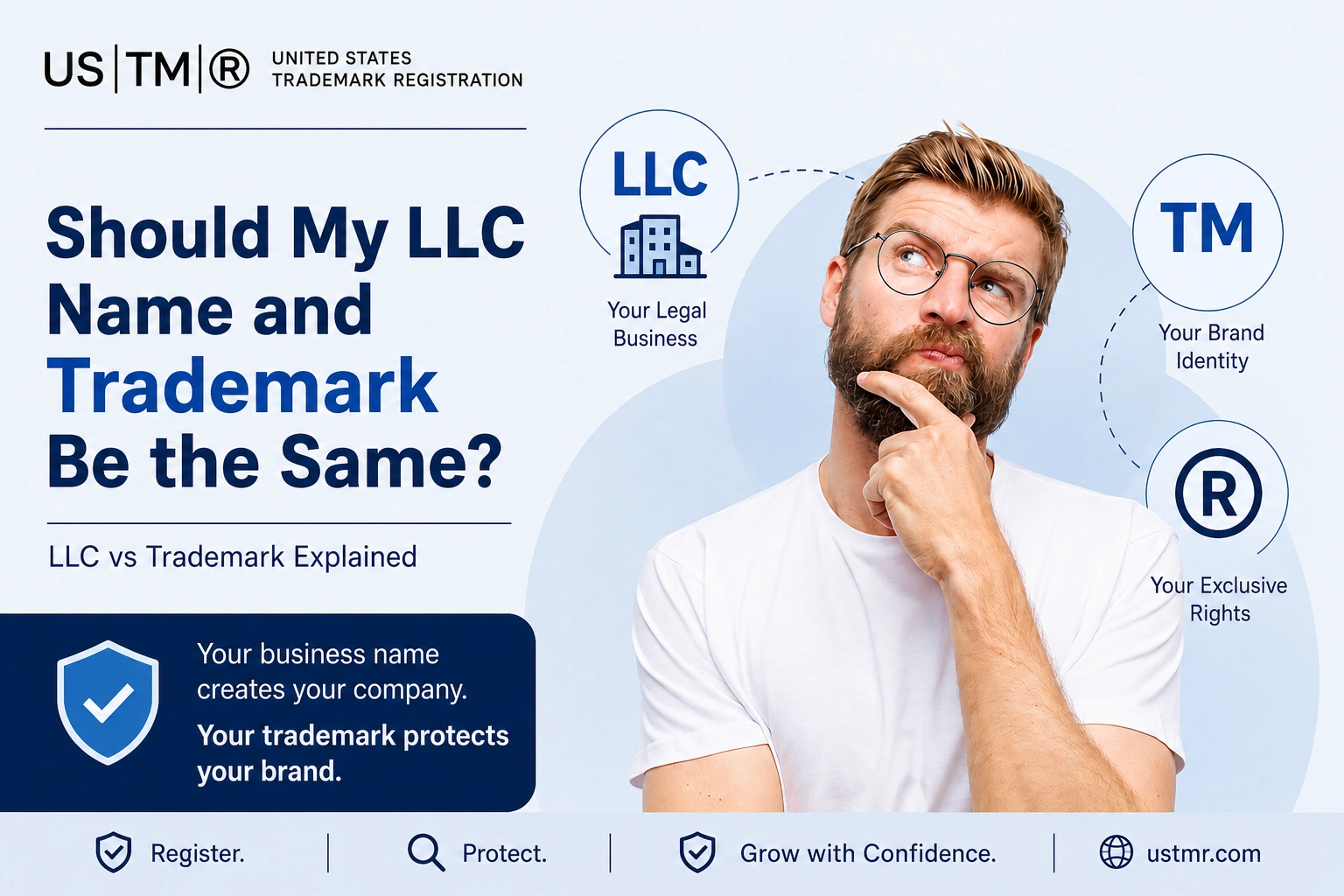
The Short Answer: No, Your LLC Name and Trademark Do Not Have to Be the Same
Let’s address the question directly.
No, your LLC name and your trademark do not have to be identical.
Many successful businesses operate under different legal and brand identities.
However, just because they can be different does not always mean they should be.
The right approach depends on your business model, growth plans, branding strategy, and intellectual property goals.
Before deciding whether your LLC and trademark should match, it is important to understand what each one actually does.
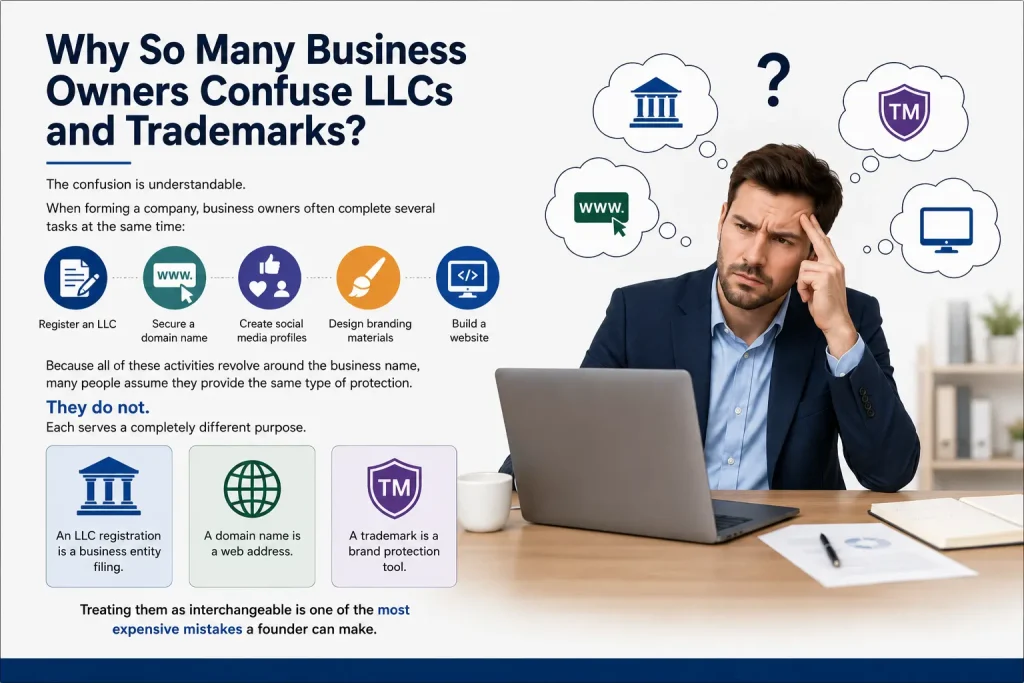
Why So Many Business Owners Confuse LLCs and Trademarks?
The confusion is understandable.
When forming a company, business owners often complete several tasks at the same time:
- Register an LLC
- Secure a domain name
- Create social media profiles
- Design branding materials
- Build a website
Because all of these activities revolve around the business name, many people assume they provide the same type of protection.
They do not.
Each serves a completely different purpose.
An LLC registration is a business entity filing.
A domain name is a web address.
A trademark is a brand protection tool.
Treating them as interchangeable is one of the most expensive mistakes a founder can make.
What an LLC Name Protects?
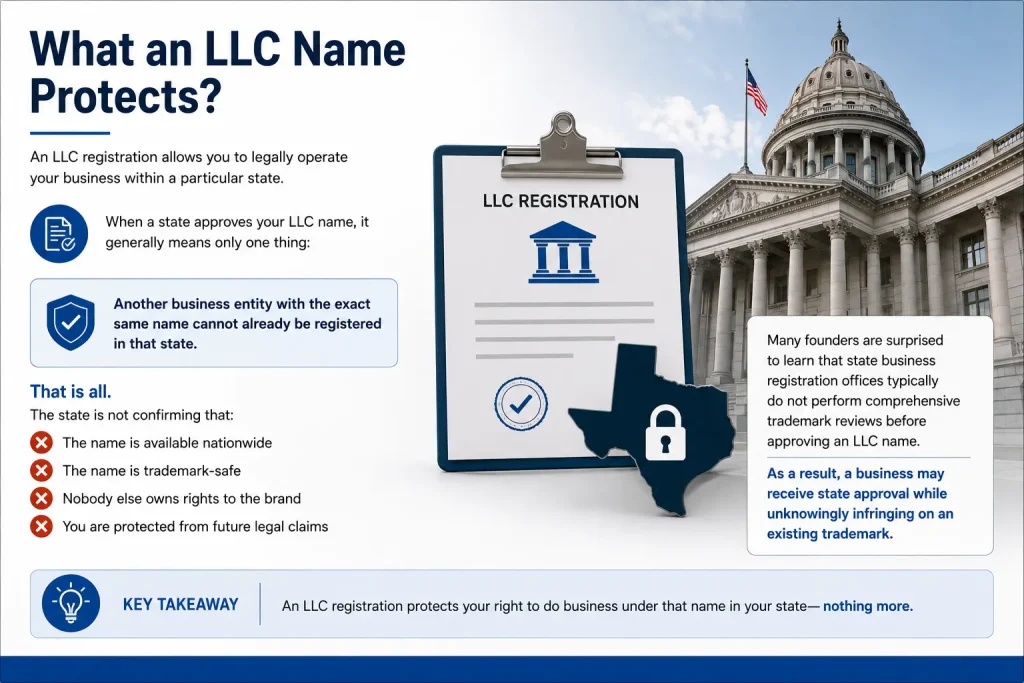
An LLC registration allows you to legally operate your business within a particular state.
When a state approves your LLC name, it generally means only one thing:
Another business entity with the exact same name cannot already be registered in that state.
That is all.
The state is not confirming that:
- The name is available nationwide
- The name is trademark-safe
- Nobody else owns rights to the brand
- You are protected from future legal claims
Many founders are surprised to learn that state business registration offices typically do not perform comprehensive trademark reviews before approving an LLC name.
As a result, a business may receive state approval while unknowingly infringing on an existing trademark.
What a Trademark Protects?
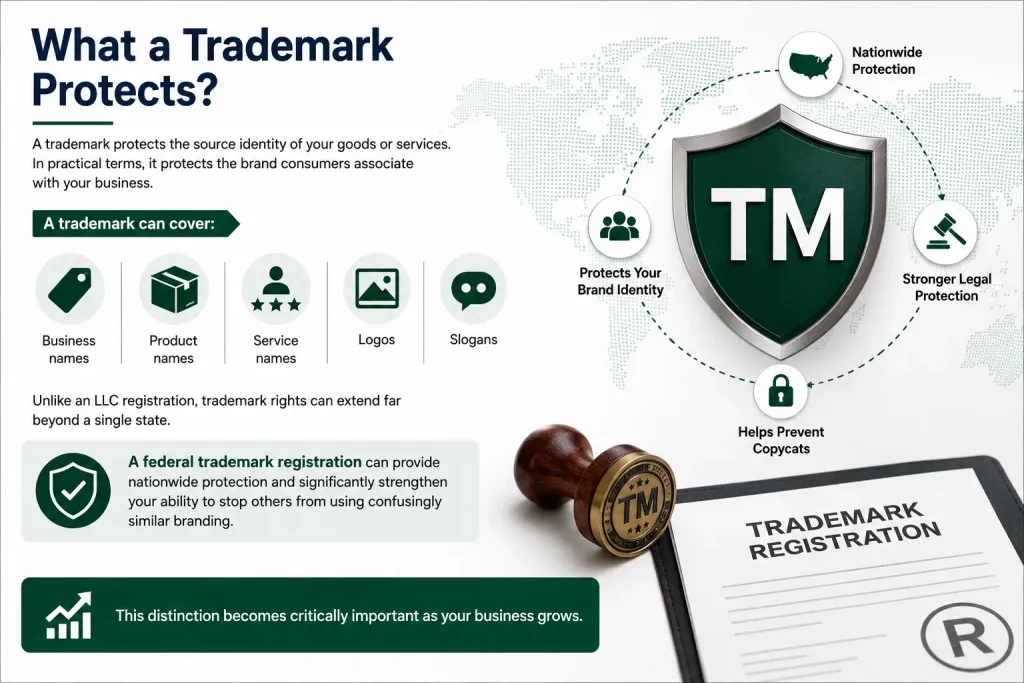
A trademark protects the source identity of your goods or services.
In practical terms, it protects the brand consumers associate with your business.
A trademark can cover:
- Business names
- Product names
- Service names
- Logos
- Slogans
Unlike an LLC registration, trademark rights can extend far beyond a single state.
A federal trademark registration can provide nationwide protection and significantly strengthen your ability to stop others from using confusingly similar branding.
This distinction becomes critically important as your business grows.
Can Someone Else Own the Trademark for My Approved LLC Name?
Yes.
And this happens more often than many business owners realize.
Imagine a founder forms an LLC called “Summit Peak Solutions LLC” in Arizona.
The state approves the filing because no other Arizona LLC exists under that exact name.
Months later, the founder discovers that a federally registered trademark for “Summit Peak” already exists in the same industry.
Now the business faces a difficult situation.
The LLC registration remains valid.
The trademark issue remains a problem.
The founder may need to:
- Change the brand name
- Rebrand marketing materials
- Replace packaging
- Update websites
- Modify customer-facing assets
The costs can quickly exceed what would have been spent on proper trademark planning from the beginning.
Why State Approval Creates a False Sense of Security?
State approval feels official.
Business owners receive formation documents and assume the name has been vetted.
That assumption often creates a dangerous sense of confidence.
The reality is that LLC approval and trademark clearance are separate processes managed by different systems for different purposes.
A state is evaluating business entity records.
Trademark examiners evaluate brand conflicts.
Those are not the same thing.
This distinction explains why businesses sometimes receive legal notices despite having properly registered LLCs.
The issue is not the company formation.
The issue is the trademark conflict.
Should Your LLC Name and Brand Name Match?
For many small businesses, matching the LLC name and trademark can simplify operations.
Benefits may include:
- Consistent branding
- Easier customer recognition
- Simpler legal documentation
- Stronger brand cohesion
A local accounting firm called Bright Ledger may choose:
LLC: Bright Ledger LLC
Trademark: Bright Ledger®
Simple. Consistent. Easy to manage.
For many businesses, this approach makes sense.
However, it is not the only option.
When Different Names Make Strategic Sense?
Many companies intentionally separate their legal entity name from their public-facing brand.
Examples include:
Holding Companies
A parent company may own multiple brands.
Legal Entity:
Northstar Holdings LLC
Brands:
- GreenPeak Coffee
- Summit Trail Gear
- Harbor Home Goods
Consumers never see the holding company name.
They interact with the brands.
Product Brand Strategies
Some businesses launch multiple products under different names.
The LLC remains the same while various trademarks support different offerings.
Future Expansion
Using a broader legal entity name may provide flexibility for future growth without requiring corporate restructuring.
This approach is common among larger businesses and rapidly growing startups.
The Hidden Risk of Building a Brand Before Checking Trademark Availability
One of the most expensive mistakes founders make is investing heavily in branding before conducting trademark due diligence.
A business may spend thousands on:
- Logo design
- Packaging
- Signage
- Marketing campaigns
- SEO
- Social media growth
Only to discover later that the name cannot be protected or conflicts with an existing trademark.
Before investing significant resources into a brand, it is wise to evaluate trademark availability and filing options through USTML’s professional trademark registration services.
Addressing these issues early is almost always less expensive than correcting them after launch.
LLC vs Trademark vs DBA vs Domain Name
Many business owners benefit from viewing these concepts side by side.
| Asset | Purpose | Protection Scope |
| LLC | Legal business entity | State-level business registration |
| DBA | Alternate operating name | Limited business use designation |
| Domain Name | Website address | Internet presence only |
| Trademark | Brand protection | Potential nationwide rights |
This table highlights why owning one does not automatically provide the benefits of another.
Each serves a unique function.
Questions Every Founder Should Ask Before Launching
Before committing to a business name, consider the following:
Is the trademark available?
A business name may be available for LLC registration while still creating trademark issues.
Is the domain available?
Consumers increasingly expect brand consistency online.
Does the name support future growth?
A highly specific name may create limitations later.
Could consumers confuse the name with another brand?
Confusion risk is one of the most common causes of trademark problems.
Is the brand worth protecting?
If the answer is yes, trademark planning should happen early.
Why Founders Don’t Prioritize Trademark Strategy?
Many entrepreneurs view trademarks as something to handle later.
The reality is often the opposite.
Brand protection decisions made at launch can influence:
- Marketing investments
- Expansion opportunities
- Investor confidence
- Marketplace enforcement
- Long-term business value
A strong trademark strategy supports growth.
A weak strategy often creates expensive corrections later.
The most successful founders do not simply ask whether a name is available.
They ask whether the name is defensible.
That distinction can determine whether a brand scales successfully or faces unnecessary obstacles.
Conclusion
Your LLC name and trademark do not have to be the same.
However, understanding the difference between the two is essential before investing in branding, marketing, or growth.
An LLC registration creates a legal business entity.
A trademark protects the identity consumers associate with your products and services.
Confusing the two can create costly problems.
Understanding the distinction can help you make smarter decisions, avoid preventable disputes, and build a stronger foundation for long-term business success.
Frequently Asked Questions
Can I trademark my LLC name?
Yes. If the name meets trademark requirements and is used in connection with qualifying goods or services, it may be eligible for trademark protection.
Does an LLC protect my business name nationally?
No. LLC registration generally provides business entity recognition at the state level. It does not automatically create nationwide trademark rights.
Can someone sue me if my LLC name is approved?
Potentially, yes. State approval does not prevent trademark disputes if another party has superior trademark rights.
Should I register an LLC first or file a trademark first?
Many businesses address both early in the formation process. The best sequence depends on business goals and trademark availability.
Can my trademark be different from my LLC name?
Absolutely. Many companies use different legal entity names and public-facing brand names.
What if my LLC name is available but the trademark is not?
You should carefully evaluate the risk before investing in branding. Rebranding later is often significantly more expensive than choosing a different name upfront.