

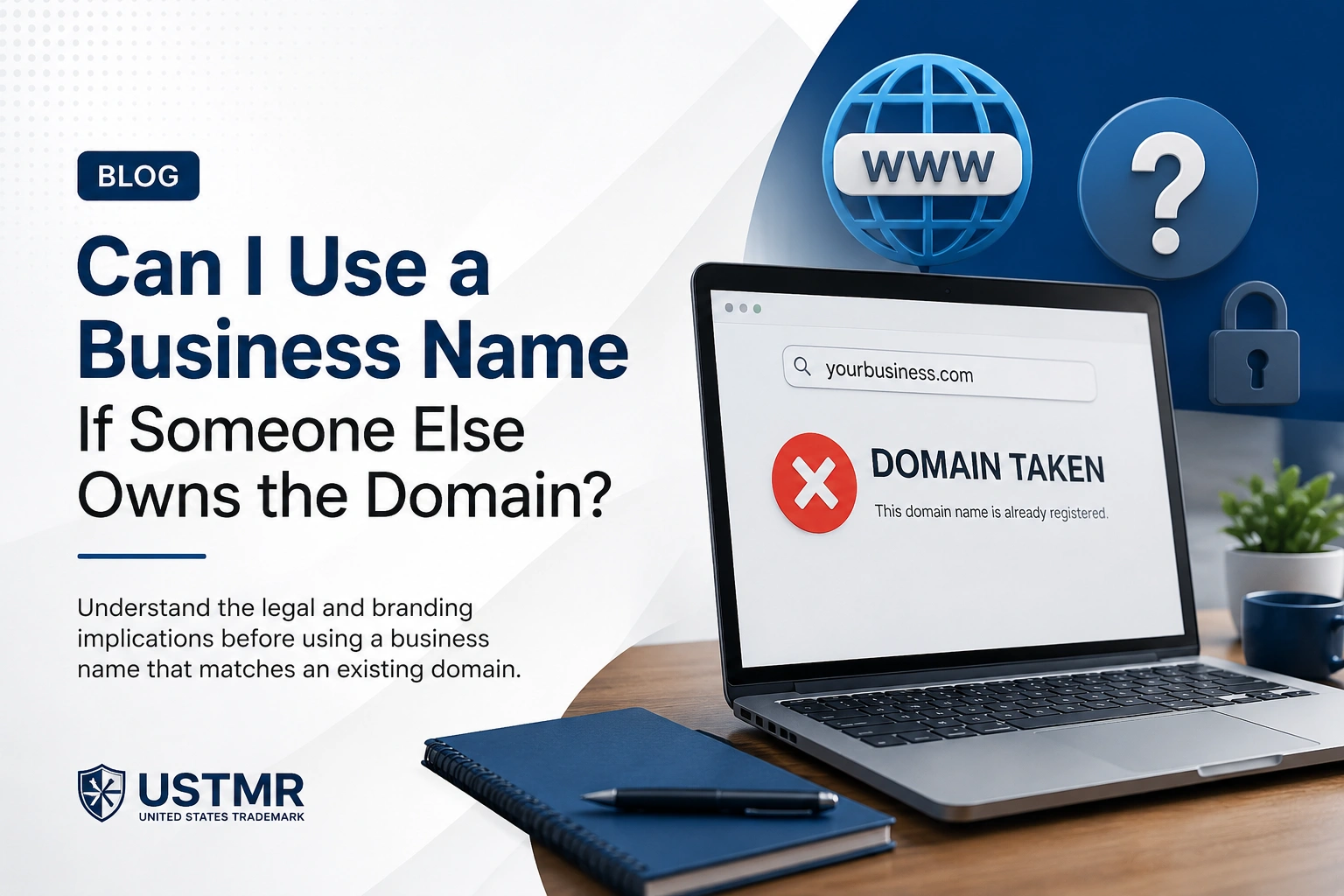
Can I Use a Business Name If Someone Else Owns the Domain?
You finally find the perfect business name.
After days of brainstorming, checking competitors, and testing ideas with friends, you’ve landed on something that feels right. The name fits your vision, looks great in a logo, and sounds like a brand that could grow with your business for years to come.
Then you search for the .com domain.
Taken.
For many entrepreneurs, that discovery feels like the end of the road. The assumption is almost automatic: if someone owns the domain, they must own the name. Surely it would be risky, or even illegal, to move forward.
In reality, things are not nearly that simple.
Every year, business owners abandon strong brand names because they misunderstand the relationship between domain ownership and trademark rights. Others make the opposite mistake. They find an available domain, assume the name is safe to use, and later discover another company already has legal rights to the brand.
The internet has conditioned us to think of domains as ownership. From a branding and legal perspective, however, a domain name is only one piece of a much larger puzzle.
The real question is not whether someone owns the domain.
The real question is whether someone owns rights to the brand.
Understanding that distinction can save a business from costly mistakes, unnecessary rebranding, and legal headaches that often surface long after a company has invested in marketing, packaging, advertising, and customer acquisition.
Why This Question Has Become So Common
Twenty years ago, finding an available .com domain was relatively easy. Today, millions of domains have been registered, parked, resold, developed, abandoned, or held by investors waiting for the right buyer.
As a result, modern entrepreneurs frequently encounter a frustrating situation: the business name they want appears available from a branding standpoint, but the matching domain has already been claimed.
This creates immediate uncertainty.
- Should you walk away from the name?
- Should you buy a different domain extension?
- Should you make an offer to purchase the domain?
- Or should you keep moving forward?
The answer depends on something far more important than domain ownership itself.
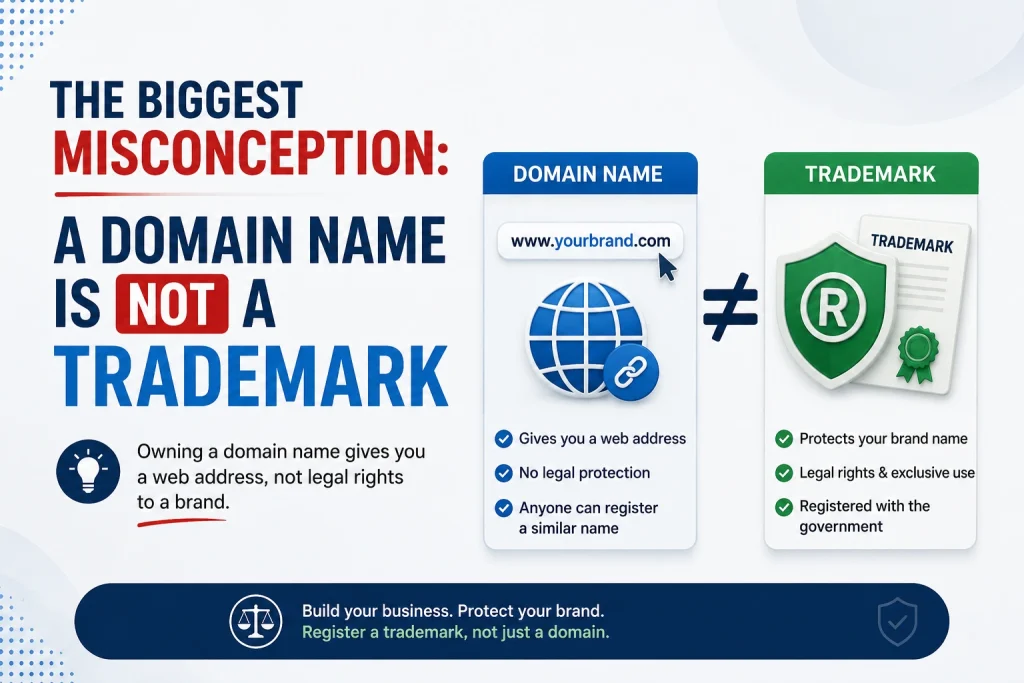
The Biggest Misconception: A Domain Name Is Not a Trademark
One of the most common misunderstandings among business owners is the belief that owning a domain automatically creates ownership of a brand.
It does not.
A domain name is simply an internet address. It tells web browsers where to find a particular website. Purchasing a domain through a registrar does not automatically grant exclusive rights to use that name in commerce.
Trademark rights serve a completely different purpose.
A trademark identifies the source of goods or services. It helps consumers understand who is behind a product, service, or brand. Trademark law exists to prevent confusion in the marketplace and protect the goodwill businesses build over time.
Because domains and trademarks serve different functions, they are governed by different rules.
This distinction explains why two parties can have legitimate interests in the same name while possessing entirely different rights.
One party may own the domain.
Another party may own the trademark.
A Real-World Example
Imagine you are launching a marketing agency called “Elevate Creative.”
You search ElevateCreative.com and discover it is already registered.
At first glance, that seems like a problem.
However, further investigation reveals that the domain owner purchased the domain years ago, never developed a website, and currently displays nothing more than a parked landing page filled with advertisements.
Does that automatically prevent you from using the name?
Not necessarily.
Now consider a different scenario.
You discover ElevateCreative.com is being actively used by an established marketing agency that serves the same clients you plan to target. The company has been operating under that name for years and owns a federal trademark registration.
That situation looks very different.
In both examples, the domain is taken.
The legal and business risks, however, are dramatically different.
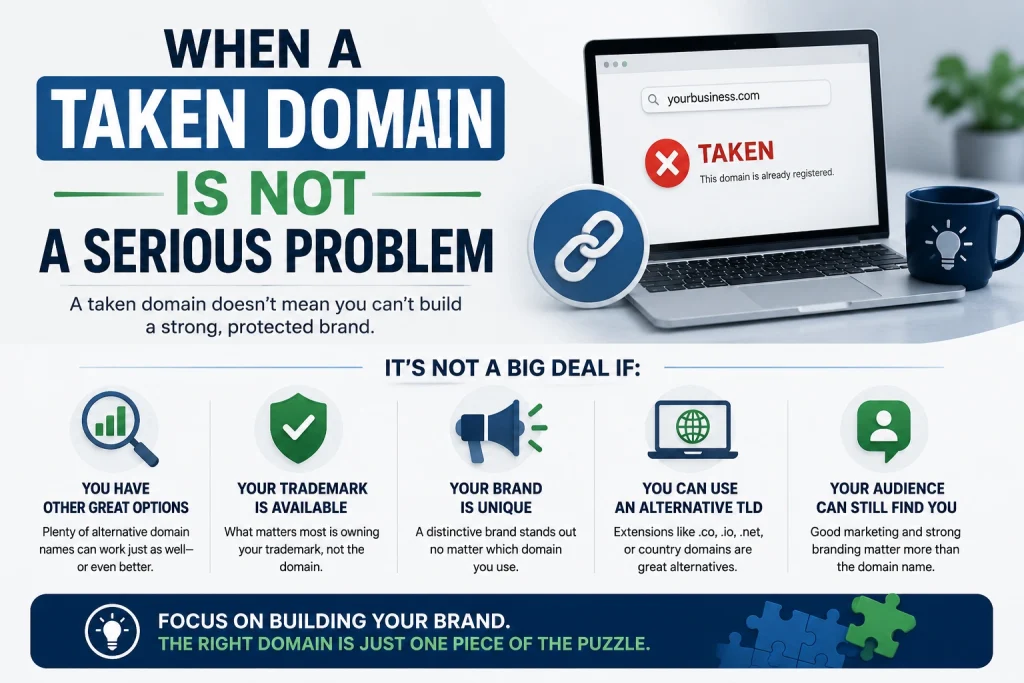
When a Taken Domain Is Not a Serious Problem
Business owners are often surprised to learn that many successful brands operate without owning the exact-match .com domain they originally wanted.
A taken domain may not present a major obstacle when:
- The domain is inactive
- The owner is not operating a business under the name
- The domain is unrelated to your industry
- No trademark rights appear to exist
- There is little risk of customer confusion
In these situations, founders may choose alternative approaches such as:
- Purchasing a modified domain
- Using an industry-specific extension
- Negotiating a future acquisition
- Building brand recognition through search and social channels
Today’s consumers increasingly discover businesses through Google, social media, marketplaces, and mobile apps rather than manually typing domain names into a browser.
That reality has reduced the importance of exact-match domains compared to the early days of the internet.
When a Taken Domain Should Raise Immediate Concerns
Not every situation is harmless.
In some cases, a taken domain may signal a larger trademark problem that deserves serious attention.
Red flags include:
An Active Business Using the Same Name
If another company is actively using the name in commerce, additional investigation is necessary.
Industry Overlap
Trademark conflicts become more likely when businesses operate in similar industries or serve similar customers.
Existing Trademark Registrations
Federal trademark registrations often indicate significant legal rights.
Established Brand Recognition
Even businesses without federal registrations may possess common-law trademark rights based on actual commercial use.
The key issue is not whether someone owns the domain.
The key issue is whether consumers are likely to believe the two businesses are connected.
Why Trademark Availability Matters More Than Domain Availability
Many founders begin their naming process by checking domains.
Experienced trademark attorneys often recommend the opposite approach.
A domain search tells you whether a web address is available.
A trademark search helps determine whether another party may already have legal rights to the brand.
One addresses convenience.
The other addresses risk.
Consider these two scenarios:
| Scenario | Domain Status | Trademark Status | Risk Level |
| A | Available | Conflicting Trademark Exists | High |
| B | Taken | No Trademark Conflict | Potentially Manageable |
Most experienced business owners would choose Scenario B.
An unavailable domain can often be solved.
A trademark conflict can force a complete rebrand.
That distinction is why trademark due diligence should play a central role in the naming process.
Before investing in logos, websites, packaging, advertising campaigns, or marketing materials, many businesses conduct a professional trademark search to identify potential conflicts and evaluate risk.
Businesses looking to validate a brand before launch often begin with a comprehensive trademark search to better understand existing rights and potential obstacles: /comprehensive-trademark-search/
That process frequently reveals issues that a simple domain lookup would never uncover.
The Cost of Getting This Wrong
The danger is not choosing a taken domain.
The danger is building a business around a name that creates legal complications later.
Imagine spending twelve months developing a brand.
You invest in:
- Website development
- Search engine optimization
- Social media growth
- Product packaging
- Advertising campaigns
- Customer acquisition
Your business gains traction. Customers recognize the brand. Revenue begins to grow.
Then a trademark dispute appears.
At that point, changing course becomes expensive.
Rebranding is not simply a matter of changing a logo.
It may require updating every customer-facing asset, rebuilding brand awareness, modifying marketing materials, and potentially losing hard-earned recognition in the marketplace.
Many businesses spend far more on rebranding than they would have spent evaluating trademark availability before launch.
Domain Name vs Business Name vs Trademark
The confusion often stems from treating these assets as if they serve the same purpose.
They do not.
| Asset | Primary Purpose | What It Actually Protects |
| Domain Name | Website address | Online location |
| LLC Name | State business registration | Legal entity within a state |
| DBA | Operating name | Business identity at a local level |
| Trademark | Brand protection | Consumer-facing brand rights |
Understanding these differences helps founders make smarter decisions when evaluating a new name.
Owning one does not automatically grant ownership of the others.
Should You Try to Buy the Domain?
Many entrepreneurs become emotionally attached to a particular domain and immediately begin negotiating with the owner.
Sometimes that makes sense.
Sometimes it does not.
Before making an expensive purchase, ask yourself:
- Is the business name legally available?
- Does the brand fit long-term growth plans?
- Is the domain owner asking a reasonable price?
- Would an alternative domain achieve the same goal?
In some cases, spending thousands of dollars on a domain acquisition may be justified.
In others, the money may be better invested in branding, marketing, or trademark protection.
Questions Every Founder Should Ask Before Moving Forward
Before committing to a business name, consider the following:
- Is there an existing trademark conflict?
- Is the domain actively used?
- Does the existing website operate in the same industry?
- Could customers confuse the businesses?
- Is the name capable of long-term growth?
- Have I evaluated both legal and branding risks?
The strongest business decisions are rarely based on a single factor.
They are based on a complete understanding of the landscape.
Final Thoughts
Can you use a business name if someone else owns the domain?
In many situations, yes.
Domain ownership alone does not automatically prevent you from using a business name, nor does it guarantee that the domain owner possesses trademark rights.
The more important question is whether another party has established legal rights to the brand and whether your use could create confusion in the marketplace.
Too many founders focus exclusively on securing the perfect domain while overlooking the trademark issues that can create far greater problems later.
A domain can often be replaced, negotiated, or worked around.
A trademark dispute is much harder to solve after a business has already invested in building a brand.
Before committing to a name, evaluate both the branding and legal dimensions of the decision. Doing so can help you avoid costly mistakes and build your business on a stronger foundation from day one.
Frequently Asked Questions
Can I trademark a business name if the domain is already taken?
Yes. Domain ownership and trademark rights are separate. A taken domain does not automatically prevent trademark registration.
Does owning a domain name give someone trademark rights?
No. Trademark rights generally arise from commercial use and trademark law, not from domain registration alone.
What if the domain owner is not using the website?
Inactive or parked domains do not automatically create trademark rights, though additional research is still recommended.
Should I avoid a business name if the .com is unavailable?
Not necessarily. Many successful businesses operate with alternative domain strategies.
What matters more, a trademark or a domain?
From a legal brand protection perspective, trademark rights are generally more important than domain ownership.
How can I determine whether a business name is legally available?
A comprehensive trademark search can help identify existing rights, potential conflicts, and risks before you invest in branding or marketing.