


Here’s a number worth sitting with.
Only about 10% of small and medium businesses in the US have any registered intellectual property at all.
Among large companies, that number jumps to roughly 50%.
That gap isn’t about big companies caring more. It’s about small businesses not realizing the gap exists until something forces them to find out.
In fiscal year 2024 alone, over 767,000 businesses filed trademark applications with the USPTO. Every one of them eventually learned the same lesson. A name only belongs to you once it’s documented.
Most business owners find that out the hard way.
The Number That Should Actually Scare You
A federal trademark filing costs around $350 per class of goods or services.
A trademark lawsuit costs somewhere between $120,000 and $750,000.
Read that again.
The filing that protects you costs less than a used car. The dispute that happens if you skip it can cost more than most small businesses make in a year.
This is where things get expensive, and it’s not hypothetical. A small coffee shop called Sambuck’s found this out when Starbucks argued the name was close enough to confuse. The shop had no federal registration to fall back on. It had to change its name, its signage, and everything built around it, not because it did anything malicious, but because it never secured the one thing that would have let it negotiate from a position of strength.
Here’s the part that stings even more. Coexistence agreements, where both businesses keep operating under similar names with minor adjustments, are actually common outcomes in these disputes. But you only get offered that option when you have something to negotiate with. A registration gives you leverage. An empty filing cabinet doesn’t.
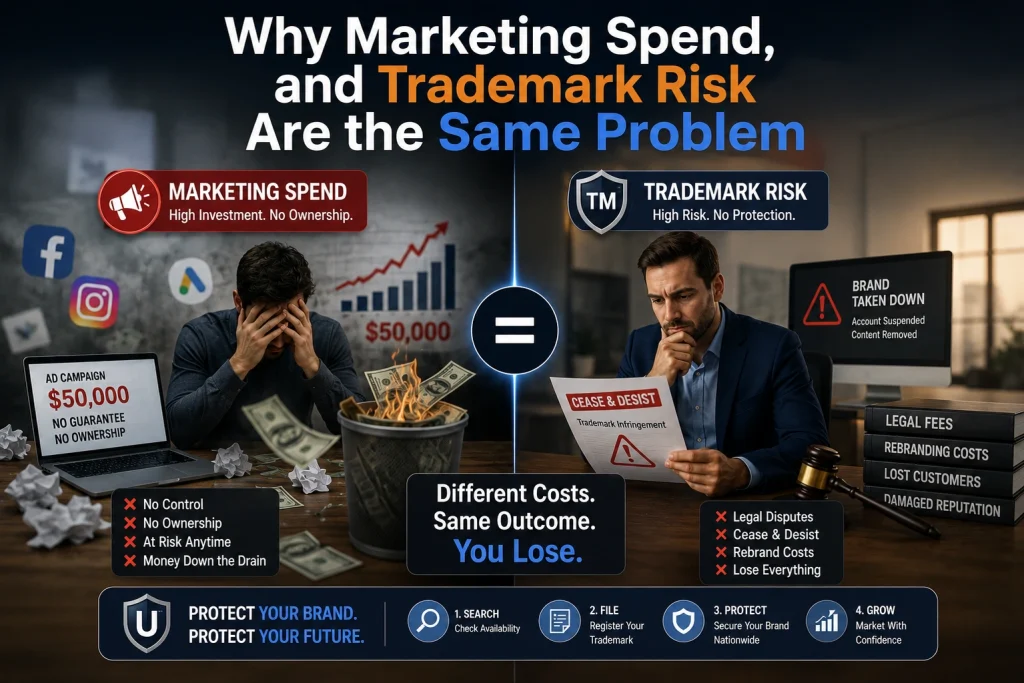
Why Marketing Spend, and Trademark Risk Are the Same Problem
Every dollar you put into ads, content, or influencer partnerships does one job. It builds recognition around your name.
Here’s the mistake almost every founder makes. They treat marketing and legal protection as two separate line items, one urgent and one someday.
They’re not separate. They’re the same investment.
Think about what you’re actually buying with a marketing budget. Not clicks. Not impressions. Recognition. The moment a stranger sees your name and already half trusts it.
If that name isn’t legally yours, you’re not building an asset. You’re renting attention on a name someone else might have a stronger claim to.
What “Owning” a Name Actually Means
Without federal registration, you’re relying on common law rights.
Common law rights only protect you where you can prove continuous, documented use. Not nationwide. Usually not even statewide.
Now compare that with federal registration. It gives you nationwide rights and a legal presumption of ownership from your filing date forward. If someone challenges you, they carry the burden of proving your registration shouldn’t stand, not the other way around.
That single shift, in who has to prove what, is usually the entire fight.
There’s a version of this that catches even more people off guard. Some states offer their own trademark registries, separate from the federal one. A state registration can feel like real protection. It isn’t, not in the way that matters once you start running national ad campaigns or selling across state lines. It covers exactly one state, and nothing beyond it.
The Class System Nobody Explains Well
Trademarks aren’t registered as a blanket claim on a word. They’re registered against specific classes of goods and services.
This trips up more founders than almost anything else in the process.
Say you trademark your name in the class covering software. That protects you in software. It does not automatically protect you if you later launch a physical product line, or a consulting service under the same name. Each class you want covered adds another filing fee, and skipping a class you’ll eventually need is exactly how businesses end up discovering, mid-expansion, that their name is only half protected.
This is precisely why a trademark search done early should account for where your business is headed, not just where it is today. Filing for the classes you’ll need in three years is far cheaper than filing for them after a competitor already claimed the gap.
Filing Before You’ve Even Launched
Here’s something most people don’t know exists until they need it.
You don’t have to already be selling something to file. An intent-to-use application lets you claim a name based on a genuine plan to use it before your product or website ever goes live.
This matters enormously for anyone planning a launch. It means you can lock in your filing date months before your marketing budget even starts moving, which protects you against someone else grabbing the name while you’re still building. You’ll formalize the filing later with a statement of use once you’re actually operating.
Founders who wait until launch day to think about this are often shocked to learn someone else filed for a nearly identical name during the months they spent quietly building in private.

This Is Where Timing Becomes Everything
A trademark filing typically takes close to a year to fully clear once you account for examination, publication, and the 30-day window where anyone can formally object to your registration. That window can stretch even further if someone requests more time to prepare a challenge.
Here’s the mistake that traps growing businesses specifically. They wait until they’re already spending serious money on marketing to start this process, which means they’re racing their own growth instead of getting ahead of it.
Businesses that register early aren’t just protecting a name. They’re protecting every dollar they’re about to spend making that name valuable. And if an office action comes back during examination, meaning the examiner flags an issue that needs a response, businesses without guidance often lose months just figuring out how to respond correctly. This is exactly the kind of delay a proper office action response process is built to shorten.
What Happens If You Plan to Grow Beyond the US?
If your marketing plans include international expansion, even just selling to customers in Canada or the UK through your website, there’s another layer worth understanding early.
US registration only protects you inside the US. Nothing more.
Most countries give priority consideration to businesses that already hold a registration in their home country, which makes filing abroad significantly smoother if you’ve already secured things domestically first. Businesses that wait to think about this until they’re actually expanding often find themselves filing from a weaker position, sometimes discovering a similar name is already registered in the market they’re trying to enter.
Do Investors Ask About This
Anyone who’s raised money knows investors dig into intellectual property early in due diligence.
Here’s why that matters more than it sounds like it should.
An unregistered brand name is an invisible liability. It doesn’t show up on a balance sheet, but it’s sitting there anyway, because if the name gets challenged after the check clears, the entire go-to-market identity the investor just funded could disappear.
Businesses with registered IP also generate roughly 41% more revenue per employee than those without, according to recent USPTO data. That’s not a coincidence. Registration tends to show up alongside businesses that think seriously about what they’re building, not just how fast they can grow it.
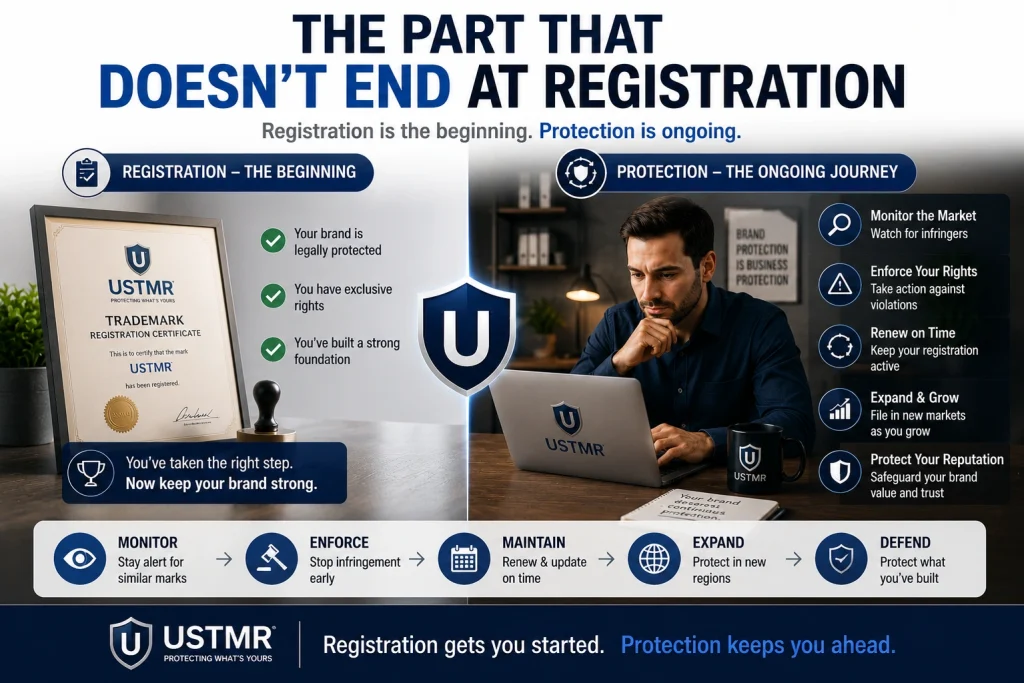
The Part That Doesn’t End at Registration
Getting the certificate isn’t the finish line. It’s the start of a maintenance schedule most founders never plan for.
Registrations require periodic renewal filings to stay active. Miss one of those windows and a trademark you paid to protect can lapse entirely, sometimes without much warning, opening the door for someone else to file for it. This is why ongoing trademark renewal tracking matters just as much as the initial filing.
There’s also the question of what happens after you’re registered. A registration doesn’t automatically alert you if someone else files something similar next year. Businesses serious about protecting their name long term typically pair registration with active trademark monitoring, so a competing filing gets caught during its opposition window, while there’s still time to act, rather than years later when it’s already established and expensive to challenge.
What USTML Sees Constantly
Most founders who come to USTML have already spent real money on branding, ads, and content and never once checked whether the name was actually available to own.
That’s exactly the gap a comprehensive trademark search closes, usually within days, not the months it takes to find out the hard way. It tells you whether anyone with a stronger claim is already sitting on your name before you spend another dollar building around it.
If the search comes back clear, USTML can move you straight into trademark registration, so the recognition your next campaign builds is actually yours to keep, not something you’re quietly borrowing until someone else notices.
Conclusion
Ninety percent of small businesses are operating without any registered protection.
The filing that fixes this costs a few hundred dollars per class.
The dispute that happens without it costs six figures, sometimes more, and it doesn’t ask permission before it shows up.
It doesn’t stop at the lawsuit either. It’s the rebrand afterward. The new domain that starts from zero in Google. The packaging reprinted. The customers who quietly stop finding you because the name they searched for doesn’t lead anywhere anymore.
Before your next $50,000 goes into marketing, spend a few hundred making sure the name it’s building actually belongs to you.