

The USPTO examiner reviewed your trademark application and issued a requirement: disclaim the word “services” or “group” or some other element of your mark. Now you’re staring at an office action that uses the word “disclaimer” and wondering whether this is a serious problem or a routine step that happens to every applicant.
The answer depends on which word they asked you to disclaim and why. Here’s what a trademark disclaimer actually means and how to think about your response.
The Actual Definition of a Trademark Disclaimer
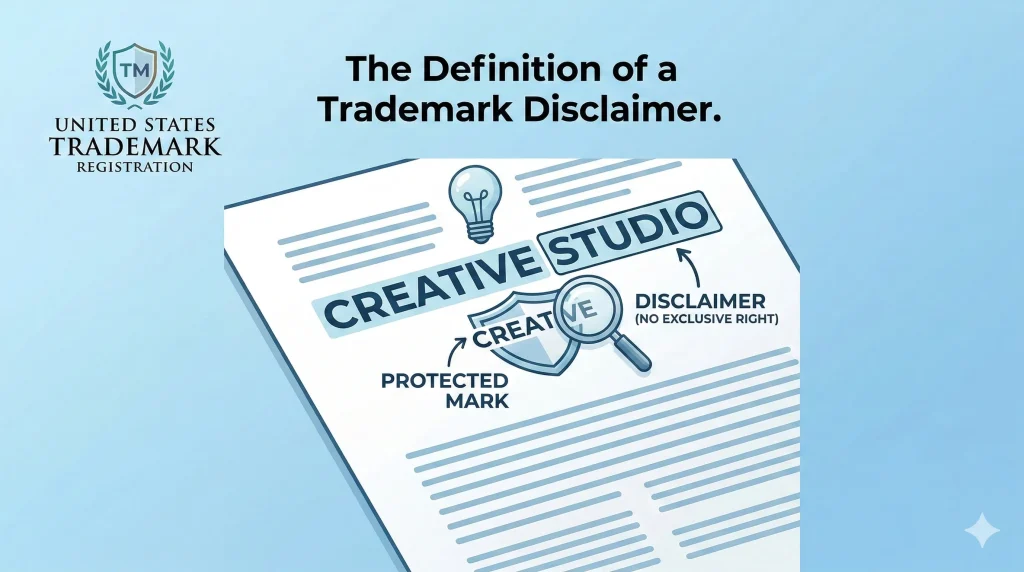
A trademark disclaimer is a formal statement in your trademark application acknowledging that you’re not claiming exclusive rights to a specific word, phrase, or element within your mark. The disclaimer appears in the USPTO’s records alongside your registration, but it doesn’t prevent your mark from being registered. It simply limits what your registration covers.
Disclaimers apply to individual components of a composite mark. A mark made up of multiple elements when one or more of those components can’t be registered on its own. You can still register the mark as a whole. You just can’t claim that the disclaimed portion is exclusively yours.
Think of it this way: if your brand name is “Golden State Plumbing Services,” the examiner will likely require you to disclaim “Plumbing Services” because that phrase is generic and descriptive. Your trademark registration covers the full phrase “Golden State Plumbing Services” as a composite, but you’ve acknowledged that no one else is locked out of using “plumbing services” as a plain descriptive phrase.
Why the USPTO Require Disclaimers?
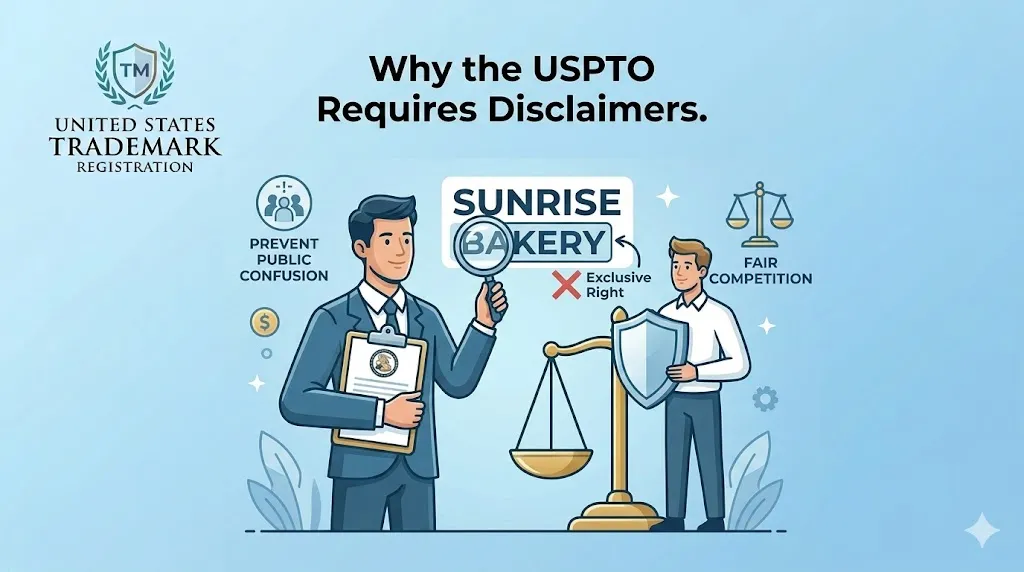
Examiners require disclaimers when a portion of your mark consists of matter that is generic, descriptive, or otherwise unregistrable on its own. The purpose is to keep the record clear about what your registration actually protects and what remains in the public domain for others to use.
Generic terms, words that name the category of goods or services itself, can never be trademarked. “Coffee” for a coffee brand, “Software” for a tech company, and “Bank” for a financial institution. These words belong to everyone in the industry. When they appear as part of a larger composite mark, the examiner wants it on record that your registration doesn’t pull them out of the public domain.
Descriptive terms get the same treatment. Words that describe a feature, quality, or characteristic of what you sell (“fresh,” “fast,” “affordable”) can be required to be disclaimed even when the overall mark is distinctive enough to register.
What Does and Doesn’t Affect a Disclaimer?
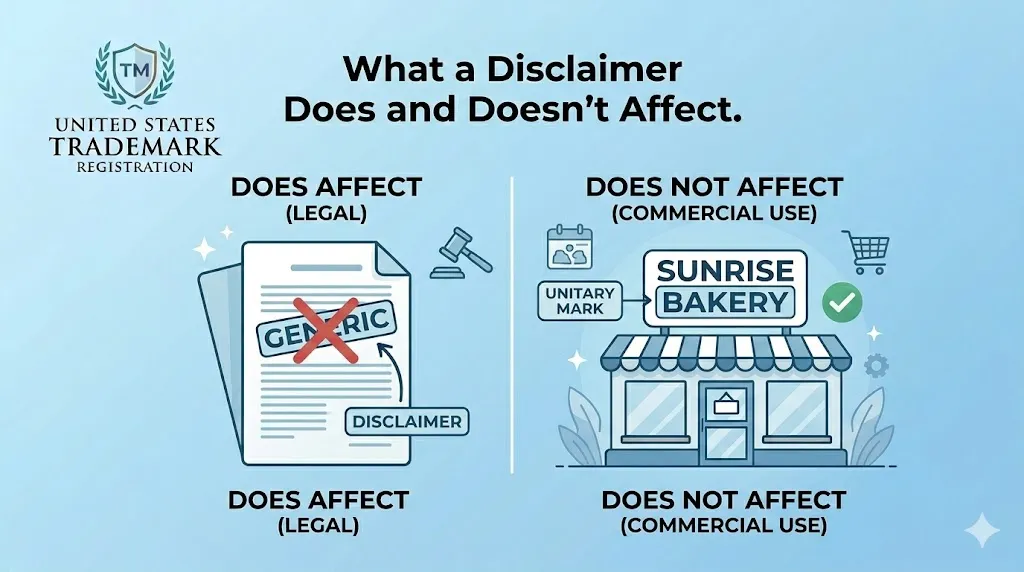
A disclaimer has no effect on the registrability of your mark as a whole. Your application can still proceed to registration. The disclaimed element still appears in your mark visually. The only thing the disclaimer changes is the scope of your exclusive rights claim; you’re saying that your rights attach to the mark as a complete unit, not to the disclaimed portion in isolation.
This matters in an infringement context. If someone uses a similar composite mark, you can still assert your trademark rights based on the overall impression of the marks. The disclaimer doesn’t strip your ability to protect your brand. It prevents you from claiming monopoly rights over a word or phrase that belongs in the public domain.
Trademark protection solutions that include a pre-filing distinctiveness review often identify disclaimer candidates before the application goes in. Knowing in advance which elements are likely to trigger a disclaimer requirement lets you make informed decisions about your mark design before you file.
When to Accept the Disclaimer Requirement?
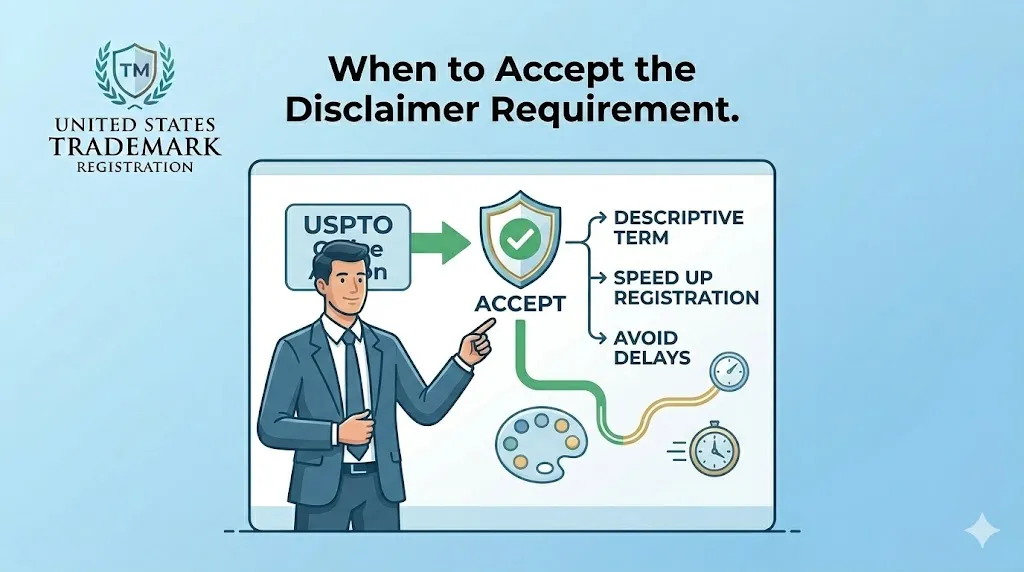
For most applicants, the smart move is to accept the disclaimer requirement and keep the application moving. If the element the examiner flagged is genuinely generic or clearly descriptive, arguing against the disclaimer rarely succeeds and always delays your registration.
If “Consulting Group” is the word they asked you to disclaim and you’re a consulting firm, fighting that requirement is an uphill battle with a low probability of success. Accept it, get your composite mark registration, and move on. Your actual brand, the distinctive portion, is protected.
Our online trademark services team handles disclaimer responses routinely. Accepting a disclaimer is a straightforward amendment to your application in most cases, and our trademark management services process it efficiently to keep your examination timeline on track.
When to Push Back?
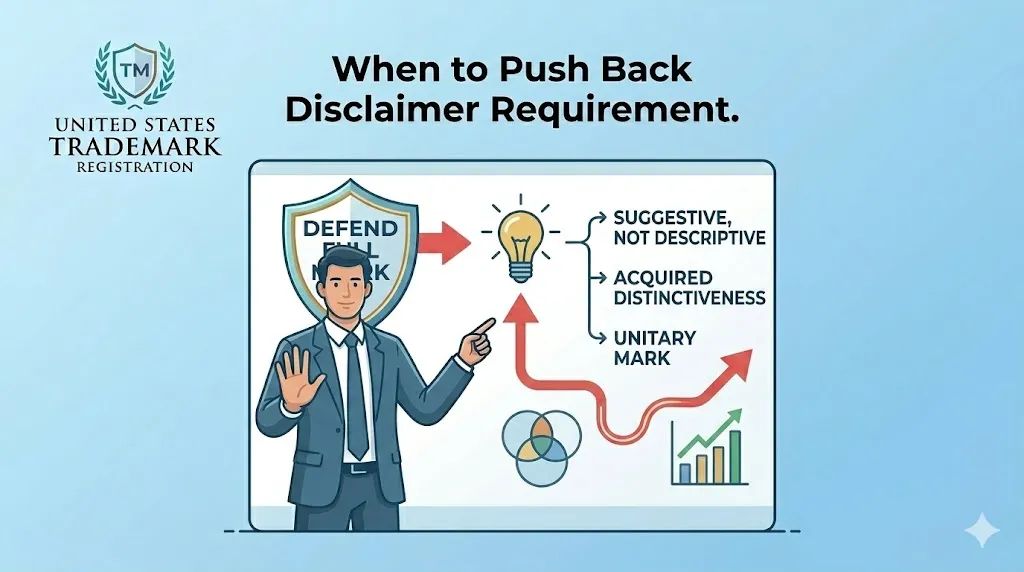
There are situations where a disclaimer requirement deserves a response rather than immediate acceptance. If the examiner has flagged an actually distinctive term, a word that’s suggestive rather than descriptive, or a coined term that only sounds like it might describe something, you have grounds to argue against the requirement.
Suggestive marks require imagination to connect the word to the goods or services. “Netflix” doesn’t directly describe a video streaming service. “Apple” doesn’t describe a computer. If your mark’s element requires a leap of imagination to connect to your products, it’s suggestive, not descriptive, and a disclaimer requirement for that element may be worth contesting.
Arguing against a disclaimer requires a written response to the office action with legal reasoning. That response has a deadline and needs to be substantive to be effective. This is the type of situation where USPTO filing services from experienced professionals make a real difference. Crafting a response that effectively argues for the distinctiveness of a questioned mark element is not a task that benefits from guesswork.
Composite Marks and Disclaimer Strategy

For brands building composite marks, the word-plus-design, brand-name-plus-tagline, or house-mark-plus-product-name disclaimer strategy is worth thinking through at the design stage. The more distinctive every individual element of your mark is, the less likely any component will require a disclaimer.
The DCMA Trademark Engine and our full-service filing team at USTML assess composite marks for disclaimer risk before filing. We identify which elements are likely to attract an examiner’s attention and help you evaluate whether the mark design warrants refinement or whether a disclaimer is simply the efficient path to registration.
The goal is always a registration that accurately reflects your brand and provides the broadest possible protection. A disclaimer, when handled correctly, is a routine administrative step, not a threat to your brand’s legal standing.
Received a disclaimer requirement on your trademark application? USTML reviews your office action and helps you decide whether to accept, respond, or appeal. Reach out directly to discuss your application.
Frequently Asked Questions
Does a trademark disclaimer weaken my registration?
A disclaimer limits the scope of your exclusive rights to the disclaimed element in isolation, but it does not weaken your registration in the overall mark as a whole. You still hold trademark rights in the full composite mark, and those rights are enforceable against confusingly similar uses.
What words are most commonly required to be disclaimed in trademark applications?
Generic terms (like “software,” “services,” “group,” or “co.”) and descriptive terms (like “fresh,” “fast,” “national,” or geographic terms used descriptively) are the most common disclaimer candidates. Industry-specific descriptors tied to the nature of the goods or services also frequently require disclaimers.
Can I oppose a trademark disclaimer requirement?
Yes. You can respond to the office action, arguing that the flagged element is distinctive enough to avoid a disclaimer. The response must explain why the element is suggestive, arbitrary, or fanciful rather than merely descriptive or generic. If the examiner maintains the requirement after your response, you can appeal to the Trademark Trial and Appeal Board.
Does a disclaimer appear on my trademark registration certificate?
Yes. If you accept a disclaimer requirement, the disclaimed element will be noted in your USPTO records and on your registration certificate. The notation typically reads, “No claim is made to the exclusive right to use [the disclaimed term] apart from the mark as shown.”
If I disclaim a word in my trademark, can I still use that word in my marketing?
Yes. A disclaimer only affects your trademark registration; it doesn’t restrict how you use words in your actual business communications or marketing. You can use the disclaimed term freely in your materials. The disclaimer simply clarifies that your trademark registration doesn’t give you exclusive ownership of that term.