

Two independent coffee brands, both called Meridian, both selling specialty roasted coffee. One operated in the Pacific Northwest, one in New England. Neither knew the other existed until the New England company filed a federal trademark application.
The USPTO examining attorney searched the database, found the Pacific Northwest registration, and issued a Section 2(d) refusal for likelihood of confusion. The applicant had built three years of brand equity. A rebrand was not something they wanted to consider.
What resolved the situation was a trademark consent agreement, a negotiated written arrangement between the two companies acknowledging that they could coexist in the market without causing consumer confusion. The USPTO accepted it. Both companies kept their marks.
Consent agreements are not commonly discussed, but they resolve a significant percentage of likelihood-of-confusion refusals. This guide explains what they are, when they work, and how to approach getting one.
What is a trademark consent agreement?
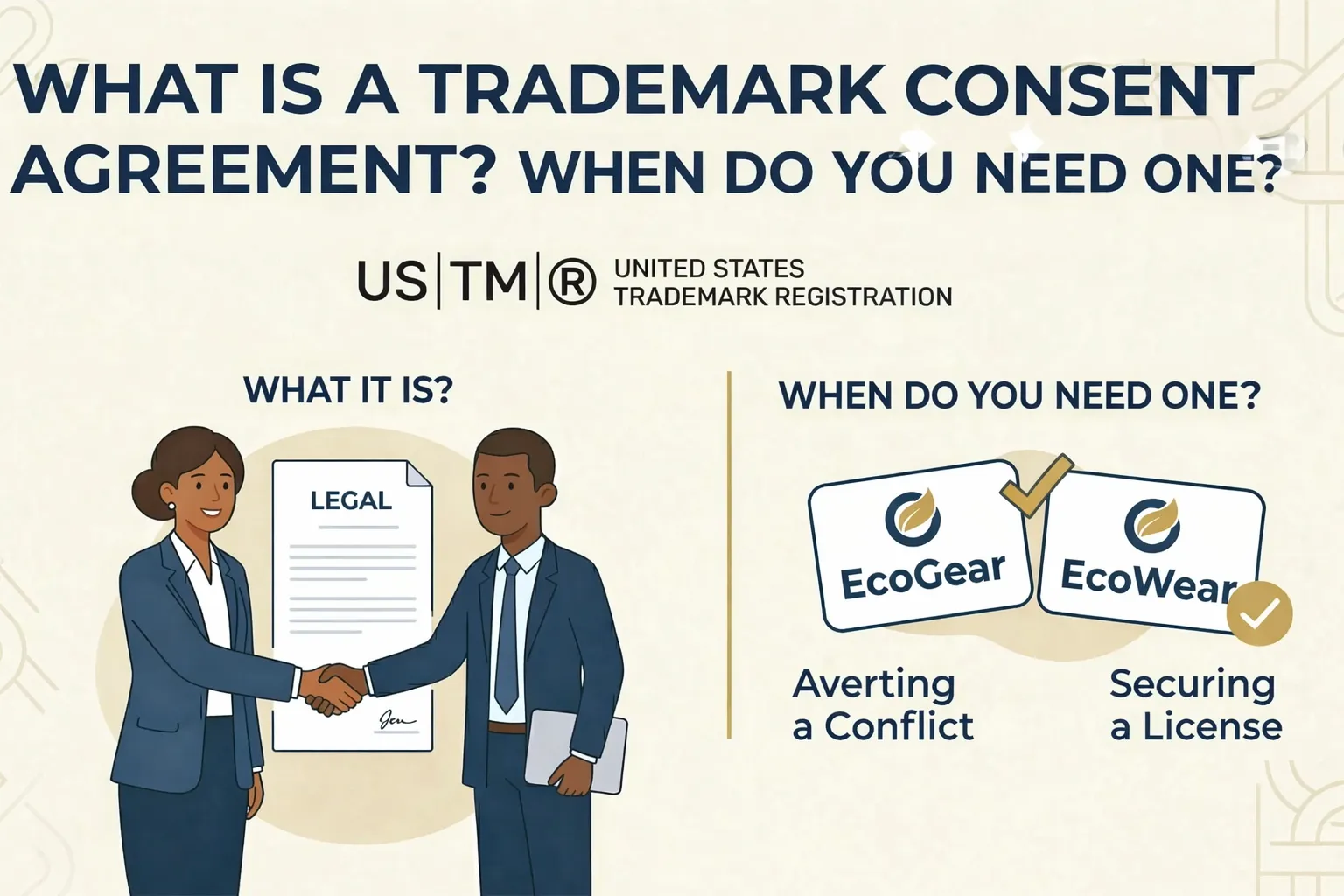
A trademark consent agreement is a written document in which the owner of an existing trademark registration gives their written consent to the USPTO for a later applicant to register a similar or identical mark. It is also called a coexistence agreement.
The agreement acknowledges that both marks can exist in commerce simultaneously without deceiving consumers about the source of goods or services. The USPTO does not automatically accept them, but a well-constructed consent agreement with meaningful terms is a significant factor in the likelihood-of-confusion analysis.
Consent agreements appear in two main contexts. First, during prosecution of a new application, when the USPTO issues a 2(d) refusal and the applicant seeks to overcome it by obtaining consent from the owner of the cited mark. Second, in coexistence negotiations between two businesses that discover each other in the market and want to avoid litigation over overlapping marks.
When does the USPTO require or consider one?
When an examining attorney determines that a new application creates a likelihood of confusion with an existing registration, the most common outcome is a refusal under Section 2(d) of the Lanham Act. The applicant then has several options to respond: argue that confusion is not likely, amend the identification of goods or services to reduce overlap, or obtain a consent agreement from the existing registrant.
A consent agreement is most effective when the refusal is based on mark similarity rather than goods or services identity. If the marks are nearly identical and the goods are essentially the same, a consent agreement alone is unlikely to overcome the refusal. The USPTO is not bound by consent agreements and can reject them when the potential for consumer deception is too high regardless of what the two parties agree.
That said, the USPTO gives significant weight to consent agreements, particularly when they contain meaningful provisions showing that the parties have carefully considered how to minimize confusion, rather than simply exchanging a document that says each company agrees the other can use the mark.
Naked consent vs. detailed consent
The Federal Circuit has distinguished between two types of consent agreements in trademark cases.
Naked consent
A naked consent agreement is a bare statement that Company A consents to Company B’s use and registration of a mark. It contains no provisions addressing how the parties will differentiate their marks in the market, how they will handle consumer complaints of confusion, or what geographic or trade channel restrictions apply. The USPTO and courts treat naked consents with skepticism because they do not actually address the confusion problem.
Detailed consent
A detailed consent agreement, sometimes called a structured consent, includes provisions that actively reduce the risk of consumer confusion. These might include geographic restrictions on where each party sells, distinct trade channels (one sells online only, one sells at retail), product category limitations, agreed-upon design differences, a protocol for handling consumer inquiries that reveal confusion, and mutual obligations to monitor and report confusion.
Detailed consents are far more persuasive to the USPTO and hold up better if either party later challenges the other’s registration. united states trademark registrations and law (USTML) strongly recommends structured agreements over bare consent letters.
What a proper consent agreement should include?
- Identification of both marks, including registration numbers where applicable
- A clear statement of consent to the registration and use
- Geographic or territorial limitations, if applicable
- Product or service category distinctions
- Trade channel distinctions (online vs. brick and mortar, wholesale vs. retail)
- Design or stylistic differences that minimize visual confusion
- A reporting mechanism if instances of actual consumer confusion arise
- Representations that neither party is aware of existing confusion
- Governing law and dispute resolution provisions
- Acknowledgment that each party’s mark is valid and not being challenged
What consent agreements cannot do?
A consent agreement creates rights between the two parties, but it does not bind the USPTO to approve the application, and it does not bind courts in subsequent infringement litigation.
If a third party later challenges one of the registrations or sues for infringement based on their own mark, the consent agreement between the two original parties has no legal force against that third party. Consenting to coexistence with one competitor does not resolve conflicts with others.
The agreement also does not prevent either party from suing the other for infringement in the future if the circumstances change and actual confusion becomes widespread. Consent agreements often include termination provisions addressing this possibility.
How to approach the owner of the cited mark?
The most common obstacle is that trademark owners are wary of giving consent because they worry it could weaken their own mark or invite future disputes. Approaching the other owner effectively requires demonstrating that coexistence is genuinely low-risk.
- Conduct a thorough market analysis first. Gather evidence that the two businesses operate in distinct geographic areas, serve different customer segments, or sell through different channels. The stronger this evidence, the more comfortable a consent request appears.
- Make a business case, not a legal demand. Approach the conversation as a neighbor, not an adversary. Explain who you are, how your business operates, and why consumers are unlikely to confuse the two brands.
- Offer a structured agreement, not just a letter. Propose specific provisions that benefit both parties, including mutual monitoring obligations and geographic or channel restrictions that protect the existing owner’s market.
- Be transparent about your application. Provide the application serial number, the goods or services covered, and the refusal you received. Owners are more receptive when they have full information.
- Allow adequate time. Trademark owners typically consult their own counsel before responding. Budget several months for this process if you pursue it during an office action response.
| What if the owner refuses to consent? If the cited mark owner declines to consent, the applicant has a few remaining options: argue against the likelihood of confusion on the merits of the marks and goods, amend the goods or services description to create more distance from the cited mark, or pursue concurrent use registration if the geographic separation is sufficiently documented. In some cases, the applicant may need to consider whether the mark is defensible in its current form or whether a rebrand is the more practical path. united states trademark registrations and law (USTML) can help you assess the strength of a 2(d) response and the feasibility of each available option. |
Frequently asked questions
Does a consent agreement guarantee my application will be approved?
No. The USPTO has discretion to reject even a detailed consent agreement if it concludes that the likelihood of confusion is too high to overcome regardless of the parties’ agreement. However, well-structured consent agreements succeed in overcoming 2(d) refusals in a significant number of cases.
How long does it take to obtain a consent agreement?
The timeline depends on how quickly the other trademark owner responds and whether they require negotiation. Simple arrangements can be completed in four to eight weeks. Complex negotiations with multiple revised drafts can take three to six months. This is relevant because USPTO office actions have a six-month response deadline.
Does the existing owner benefit from giving consent?
Many trademark owners see mutual benefit. By formalizing a coexistence arrangement, both parties have written documentation of the scope of their respective rights and a mechanism for handling future confusion. Giving consent can reduce litigation risk compared to doing nothing while the applicant continues to use the mark without agreement.
Can I use a consent agreement to register a mark internationally?
Consent agreements accepted by the USPTO apply only to the US registration. International trademark offices, including the EUIPO and national offices in other jurisdictions, apply their own standards and may or may not accept consent agreements as evidence in likelihood-of-confusion proceedings.
What happens to the consent agreement if one party sells their business?
Trademark consent agreements are typically binding on successors and assigns. When a business changes hands, the new owner takes on the obligations of the consent agreement along with the trademark. Both parties should confirm that any acquisition agreement includes specific reference to the consent agreement and its terms.
| Received a 2(d) refusal? We can help. united states trademark registrations and law (USTML) handles office action responses, including likelihood-of-confusion refusals, and can advise on whether pursuing a consent agreement is the right strategy for your application. Get help with your office action: ustmr.com/office-action-reponse/ |