

Most discussions of trademark law focus on what are called ordinary marks: a brand name or logo that one business uses to identify its goods or services to consumers. That framework covers the majority of trademark applications. But two other types of marks exist in the federal trademark system that serve very different purposes and are governed by different rules.
Collective marks and certification marks are both registrable with the USPTO, both appear on the Principal Register, and both provide federal trademark protection. They are not interchangeable. Choosing the wrong category at the time of filing creates real legal complications that can be difficult and expensive to correct.
What Is a Collective Trademark?
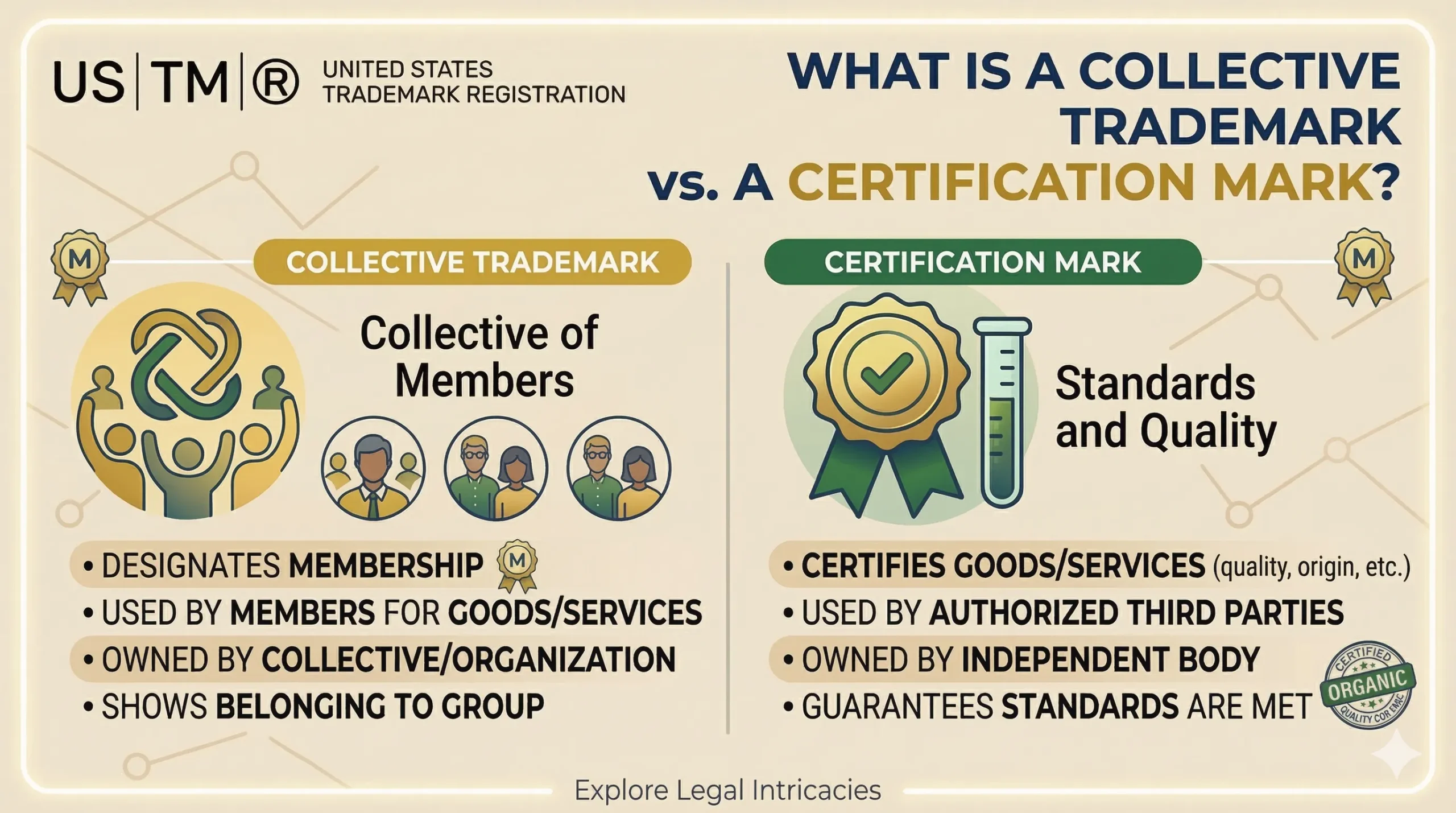
Trademark registration services for collective marks serve a specific organizational function. Members of a collective use a collective trademark. This group can include an association, cooperative, union, or similar organization, and the mark identifies them as belonging to that group.
The mark is owned by the collective organization itself, not by any individual member. Members use the mark to indicate that they belong to the organization. Consumers see the mark and understand that the business displaying it is a member of that collective. The AFL-CIO union labels that once appeared on manufactured goods fall into this category. So do geographic collective marks used by regional producer associations. Professional association membership marks are included as well.
A collective trademark does not certify that the goods or services meet any particular standard. It simply communicates membership status. The organization owns the mark, sets the membership criteria, and controls who is authorized to display it. Individual members use the mark under the umbrella of that collective ownership.
Federal trademark filing for collective marks requires identifying the organization as the owner. It also requires documenting the membership structure that governs use of the mark. The application must state that the mark is collective. It must describe the relationship between the organization and its members.
What Is a Certification Mark?
Trademark Protection Solutions for certification marks serve a fundamentally different purpose. A certification mark is used to certify that the goods or services of others meet certain defined standards or characteristics. The owner of a certification mark does not use it on their own goods or services. Instead, they authorize others to use it when those others meet the certification criteria.
The standards being certified can take many forms. Geographic origin is one category: a mark that certifies goods were produced in a specific region, such as a regional agricultural certification. Quality standards are another category: a mark that certifies goods meet defined safety, environmental, or performance standards. Material standards, manufacturing processes, labor conditions, and professional qualifications can all be the subject of certification marks.
The UL mark on electrical products, certifying compliance with safety standards, is a certification mark. The USDA Organic seal is a certification mark certifying that agricultural products meet organic production standards. Fair Trade certifications, professional licensing seals, and industry quality marks are all certification marks.
Brand Protection Services for certification marks require the certifying organization to maintain and enforce the standards being certified. A certification mark owner who fails to police the standards and control authorized use of the mark risks losing the registration.
The Critical Difference: Who Uses the Mark and Why
Online trademark service professionals explain the core distinction this way: members use a collective mark to show their membership, while others use a certification mark to show that their goods or services meet the owner’s defined standards.
In a collective mark arrangement, the organization owns the mark and its members use it because they belong to the group. Membership is the qualifying criterion. In a certification mark arrangement, the organization owns the mark but does not use it on their own goods. They authorize others to use it as evidence of meeting a defined standard. The certifying organization and the mark user are always different parties.
This distinction creates an important rule: the owner of a certification mark cannot use it on their own goods or services. Doing so would convert the mark from a certification mark into an ordinary trademark, because the whole point of a certification mark is third-party verification of a standard. Self-certification is not certification.
Application Requirements and Ongoing Obligations
Trademark Application Services for collective and certification marks involve additional requirements beyond those for ordinary marks.
A collective mark application must describe the membership criteria or conditions for authorized use. The applicant must demonstrate that they are a collective organization and that the mark will be used by members, not by the organization itself in connection with its own commercial goods or services.
A certification mark application must include a copy of the standards or criteria that goods or services must meet to qualify for use of the mark. The certifying body must agree to examine goods or services to ensure they meet the standards, to permit use of the mark by all parties whose goods or services meet the standards, and to control the quality of the certification process itself.
Trademark Management Services for certification marks emphasize that the ongoing obligations are significant. The certifying organization must actively monitor the mark’s use, enforce the standards consistently, and revoke authorization whenever a previously certified party fails to meet the criteria. Inconsistent enforcement is grounds for challenging the certification mark registration.
Which Does Your Organization Need?
If your organization is a trade association, professional society, union, cooperative, or similar member-based group and you want members to be able to display a mark that identifies them as belonging to your organization, a collective mark is the right vehicle.
If your organization sets standards, conducts testing or audits, and wants to create a mark that authorized parties can use on their goods or services to communicate compliance with those standards to consumers, a certification mark is the right vehicle.
united states trademark registrations and law Services (USTML) helps associations, certification bodies, and cooperatives evaluate which type of mark serves their purpose and file the correct application with the required supporting documentation. Start with a free trademark search to see if your intended mark is available.
Frequently Asked Questions
Can the owner of a certification mark use it on their own products?
The owner of a certification mark cannot use it on their own goods or services. Only parties other than the owner may use the mark to show that their goods or services meet the owner’s defined standards. This restriction forms the core principle of certification marks.
Can a collective mark certify quality standards?
A collective mark communicates membership, not quality certification. It tells consumers that the user is a member of a particular organization. It does not by itself represent that the member’s goods or services meet any particular standard. If quality certification is the goal, a certification mark is the appropriate choice.
What happens if a certification mark owner stops enforcing its standards?
Failure to control and enforce the standards associated with a certification mark can result in the mark losing its significance as a quality indicator, which opens the registration to challenge and potential cancellation. The USPTO requires certification mark owners to maintain consistent control over the standards and their enforcement.
Are collective marks and certification marks registered the same way as ordinary trademarks?
The registration process uses the same TEAS filing system, but the applications require different supporting information. Collective mark applications must describe the membership structure. Certification mark applications must include the standards or criteria being certified. Both types receive federal protection upon registration but are subject to different ongoing obligations than ordinary trademarks.