

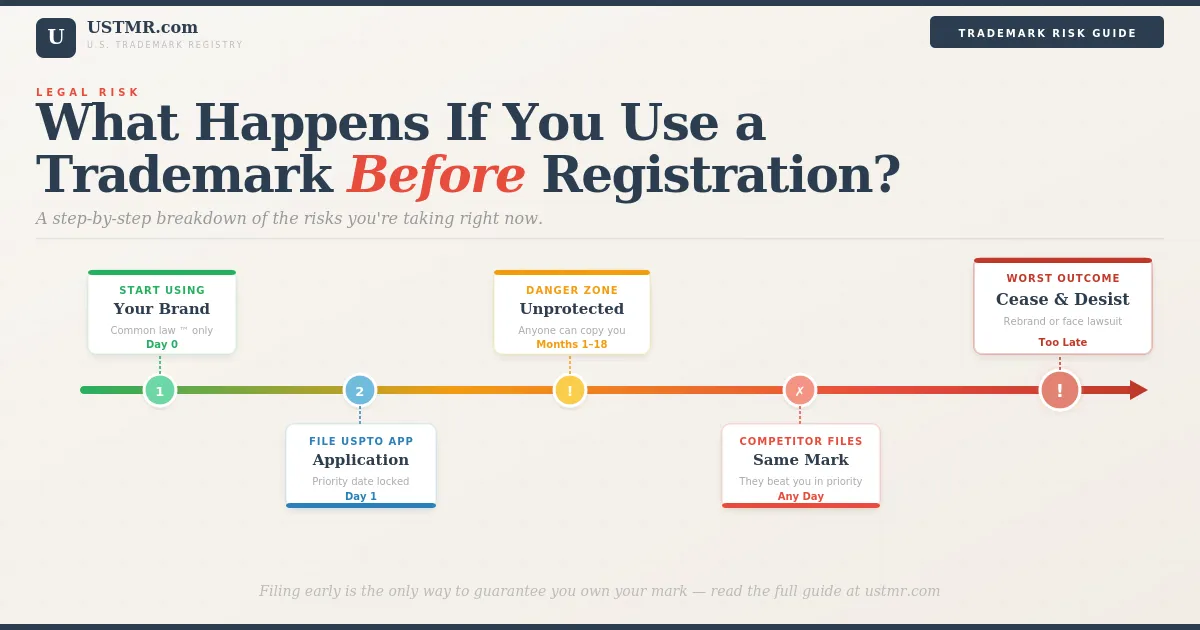
Businesses can legally use a trademark before registering it. Millions do this every day. What matters is understanding exactly what rights that use creates, what risks it carries, and how registration changes the picture entirely. The gap between unregistered use and registered protection is where most trademark problems originate. Closing that gap with a federal trademark filing is one of the most important steps any brand can take.
The TM Symbol vs. the R Symbol
Anyone can display the TM symbol on any mark, at any time, without registration. It signals that a business claims trademark rights in a name, logo, or slogan. Using TM requires no USPTO approval and creates no legal rights beyond what the common law already provides.
The registered trademark symbol, the circled R, requires a federal registration certificate from the USPTO before anyone can legally display it. Using the R symbol on an unregistered mark violates federal law and can cost a business its trademark rights in litigation. Many businesses misuse this symbol without realizing the consequences.
The practical difference: TM is a declaration of intent and claim. The R symbol is a legal statement of fact. Only one of them carries federal weight.
Common Law Rights from Unregistered Use
Using a mark in commerce without registration creates common law trademark rights. These rights are real and enforceable, but they are geographically limited to the area where the business actually operates and has established consumer recognition.
A business using a name in Dallas has common law rights in Dallas. It does not have rights in Houston, and it has no rights against a federal trademark holder anywhere in the country. If a federally registered mark with an earlier priority date conflicts with the Dallas business’s name, the trademark holder can force that business to stop using the name, even in its home market.
Common law rights require proof of use to enforce. Sales records, dated marketing materials, invoices, and geographic evidence of commercial activity all become necessary in any dispute. This documentation burden does not exist for a registered trademark holder.
The Priority Date Problem
When two parties claim rights to the same or similar mark, priority generally goes to whoever has the earlier established claim. For common law users, that date is when they first used the mark in commerce. For registered trademark holders, it is the filing date of the application, which precedes actual registration by 8 to 12 months.
An intent-to-use trademark application creates a priority date before any use begins. A business that files an intent-to-use today holds an earlier priority date than a competitor who starts using the same name next month, even if the competitor begins selling before the applicant does.
This is the core reason early filing matters. The priority date is the anchor of trademark rights. Establishing it through filing, rather than waiting to accumulate common law use, is a fundamental strategic advantage.
Risks of Operating Without Trademark Registration
Using a trademark without registration carries specific risks that many business owners underestimate:
- No constructive notice: Without registration, no public legal record establishes the mark as claimed. A competitor who independently adopts the same mark without knowing about the prior user may argue a valid defense in an infringement claim.
- No presumption of validity: In litigation, courts presume a registered trademark valid. An unregistered mark owner must prove validity from scratch, adding time and cost to every enforcement action.
- No federal court access based on trademark registration: Federal trademark infringement claims under the Lanham Act require a registered mark. Unregistered mark disputes typically proceed in state court with weaker remedies.
- No customs recordation: Only registered trademark owners can record their mark with U.S. Customs for border protection against counterfeit imports.
What Trademark Registration Adds?
Federal trademark registration through the USPTO transforms a common law claim into a nationwide legal right. Registration provides constructive notice to all subsequent users, a legal presumption of ownership and validity, the right to use the registered trademark symbol, access to federal court remedies, including statutory damages and attorney fees in willful infringement cases, and the ability to record the mark with U.S. Customs.
These are not administrative formalities. They are the tools that make trademark enforcement practical and affordable.
How USTML Helps Businesses Make the Transition?
At U.S. Trademark Registration (USTML), we regularly work with businesses that have been using a mark for years without registration. The first step is always a comprehensive trademark search to assess whether the mark is still available for registration and whether any conflicts have developed during the period of unregistered use.
Our trademark application services handle the full process from search through registration, including documentation of first use dates that support the application. Our trademark protection solutions convert years of common law use into the federal protection that common law alone cannot provide.
Frequently Asked Questions
Can I use the TM symbol without registering my trademark?
Yes. The TM symbol can be used on any mark at any time without USPTO registration. It signals a claim of trademark rights based on common law use. The registered trademark symbol (R) can only be used after the USPTO issues a federal registration certificate.
What rights do I have if I use a trademark without registering it?
You have common law trademark rights limited to the geographic area where you actively operate and have established consumer recognition. These rights are real but narrow and can be difficult to enforce without documented proof of prior use.
What is the risk of using a trademark that is not registered?
Key risks include geographic limitation of rights, no constructive notice to later users, no presumption of validity in litigation, limited access to federal court remedies, and inability to record the mark with U.S. Customs for border protection against counterfeits.
How do I prove common law trademark rights?
Common law rights are proven through documented evidence of commercial use: dated sales records, invoices, marketing materials, customer communications, and geographic evidence of where the business operates and has established recognition.