

Not every business name qualifies for trademark protection. The USPTO evaluates marks on a spectrum of distinctiveness, and where a name falls on that spectrum determines whether it can be registered, how strong the protection will be, and how hard it will be to enforce. Before spending money on a trademark application, run through this self-check. It will not replace a professional search and legal assessment, but it will tell you quickly whether a name has a realistic path to registration.
The Distinctiveness Spectrum
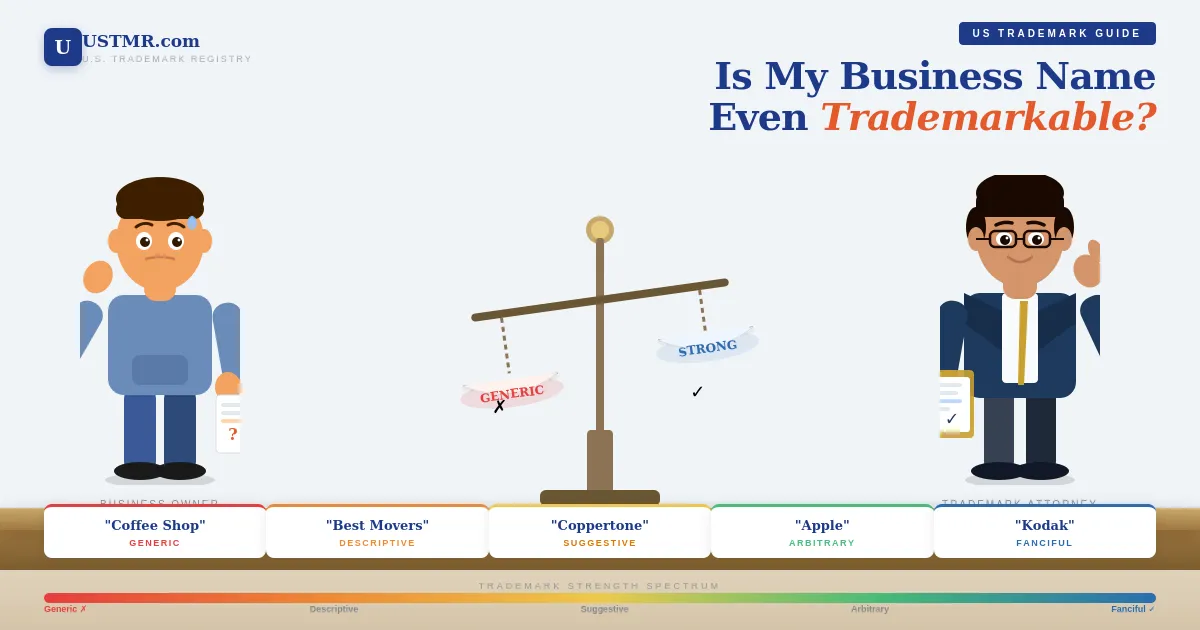
The USPTO places trademarks into five categories based on how distinctive they are in relation to the goods or services they cover. From strongest to weakest:
- Fanciful marks: Invented words with no prior meaning. Kodak, Xerox, Häagen-Daz. These are the strongest trademarks and the easiest to register.
- Arbitrary marks: Real words used in a context unrelated to the product. Apple for computers. Amazon for retail. Strong marks with clear paths to registration.
- Suggestive marks: Names that hint at a quality or feature without directly describing it. Netflix suggests streaming but does not describe it. Registrable without proving distinctiveness.
- Descriptive marks: Names that directly describe a feature, quality, or characteristic of the goods or services. These cannot be registered without proving acquired distinctiveness through long-term use.
- Generic terms: The common name for the goods or services themselves. “Coffee” for a coffee shop. Cannot be registered under any circumstances.
The higher on this spectrum a name sits, the easier it is to register, and the stronger the resulting trademark will be.
The Descriptiveness Problem
Descriptive marks are where most rejections happen. A name that directly tells customers what a product does or what a service provides is descriptive. The USPTO refuses to register these without substantial evidence of secondary meaning, meaning consumers have come to associate the name with a specific source through long-term exposure.
Common examples of descriptive names that face registration challenges are “Fast Delivery” for a courier service, “Fresh Baked” for a bakery, and “Legal Help” for a law firm. These names describe the service. They do not identify the source.
If a name falls into the descriptive category, registration is possible but requires submitting evidence of acquired distinctiveness: sales figures, advertising spend, customer declarations, and years of exclusive use. That process is more expensive and less certain than registering a distinctive mark from the start.
Surnames and Geographic Terms
Two specific categories create consistent registration problems.
Surnames are primarily merely a surname unless they have acquired distinctiveness. “McDonald’s” is a surname but has acquired a massive secondary meaning. A new business called “Johnson Consulting” faces an uphill battle registering that name alone.
Geographic terms that primarily describe the origin of goods or services face similar hurdles. “Chicago Pizza” for a pizza restaurant describes where the pizza is from, not who makes it. These marks typically require long-term use evidence to register.
The Quick Self-Check
Run these questions against the business name:
- Does the name directly describe what the product does or what the service provides?
- Is the name a common word that competitors would reasonably need to use to describe their own products?
- Is the name primarily a surname with no other meaning in context?
- Is the name primarily a geographic location connected to where the business operates?
- Could multiple businesses in the same industry reasonably want to use this name?
Answering yes to any of these signals indicates potential registration problems. It does not mean a name cannot be protected, but it means the path to registration requires more work, and the resulting protection may be narrower.
Conflicts With Existing Marks
A name can be perfectly distinctive and still face rejection if a confusingly similar mark already exists in a related category. The USPTO checks for the likelihood of confusion with registered marks. If a similar mark covers similar goods or services, registration will be refused.
This is why a comprehensive trademark search is essential before filing. Searching only for the exact name is not enough. A proper search covers phonetic equivalents, spelling variations, and similar marks in related product or service categories.
We run full conflict searches as part of every trademark application service we provide. Discovering a conflict before filing saves the filing fee and the months of waiting before a rejection arrives.
What to Do If the Name Has Problems?
If the self-check surfaces concerns, there are options. Adding a distinctive element to a descriptive name can push it into registrable territory. A geographic or descriptive name paired with a distinctive logo may support a design mark registration. In some cases, slightly modifying the name before filing resolves the issue entirely.
The earlier these issues are caught, the less disruptive the fix. Discovering a registration problem after a brand has been built and marketed is far more costly than addressing it during name selection.
Start With a Search Before You Go Further
Distinctiveness is only one dimension of registrability. Conflict with existing marks is the other. Both need to be clear before a name is worth building a brand around.
Our free trademark search gives an initial read on whether a name has conflicts in the USPTO database. For a full assessment that covers phonetic similarities, design mark overlaps, and classification analysis, our comprehensive trademark search provides the complete picture.
We tell clients what we find, including when a name has problems that make it a poor foundation for a brand. That honest assessment upfront saves significant time and money down the road.