


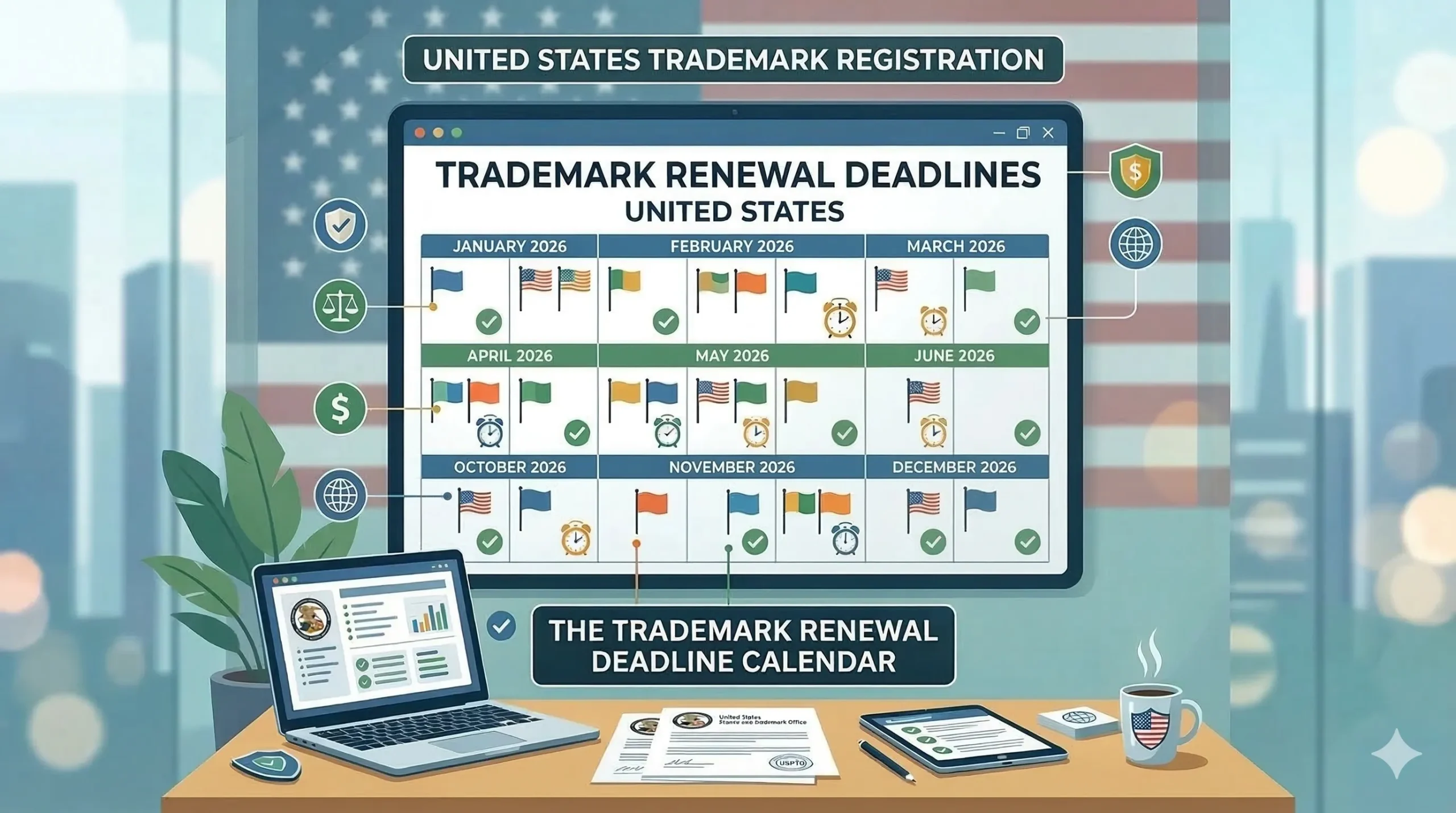
Here is a situation we see more than once a year. A business owner files their trademark application, waits through the examination process, receives their registration certificate, and moves on. Years pass. The business grows. The trademark registration sits in a filing cabinet or an email folder. Then, between the fifth and sixth year after registration, a maintenance trademark Renewal deadline passes without anyone noticing. The USPTO cancels the registration.
What You Need to File and When?
There is no automatic warning system. The USPTO does not send reminder letters. There is no grace period long enough to protect someone who has simply lost track. Trademark registrations require specific filings at specific intervals to stay active, and missing those filings means starting the entire process over from scratch. Here is the complete calendar of every filing requirement, with the context you need to make sure none of them catches you by surprise.
Your Registration Date Is Your Starting Point for Everything
Trademark Registration approval creates your official registration date. This is the date printed on your registration certificate and the date from which every future maintenance deadline is calculated. Write it down. Put it in your calendar system. Make sure whoever manages your legal and administrative affairs knows it exists and what it means.
The registration date is not the same as your filing date or your first use date. It is the date the USPTO officially issued your registration. That specific date governs every subsequent obligation.
The First Major Deadline: Years 5 to 6
Trademark Renewal obligations begin earlier than most registrants expect. Between the fifth and sixth anniversary of your registration date, you must file a Declaration of Continued Use under Section 8 of the Lanham Act.
This filing serves one purpose: it tells the USPTO that your trademark is still actively being used in commerce in connection with the goods or services identified in your registration. It is a maintenance filing, not a renewal in the traditional sense. You are confirming continued use, not renewing the registration period itself.
Federal Trademark Filing maintenance through this Declaration requires you to submit a specimen showing current use in commerce. The same standards that applied to your original filing specimen apply here. A product label, a website screenshot showing the mark in connection with the identified goods or services, or another form of real-world commercial use evidence is required. A mock-up or archived historical use will not satisfy the requirement.
The filing window opens at the beginning of the fifth year and closes at the end of the sixth year after registration. The USPTO provides a six-month grace period extending to the end of the grace month, but filings made during the grace period carry an additional surcharge per class. Filing within the actual anniversary window avoids the surcharge and is the recommended approach. After the grace period closes, the registration is cancelled, and no further action is accepted.
The Second Major Deadline: Years 9 to 10
Trademark Management Services treats the ten-year milestone as the most consequential point in the trademark maintenance calendar because it involves a combined filing that is different in structure from the five-year declaration.
Between the ninth and tenth anniversary of your registration date, you must file two things simultaneously: a Section 8 Declaration of Continued Use and a Section 9 Application for Renewal. These are not the same filing, and both are required.
The Section 8 Declaration confirms continued use, exactly as the earlier five-to-six-year filing did. The Section 9 Application for Renewal is a different legal instrument. It extends your trademark registration for another ten years. Without Section 9, your registration expires regardless of whether you submitted Section 8. Both filings must be submitted during the anniversary window, and both carry their own fees.
Brand Protection Services teams emphasize that failing to understand this combined requirement is one of the most common trademark maintenance errors. Submitting only one of the two required filings at the ten-year mark will still result in registration lapse.
Every Decade After That: The Ongoing Renewal Cycle
After the initial ten-year renewal, trademark registration can continue indefinitely. There is no maximum number of renewal periods. As long as the mark continues to be used in commerce and the required filings are submitted on time, a trademark registration can be maintained for the full life of the business and beyond.
Online Trademark Services professionals explain to clients that the ongoing maintenance structure is straightforward once you understand it. At every subsequent tenth anniversary of your registration date, you must file the combined Section 8 and Section 9 package. The structure, requirements, and fees are the same as the initial ten-year filing. The window and grace period rules are the same as well.
Businesses that have maintained trademarks for decades are simply repeating the same combined filing cycle at each ten-year interval. The most important thing is having a reliable system to track those anniversaries and initiate the filings with sufficient lead time.
Complete Trademark Renewal Timeline
| Timing | What to File | Consequence of Missing |
| Years 5 to 6 | Section 8 Declaration of Continued Use | Registration cancelled; no revival available |
| Years 9 to 10 | Section 8 Declaration plus Section 9 Application for Renewal | Registration expires and cannot be reinstated |
| Years 19 to 20 | Section 8 Declaration plus Section 9 Application for Renewal | Registration expires |
| Every 10 years thereafter | Section 8 Declaration plus Section 9 Application for Renewal | Registration expires if missed |
Grace Periods, Surcharges, and What Happens When You Miss
Trademark Protection Solutions include a thorough understanding of what the grace period does and does not protect against.
For all maintenance filings, the USPTO provides a six-month grace period that begins after the close of the anniversary window. A Section 8 Declaration due between years five and six, for example, can still be accepted during the additional grace period that runs through the end of the sixth anniversary month. Filings made during the grace period are valid, but they carry an additional surcharge on top of the standard filing fees. The surcharge applies per class.
After the grace period ends, the USPTO cancels the registration. There is no further filing that can save it. There is no petition to accept a late maintenance filing. The registration is gone. The only path forward is filing a new trademark application, which means paying current filing fees, waiting through the full examination process again, and entering the market at whatever point in time that new application is filed. Any prior registration date or priority advantages are lost entirely.
This is not an administrative inconvenience. For an established brand with years of marketplace recognition built on top of a registration, losing the registration has real legal consequences. Third parties become free to challenge your rights without the benefit of the registration’s legal presumptions. Enforcement actions become harder. Monitoring and opposition leverage diminish.
Building a Reliable Trademark Maintenance System
Trademark Management Services consistently recommends that clients create an active, redundant tracking system the moment their registration certificate arrives, rather than relying on memory, file folders, or the assumption that their attorney will track everything automatically.
A practical system includes calendar reminders set 90 days before the anniversary window opens, a second reminder at the start of the window, and a final reminder with two weeks remaining in the window. This gives you three distinct opportunities to initiate the filing process before a deadline becomes critical. Build this system for every registration you hold.
If your business holds multiple trademark registrations, which is common for companies that have registered across classes or registered in multiple jurisdictions, a centralized trademark register document that lists each registration, its date, and all future deadlines is an essential administrative tool. Many businesses use trademark management software for this purpose. Others rely on their trademark services provider to maintain the record and provide proactive deadline alerts.
Never Miss a Renewal Deadline
united states trademark registrations and law (USTML) includes renewal tracking and filing services as part of our ongoing brand protection offering. We maintain records of your registration dates, send proactive alerts well before each deadline window opens, and handle the full preparation and submission of your maintenance filings, including specimen selection, declaration preparation, and fee management.
Trademark Renewal is too consequential to leave to memory or chance. Our tracking system ensures it is handled accurately and on time for every registration we manage. Reach out today to add renewal monitoring to your existing registrations, or start with a free trademark search to begin building the registration portfolio your brand deserves.
Frequently Asked Questions
What happens if I miss both the anniversary window and the grace period?
Your trademark registration is permanently cancelled. The USPTO does not have a mechanism to revive a registration that was cancelled due to failure to file maintenance documents after the grace period has expired. The only available path is to file a new trademark application, which starts the priority clock over from the new filing date and requires you to go through the full examination process again.
Is there any way to revive a cancelled trademark registration?
No. Unlike an abandoned trademark application, which can potentially be revived through a petition within a specific period, a registration cancelled due to failure to maintain cannot be revived under any circumstances. This is one of the most important distinctions in trademark procedure and one of the strongest arguments for maintaining reliable deadline tracking systems.
How much do trademark renewal filings cost?
USPTO fees for maintenance filings are assessed per class. Section 8 Declarations and Section 9 Renewal Applications each carry their own per-class fees, and filing during the grace period adds a surcharge per class on top of the base fees. Fee schedules are updated periodically, so checking the current USPTO fee schedule before filing ensures you submit the correct amounts.
Can I handle trademark renewal filings myself without a professional service?
Yes. USPTO trademark maintenance filings can be submitted directly through the TEAS online system by the trademark owner. However, errors in specimen submission, incomplete declarations, incorrect class identifications, or missed deadlines can all jeopardize your registration. Many trademark owners choose to use professional services specifically because the consequences of errors or missed deadlines are so significant.