

App stores are competitive environments where name recognition drives discoverability, downloads, and user trust. Whether you have built a mobile app, a SaaS platform, a software product, or another technology offering, your brand name is often your company’s most valuable asset. It is frequently the single asset your business ultimately controls and owns. It is also, without trademark protection, one of the most vulnerable.
Software companies routinely underinvest in trademark protection in their early stages, prioritizing development and growth over legal infrastructure. That calculation can change quickly. A competitor may launch a confusingly similar product name. An App Store dispute may arise. A potential acquirer may also discover that your core brand has no trademark registration. Here is what developers and software founders need to know.
Why Software Brands Are Particularly Vulnerable Without Trademark Protection?
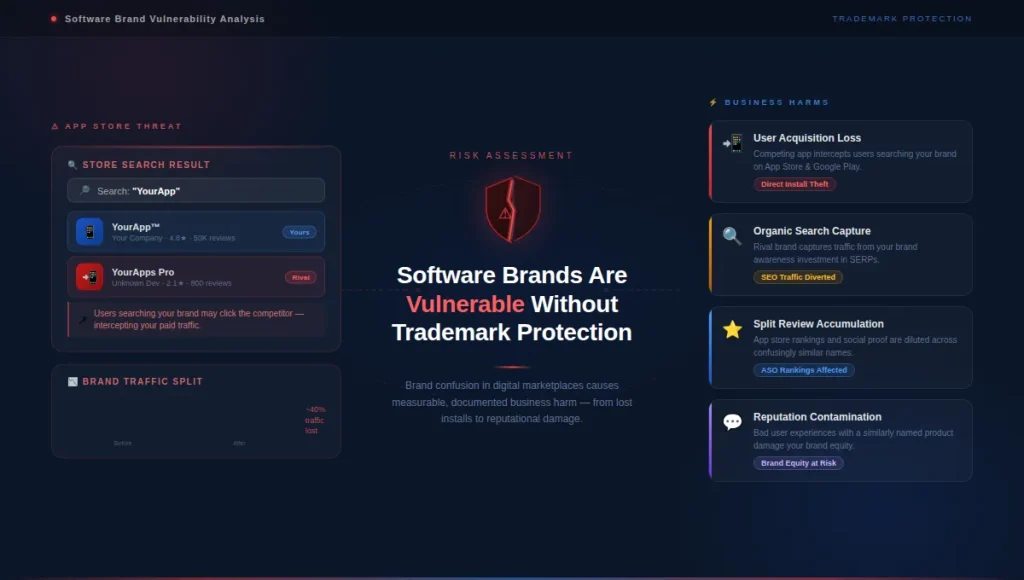
Brand Protection Services for software companies address a unique risk profile. In digital marketplaces, brand name confusion is not just an inconvenience. It causes measurable business harm.
On the App Store and Google Play, a similar-sounding app name in the same category can intercept users searching for your product. Users may click the competing app instead of yours.
Search result traffic then becomes contested. App store optimization rankings can also be affected. Review accumulation may be split between the two apps. This often happens when a competitor operates under a confusingly similar name. In organic search, a competing brand name can capture traffic generated by your brand awareness investment. Users who hear about your product and search for it by name may instead find and download a competitor’s product.
Beyond user acquisition, brand confusion creates customer service and reputation complications. If a user has a bad experience with a similarly named product, your brand absorbs reputational damage even though your product was not involved. These are real, documented business harms that trademark protection is specifically designed to prevent.
Intellectual Property Services for technology companies treat trademark registration as infrastructure, not as an afterthought. The same way you protect your code base and your proprietary data, you protect your brand name through trademark registration.
The Two Primary Trademark Classes for Software
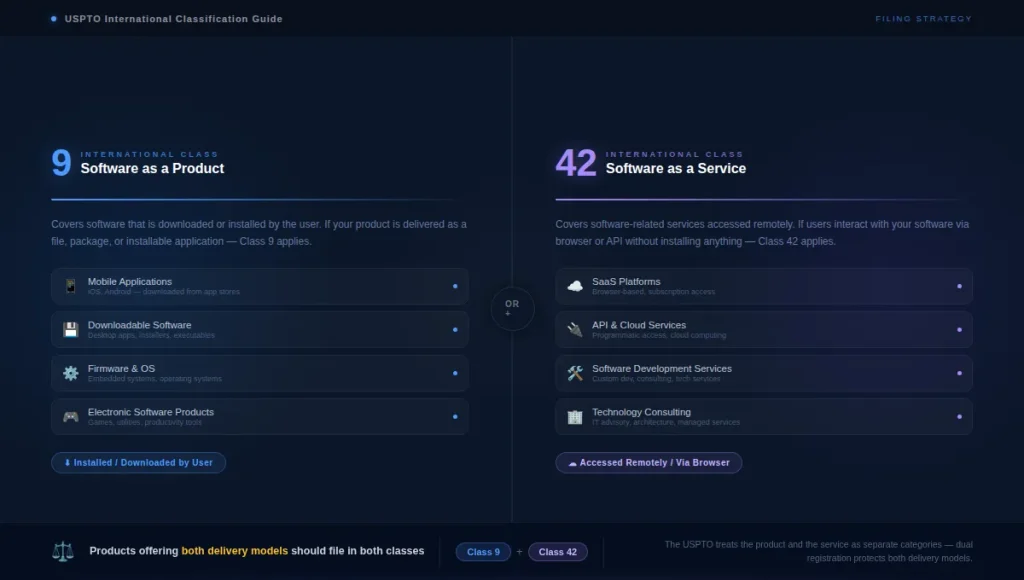
Trademark Application Services for software clients work primarily within two international classes, and understanding the distinction between them is essential for filing correctly.
Class 9 covers software as a product. Downloadable applications, mobile apps, firmware, operating systems, and electronic software delivered to users as an installable or downloadable product all belong in Class 9. If someone downloads or installs your software, your trademark for that product should fall in Class 9.
Class 42 covers software-related services and technology services. SaaS platforms usually fall into Class 42. This applies when users access your software through a browser or API without downloading it. Software development services are also in Class 42. Cloud computing and technology consulting fall into the same class.
If your product is a service rather than installed software, Class 42 typically covers that service component.
Software companies that offer both a downloadable product and a cloud-based service should consider filing in both classes. The USPTO treats the product and the service as separate categories. That distinction matters during the examination. Protecting both delivery models usually requires registration in both relevant classes.
App Store and Google Play Name Protection: How It Actually Works?
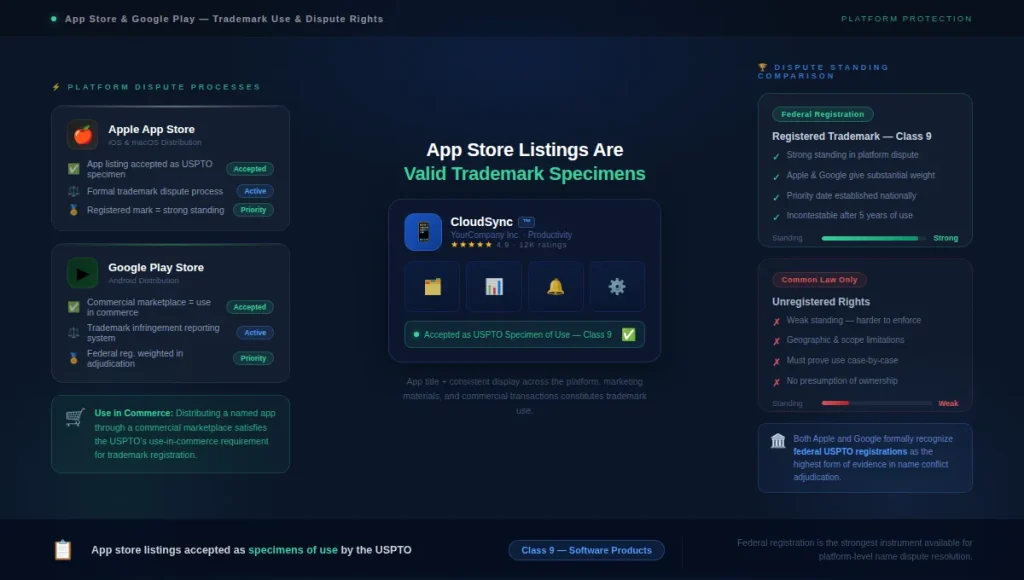
Online Trademark Services teams are regularly asked whether having an app on the App Store or Google Play constitutes trademark use sufficient to support a federal registration. The answer is yes in most cases.
Distributing a named application through a commercial marketplace represents use in commerce. Your app title, consistently displayed in connection with the product across the platform, in marketing materials, and in commercial transactions, functions as a trademark in the way trademark law requires. App store listings have been accepted as specimens of use by the USPTO in trademark applications for software products.
The practical benefit of federal registration for App Store and Google Play protection is significant. Both Apple and Google have formal trademark dispute processes, and both platforms give substantial weight to federal trademark registrations when adjudicating name conflicts. A developer with a registered trademark in Class 9 has much stronger standing in a platform-level dispute than a developer relying on unregistered common law rights.
The Descriptiveness Challenge for Tech Brand Names
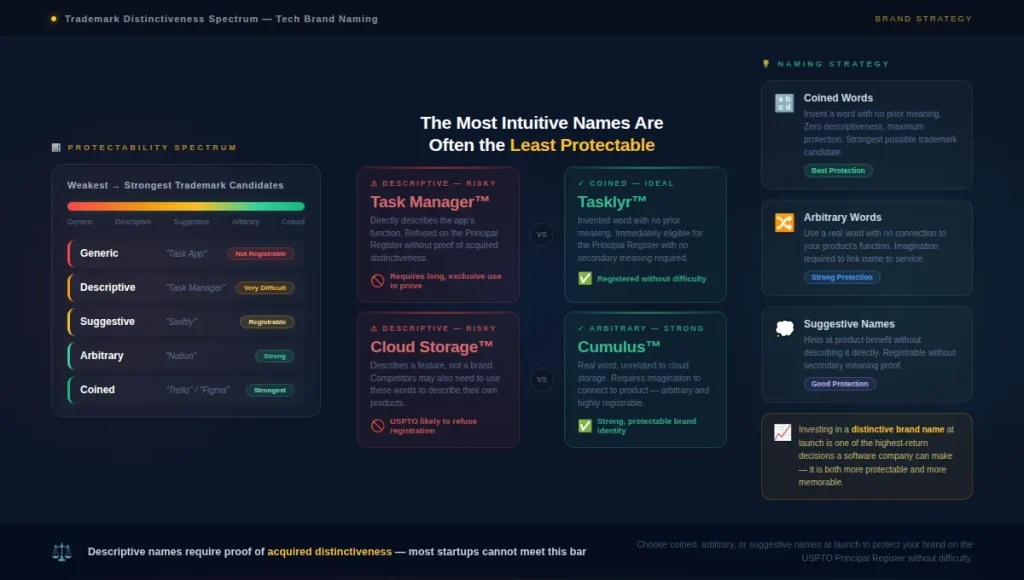
Trademark Protection Solutions for technology brands sometimes face a fundamental tension. The most intuitive app names, the ones that immediately communicate what the app does, are often the least protectable under trademark law.
A name like “Task Manager” for a task management app is directly descriptive of the app’s function. Directly descriptive names are refused on the Principal Register unless the applicant can demonstrate that the name has acquired distinctiveness, meaning consumers have come to associate that specific name with one source through long and exclusive use. For most startups and newer apps, acquired distinctiveness is difficult to prove.
Names that are distinctive rather than descriptive are significantly stronger trademark candidates. A coined word that has no prior meaning, an arbitrary word that has no connection to the product’s function, or a suggestive name that requires some imagination to connect to the product are all more likely to be on the Principal Register without difficulty. Investing thought in a distinctive brand name at the naming stage is one of the highest-return decisions a software company can make, because a distinctive name is both more protectable and more memorable.
Trademark Filing Before Launch: Why It Matters in Development?
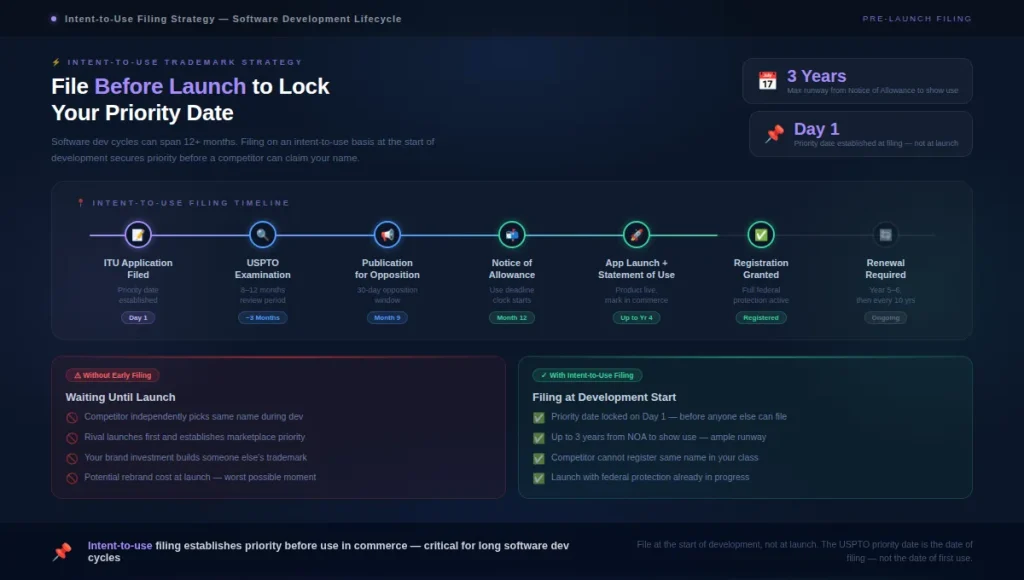
Trademark Management Services for technology companies consistently recommend filing on an intent-to-use basis before launch whenever the development timeline permits.
Software development cycles are often long. A product that you begin developing today may not reach the App Store or go live as a SaaS platform for a year or more. In that time, another company could independently choose a similar name, launch before you, and establish both marketplace presence and trademark priority. Filing on an intent-to-use basis at the start of your development process establishes your priority date immediately, before anyone else can claim the name, even though you are not yet using the mark in commerce.
The intent-to-use process gives you up to three years from the Notice of Allowance to show actual use in commerce. That is typically sufficient runway to get most software products from development to launch while maintaining the trademark priority you established at filing.
Platform Disputes, Acquisitions, and Brand Deals
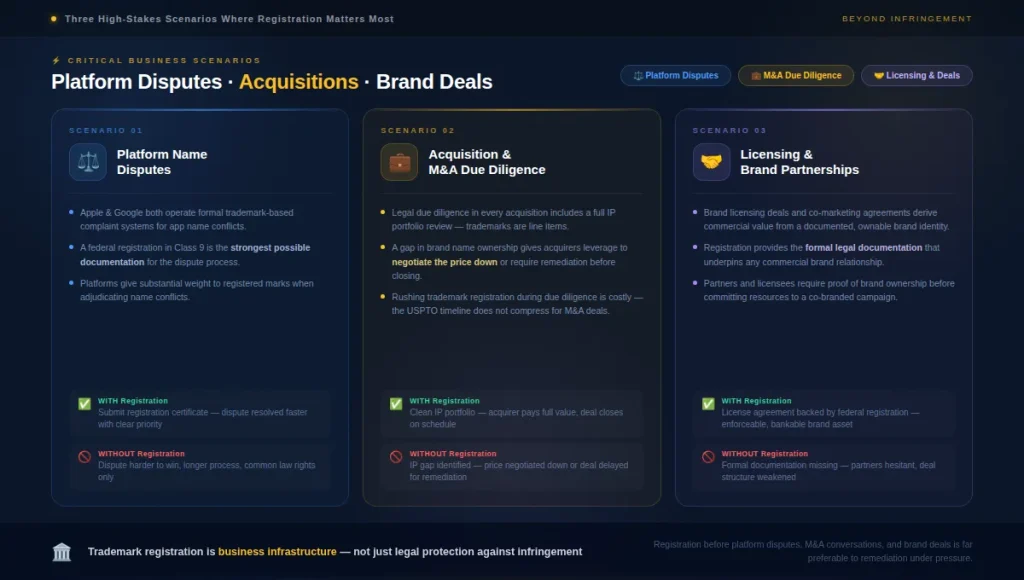
Three specific situations illustrate why trademark registration matters to software companies beyond the basic infringement scenario.
In platform disputes, both Apple and Google allow developers to submit trademark-based complaints when another developer uses a confusingly similar app name. A federal trademark registration in the relevant class is the strongest possible documentation for that process. Without registration, the platform dispute is harder to win and takes longer.
In acquisition conversations, legal due diligence always includes a review of intellectual property. A software company that cannot demonstrate trademark ownership of its core brand name has a gap in its IP portfolio that acquirers will identify and use to negotiate a price down or to require remediation before closing. Registration before an acquisition conversation is far preferable to trying to rush through the process during diligence.
In brand partnerships and licensing discussions, the same principle applies. Your brand is what makes a licensing deal or co-marketing agreement valuable. Without registration, the formal documentation that underpins those commercial relationships is missing.
Protect Your Brand from Day One
united states trademark registrations and law (USTML) works with app developers, SaaS founders, and software companies of all sizes. We conduct the comprehensive searches needed to identify conflicts before you file, recommend the correct class structure for your specific product and business model, handle the full filing process, and respond to any office actions during examination. We also provide monitoring services so you know when a competing name enters the market.
Start with a free trademark search to check your app name availability before your next development milestone.
Frequently Asked Questions
Can I trademark my app name?
Yes. An app name used consistently to identify your product in commerce can function as a trademark and be registered with the USPTO. The mark must be distinctive, not merely descriptive of what the app does, and you must be using it in commerce or have a bona fide intent to do so. The stronger the distinctiveness of the name, the more straightforward the registration process will be.
Do I need both Class 9 and Class 42 for my software company?
It depends on how your product is delivered. Class 9 covers downloadable software products. Class 42 covers software delivered as a service. If you offer both a downloadable version and a cloud-based service version of your product, registering in both classes provides comprehensive coverage. If you only offer one delivery model, the single relevant class may be sufficient.
Can I use my App Store listing as a specimen for my trademark application?
Yes. A screenshot of your app listing in the App Store or Google Play showing the app name and icon in connection with the downloadable product can serve as an acceptable specimen of use. The mark must be clearly visible, and the context must show it being used to identify the commercial product.
What if another app already has a similar name in the App Store?
A similar name in the App Store does not automatically mean there is a trademark conflict that would block your registration or require you to change your name. Whether a legal conflict exists depends on the similarity of the names, the nature of the goods or services, the strength and distinctiveness of both marks, and any existing trademark registrations. A comprehensive trademark search is the right first step to understand the landscape.