

Most business owners assume they need to trademark their logo. The reality is more nuanced, and getting this decision wrong can leave significant gaps in brand protection. A trademark covers what it covers, nothing more. A logo registration protects that specific design. A name registration protects the name itself, regardless of how it is styled or displayed. Choosing between them or deciding to file both is one of the first strategic decisions in any trademark registration process.
Standard Character Marks: Protecting the Name
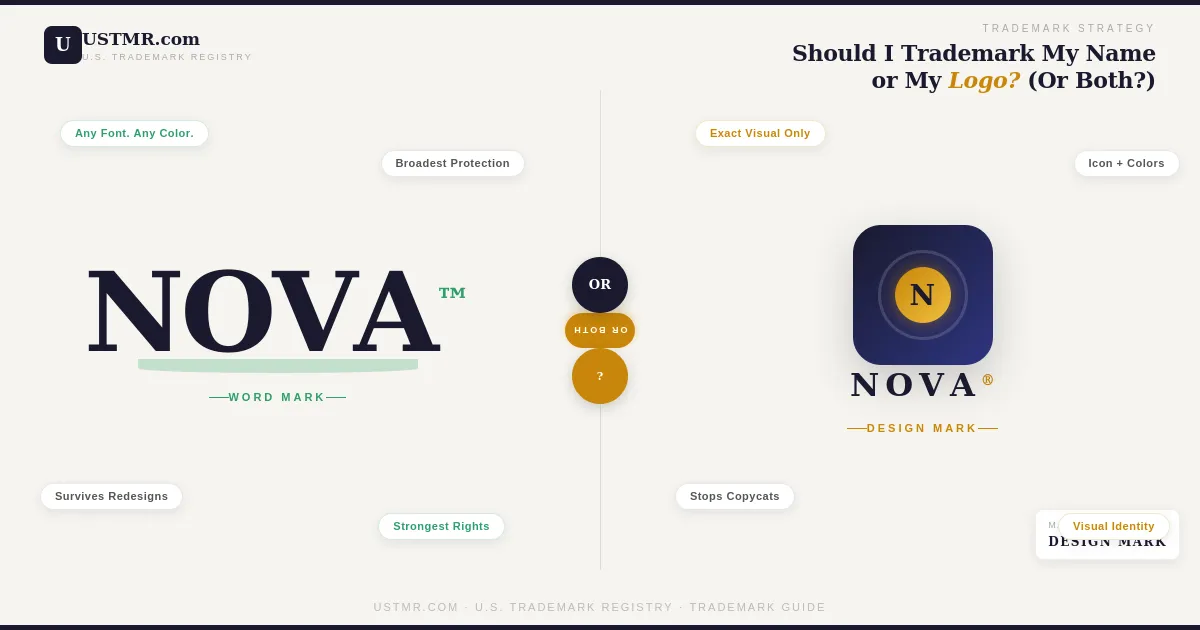
A standard character mark, also called a word mark, protects the text of a name or phrase in any font, style, size, or color. It is the broadest form of trademark protection available for a name.
When we register a client’s business name as a standard character mark, that registration covers the name whether it appears in bold, italics, script, sans-serif, or any other typographic treatment. The protection follows the word, not the surrounding design.
This is why a word mark is almost always the first filing we recommend. If someone uses your business name in any visual form, the word mark registration supports enforcement. A logo registration alone would not cover a competitor using your name in plain text.
Design Marks: Protecting the Logo
A design mark, sometimes called a stylized mark, covers a specific logo, graphic element, or stylized version of a name. It protects the visual presentation: the particular font treatment, graphic elements, color combinations, or icon associated with the brand.
Design marks are narrower in scope than word marks. They protect that specific visual execution. A competitor using the same name in a different visual style would not be covered by a design mark registration alone.
Design marks make the most sense when a logo is genuinely distinctive and central to brand identity. For brands where the visual mark is as recognizable as the name itself, adding a design registration creates an additional layer of trademark protection
Which One Should You File First?
For most businesses, especially those early in brand development, a wordmark comes first. Here is why:
- Word marks offer broader protection against more types of infringement
- Logos evolve. A wordmark stays valid even after a visual rebrand
- If the name is distinctive and registrable, the word mark is the foundation on which everything else builds.
- Enforcing a word mark against copycats is generally more straightforward than enforcing a design mark.
The exception: if a brand relies heavily on a distinctive visual mark, like a specific icon or graphic that consumers associate with the business independently of the name, filing the design mark alongside or before the word mark may make sense.
When to File Both?
Filing both a word mark and a design mark gives a brand the fullest available protection. The word mark covers the name in any form. The design mark covers the specific logo execution. Together, they close most of the gaps a single filing leaves open.
Both filings come with separate USPTO fees. As of 2025, the TEAS Plus filing fee is $250 per class per application. Two applications covering one class each means $500 in USPTO fees at a minimum, before any service or preparation costs.
For established brands with recognizable logos and significant market presence, that investment is usually justified. For early-stage businesses still refining their visual identity, starting with the wordmark and adding the design mark after the logo stabilizes is a more practical approach.
What About Color?
Color is worth addressing directly because it creates confusion for many applicants. A standard character word mark registration covers the name in any color. It does not need to specify a color.
A design mark can be filed in color or in black and white. A black and white design mark registration generally covers the design in any color combination, while a color design mark registration covers only that specific color version. For most logo filings, we recommend a black and white design mark registration because it provides broader coverage.
Slogans and Taglines
Slogans and taglines can also be registered as standard character marks, provided they meet the distinctiveness requirements. If a tagline functions as a brand identifier and not just a descriptive phrase, it may qualify for its own registration.
We assess slogans as part of any comprehensive brand audit. Some qualify immediately. Others need evidence of acquired distinctiveness through long-term use before the USPTO will accept them.
We Help Clients Build the Right Filing Strategy
The name-versus-logo question does not have a universal answer. It depends on where the brand is in its development, how central the visual identity is to consumer recognition, and what the budget allows for initial filings.
At U.S. Trademark Registration (USTML), our trademark filing experts assess each client’s situation before making a recommendation. We look at what the brand actually needs to be protected, not just what is easiest to file.
Start with our free trademark search to see whether the name, logo, or both are available to register. From there, we walk through the strategy and costs so clients can make the right decision before any application goes in.