

Most people filing a trademark application for the first time hit the same wall. The USPTO asks you to select a class for your goods or services, and suddenly you’re staring at a list of 45 categories written in a language that feels like it was designed to confuse you. It wasn’t designed to confuse you, but it wasn’t designed for business owners either. It was designed for trademark attorneys working within an international classification framework called the Nice Classification system. We’re going to translate it for you.
Why Trademark Classes Exist?
The trademark registration system doesn’t protect your mark across every existing product and service. It protects your mark within the specific categories where you actually do business. That’s the core idea behind trademark classes. When you register in a class, you’re telling the USPTO exactly what goods or services your brand is connected to. Your protection lives inside those boundaries.
This matters more than most applicants realize. If a competitor starts selling similar products in a class you didn’t file in, your registered trademark gives you very limited leverage against them. The class defines the fence around your brand. Get the fence wrong, and parts of your brand sit exposed.
The 45-Class Breakdown
The Nice Classification system divides everything into 45 classes. Classes 1 through 34 cover physical goods. Classes 35 through 45 cover services. Here’s how to think about them in terms you actually use.
Classes 1 through 5 cover chemicals, cosmetics, cleaning products, and pharmaceuticals. If you make or sell anything people put on or in their bodies for health or hygiene purposes, you’re likely looking at this range.
Classes 6 through 11 cover manufactured goods, metals, machinery, tools, electronics, and lighting. Think hardware, industrial equipment, and physical technology products.
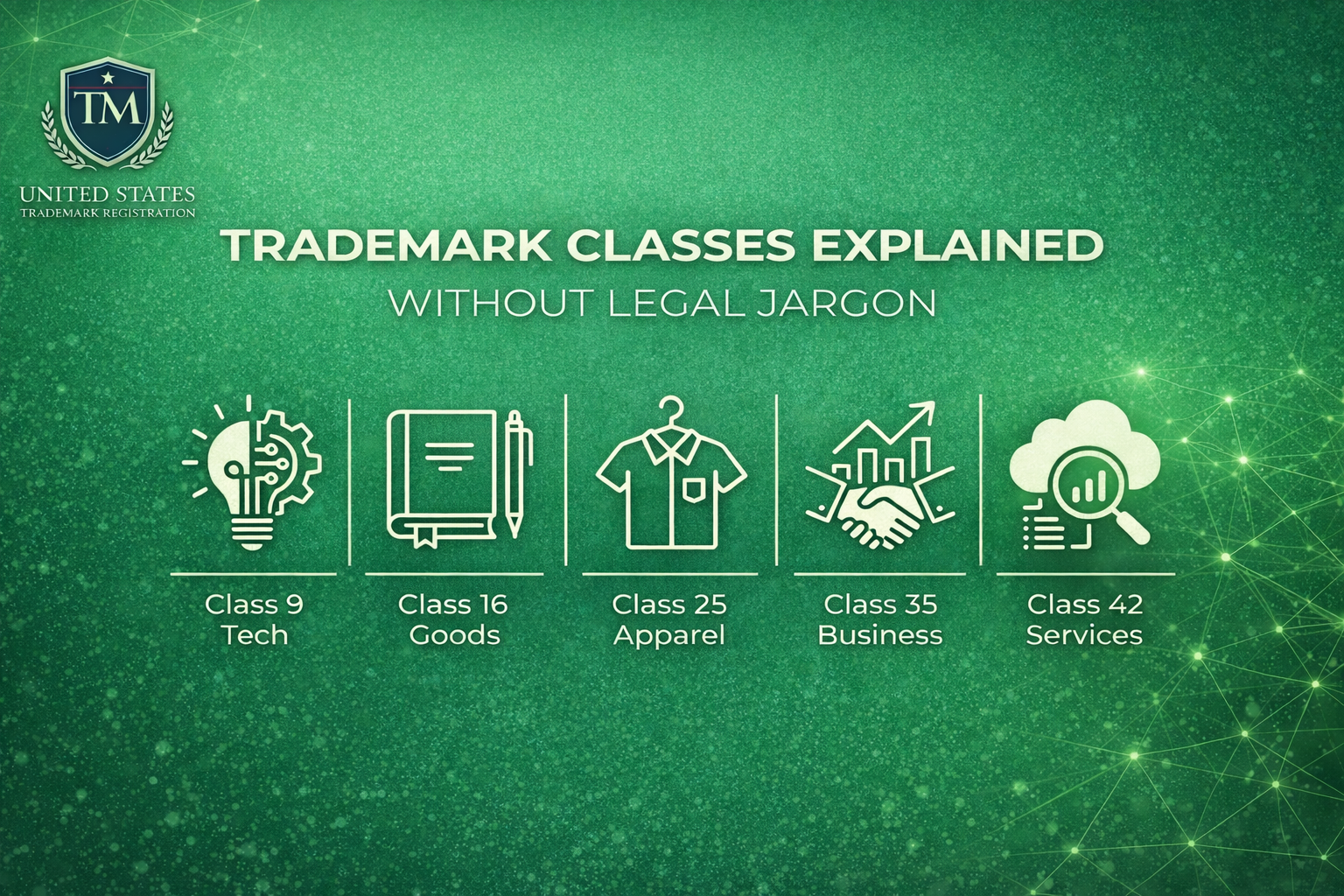
Classes 14 through 26 cover consumer goods. Jewelry lands in Class 14. Clothing goes in Class 25. Paper goods and printed materials fall into Class 16. These are the classes that e-commerce sellers most often get wrong because the lines between them aren’t always obvious.
Classes 35 through 45 are where service businesses live. Business consulting, marketing, and advertising services typically fall in Class 35. Financial services go in Class 36. Technology and software services usually land in Class 42. Legal services are in Class 45.
The Classes That Trip People Up Most
Clothing is Class 25. But if you’re also selling headwear separately, that’s still Class 25. If you sell footwear, it’s also Class 25. The category is broad and covers most wearable apparel.
Software is almost always Class 42, but the application you sell as a product could also touch Class 9. If your software comes with printed instructional materials you sell separately, Class 16 might be relevant. Multi-product or multi-function businesses frequently need more than one class.
Food and beverage is another area where applicants guess wrong. Raw foods often fall in Class 29 or 31. Processed foods and snacks usually go in Class 30. Alcoholic beverages have their own home in Class 33. Non-alcoholic beverages are in Class 32. Filing a beverage brand in the wrong class is one of the most common mistakes we see with consumer product companies.
Retail services are not the same as the products you sell. If you operate a retail store or an online shop, Class 35 covers your retail service activity. The products you sell in that store get their own separate class filing. Many applicants only file for the product and leave their retail operation unprotected.
How Many Classes Do You Need?
The honest answer is as many as accurately reflect where your brand operates today and where you plan to operate within the next few years. You don’t need to file in every class that might someday be tangentially related to your business. Overfiling wastes money and can actually weaken your application if you can’t show genuine use across all claimed classes.
Under-filing is the more dangerous mistake. If you sell both a physical product and a software platform under the same brand, filing in only one class leaves half your business exposed. Online trademark services exist specifically to help business owners navigate this decision before they file, not after a refusal forces them to refile and lose time.
What Happens When You File in the Wrong Class?
The USPTO examiner may not catch it during examination, which sounds like a relief but isn’t. If your mark registers in the wrong class, your registration doesn’t actually protect your real-world use. A competitor who files correctly in the class where you actually operate can challenge your mark or move into your space without legal consequence.
If the examiner does catch it, you’ll face an office action requiring you to correct the class identification. That costs time. Depending on where you are in the process, it can cost money, too. Starting the class selection process correctly with USPTO filing services from professionals who know the classification system eliminates this risk before it starts.
How USTML Approaches Trademark Class Selection?
At united states trademark registrations and law, we treat class selection as a critical first step, not a checkbox. Our united states trademark registrations and law Services include a thorough review of your goods, services, and business model before we recommend which classes to file in. We look at what you sell now, how you sell it, and what your brand roadmap looks like. Then we match that to the correct Nice Classification categories.
We also conduct a comprehensive trademark search across your target classes before filing. Knowing the competitive landscape in your specific class gives you a much clearer picture of approval likelihood and potential conflicts before you spend a dollar on application fees.
Getting the class right from the start is the single most important structural decision in your entire trademark application process. Everything else builds on it.
Ready to file in the right class the first time? Our team at united states trademark registrations and law reviews your business and recommends the exact classes you need before a single form gets submitted. Start with a free trademark search, and let us map the right path forward for your brand.
Frequently Asked Questions
What are trademark classes, and why do they matter?
Trademark classes are categories defined by the USPTO’s Nice Classification system that organize all goods and services into 45 groups. Your trademark protection applies only within the classes you file in, so selecting the correct classes is essential to actually protecting your brand where it operates.
How do I know which trademark class my product falls under?
Start by identifying whether you sell goods (Classes 1–34) or services (Classes 35–45), then narrow down by industry. Physical clothing is Class 25, software services are typically Class 42, and food products vary between Classes 29, 30, 31, and 32 depending on the product type. When in doubt, working with a trademark filing professional eliminates the guesswork.
Can I file more than one trademark class?
Yes, and many businesses should. If your brand covers both a physical product and a related service, you likely need multiple classes. Each class requires a separate filing fee, but the protection across multiple classes is often worth the investment.
What happens if I file in the wrong trademark class?
You may end up with a registration that doesn’t protect your actual business activities. If a competitor operates in the class you missed, your registered trademark offers little protection against them. In some cases, an examiner will issue an office action requiring you to correct the class before the application can proceed.
Do trademark classes differ between countries?
The Nice Classification system is used internationally, so the same 45-class framework applies in most countries. However, how each national trademark office interprets and applies those classes can vary, which is why international filings require jurisdiction-specific strategy.