


Most private-label and white-label businesses enter the market with a simple assumption. If you source a product, build a brand name, and start selling, you own that brand. That assumption feels correct in practice. It is also the reason many growing e-commerce brands later face trademark disputes they did not expect.
In US trademark law, ownership does not come from production or sales. It comes from enforceable rights in a mark that identifies the source under the Lanham Act and is evaluated through USPTO standards. This gap between commercial activity and legal ownership is where most private label risks begin.
Private label brands do not automatically own trademark rights
In US trademark law, ownership is not created through manufacturing, sourcing, packaging, or selling products on a marketplace. It is created through use in commerce that functions as a source identifier and is legally enforceable under the Lanham Act.
This distinction is critical in private-label and white-label models because many sellers assume that controlling production equals owning the brand. Legally, that is not the case.
Trademark rights only become enforceable when the mark identifies source and meets distinctiveness requirements. Without federal registration, those rights remain limited geographically and harder to enforce in disputes.
If you are structuring a private label brand, USTML is the place where formal protection becomes relevant through strategic trademark registration services.

USPTO evaluates trademarks using the DuPont likelihood of confusion standard
According to the United States Patent and Trademark Office (USPTO), the DuPont factors from In re E. I. du Pont de Nemours & Co. (TTAB 1973) determine whether a trademark should be registered.
The central question is whether consumers are likely to be confused about the source of goods or services.
Key factors include:
- similarity of the marks in appearance, sound, and meaning
- similarity of goods and services
- overlap in trade channels
- strength or distinctiveness of the mark
- actual marketplace conditions
Even small similarities can lead to refusal if the commercial impression overlaps.
For private label sellers, this means brand names that feel “unique enough” in isolation may still be legally conflicting when evaluated against existing marks.
White label models increase dependency on trademark strength
White label structures involve multiple sellers using identical or near-identical products sourced from the same manufacturer. In these models, differentiation does not exist at the product level.
The brand becomes the only legal identifier.
If that brand is not federally registered or is weak in distinctiveness, competitors can enter the same category with similar branding until formal enforcement action is taken.
In disputes, the legal question is not who manufactured the product. It is who owns enforceable rights in the mark identifying it in commerce.
Amazon Brand Registry creates a trademark enforcement gate
Amazon requires a USPTO-registered trademark (or equivalent accepted registry) to enroll in Brand Registry.
Once enrolled, the brand gains access to enforcement tools that are not available to unregistered sellers.
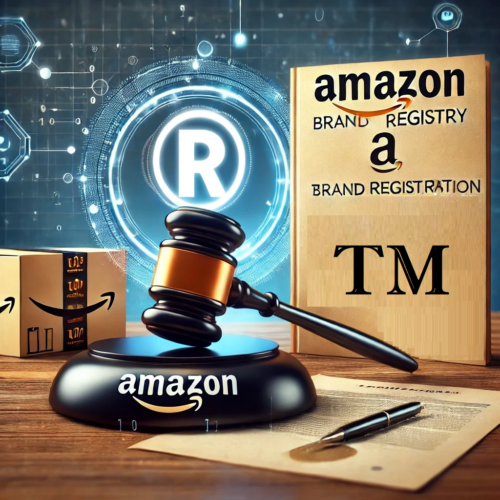
Amazon Brand Registry enforcement flow
- USPTO trademark registration confirmed
- Brand enrolled in Amazon Brand Registry
- Listings are linked to brand identity (ASIN mapping)
- Enforcement tools activated
- Report a Violation tool
- Listing removal requests
- Counterfeit reporting system
- Repeat infringement escalates enforcement priority
Without registration, sellers operate without full access to these controls, even if they have a strong sales history.
This creates a structural imbalance between registered and unregistered brands.
Confusion in real e-commerce scenarios
Trademark disputes in private label markets rarely involve identical copying. They involve similarity that creates consumer confusion.
Example scenario
- Brand A: “NATURALO” (supplements)
- Brand B: “NATURALUX” (supplements)
Even if packaging, logos, and pricing differ, USPTO analysis may still find likelihood of confusion because
- shared the dominant prefix “NATURAL.”
- identical product category (Class 5 dietary supplements)
- overlapping Amazon and retail channels
This can result in refusal under Section 2(d) of the Lanham Act during examination or support infringement claims in litigation.
Private label infringement usually begins with market overlap, not copying
In e-commerce environments, trademark conflict typically emerges gradually.
It starts when:
- similar brand names appear in search results
- multiple sellers use overlapping branding themes
- listings compete for identical keywords
- customers begin confusing product sources
At this stage, the issue is not direct counterfeiting. It is marketplace confusion, which is the core standard in US trademark enforcement.
Once confusion is established, enforcement depends heavily on whether the trademark is registered and structurally defensible.

Enforcement capability depends on registration status
Without federal registration, enforcement relies on common law trademark rights. These rights exist but are limited in scope and harder to prove across jurisdictions.
Comparison of enforcement strength
| Factor | Unregistered Brand | Federally Registered Brand |
| Legal presumption of ownership | No | Yes |
| Amazon Brand Registry access | No | Yes |
| Speed of takedown enforcement | Inconsistent | Fast and standardized |
| Geographic protection | Limited | National |
| Litigation strength | Evidence-heavy | Statutorily supported |
This difference becomes decisive in competitive e-commerce categories.
The first-use does not guarantee exclusive rights
US trademark law recognizes priority of use, but it does not guarantee exclusive rights in all situations.
Rights depend on:
- actual commercial use
- geographic reach
- distinctiveness of the mark
- conflict with existing registrations
- likelihood of confusion under DuPont factors
A seller can be first in the market and still lose enforcement strength if another party holds a stronger or earlier registered mark in the same class.
Why do private label brands become vulnerable after growth?
Private label businesses typically experience trademark risk after success, not before it.
As visibility increases:
- competitors enter the same niche
- similar branding appears in listings
- search results become crowded
- customers lose brand clarity
At that point, the business is no longer competing on product alone. It is competing on brand enforceability.
If trademark structure is weak, growth increases exposure faster than protection.
Conclusion
Private label and white label models do not automatically create enforceable trademark rights in the United States. Yes, they create commercial activity, but they do not confer exclusive ownership of brand identity.
Under USPTO standards and federal trademark law, enforceability depends on distinctiveness, use in commerce, and registration status, not manufacturing origin or marketplace success.
For e-commerce businesses, trademark registration services function as the legal mechanism that converts a product listing into a protected and enforceable brand asset.