

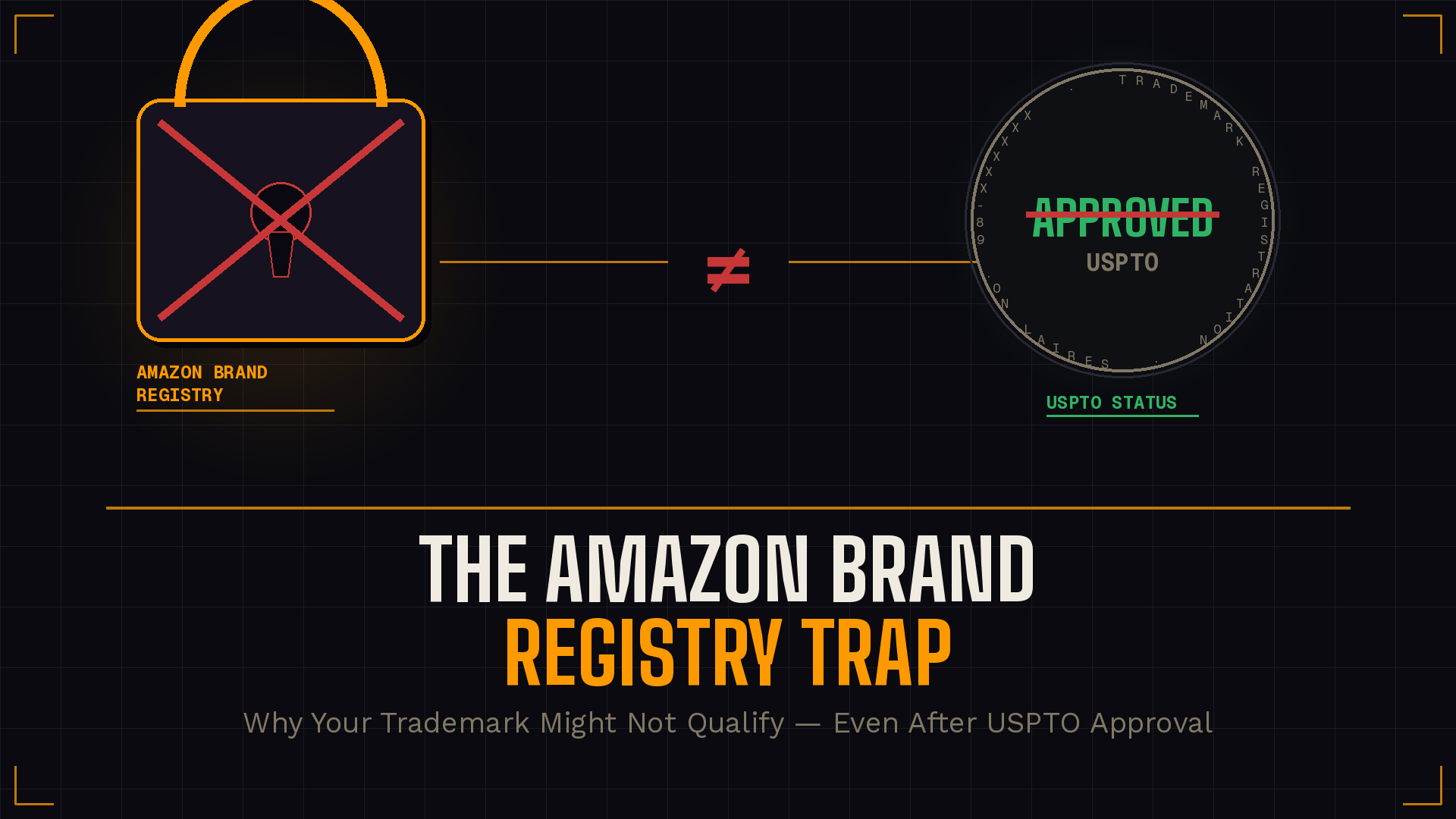
You spent months getting your Amazon trademark registration approved. You paid the fees. Furthermore, you jumped through all the USPTO hoops. Your registration certificate finally arrived. Now you’re ready to enroll in Amazon Brand Registry to protect your products from hijackers and counterfeiters.
You start the enrollment process, upload your trademark certificate, and wait for approval. Then you get the rejection email: “Your trademark does not meet Amazon Brand Registry requirements.”
Wait, what?
You have a legitimate USPTO trademark registration. How can it not qualify?
Here’s the problem: Amazon Brand Registry has its own requirements on TOP of USPTO requirements. A valid federal trademark doesn’t automatically mean Amazon will accept it.
Let us give you a walkthrough of the hidden requirements that catch thousands of sellers by surprise and how to make sure your trademark actually protects your Amazon business.
What Is Amazon Brand Registry, And Do You Really Need It?
Amazon Brand Registry is Amazon’s brand protection program. Once enrolled, you get:
Anti-counterfeiting tools: Report listings selling fake versions of your products
Buy Box control: Better protection against unauthorized resellers hijacking your listings
A+ Content access: Enhanced product descriptions with images and comparison charts
Sponsored Brand ads: Run ads featuring your brand logo
Brand Analytics: Access to search term data and competitor insights
Stores: Create a custom storefront showcasing your full product line
Without Brand Registry: Any seller can jump on your listing, change your content, and steal your Buy Box with lower prices. You have limited tools to stop them.
With Brand Registry: You control your listings. You can remove unauthorized sellers. You get better protection against counterfeiters.
For most Amazon sellers, Brand Registry isn’t optional. It’s essential.
The Basic Amazon Brand Registry Requirements
Amazon lists these official requirements:
- You must have an active registered trademark in the country where you’re enrolling
- The trademark must be text-based or image-based, with words
- The trademark must appear on your products or packaging
- You must be the trademark owner or an authorized representative
Sounds simple, right? You got your USPTO registration, you’re the owner, and your brand name is on your products. You should be good.
Not so fast.
Hidden Requirement #1: Your Trademark Must Be a “Word Mark” or Design Mark WITH Words
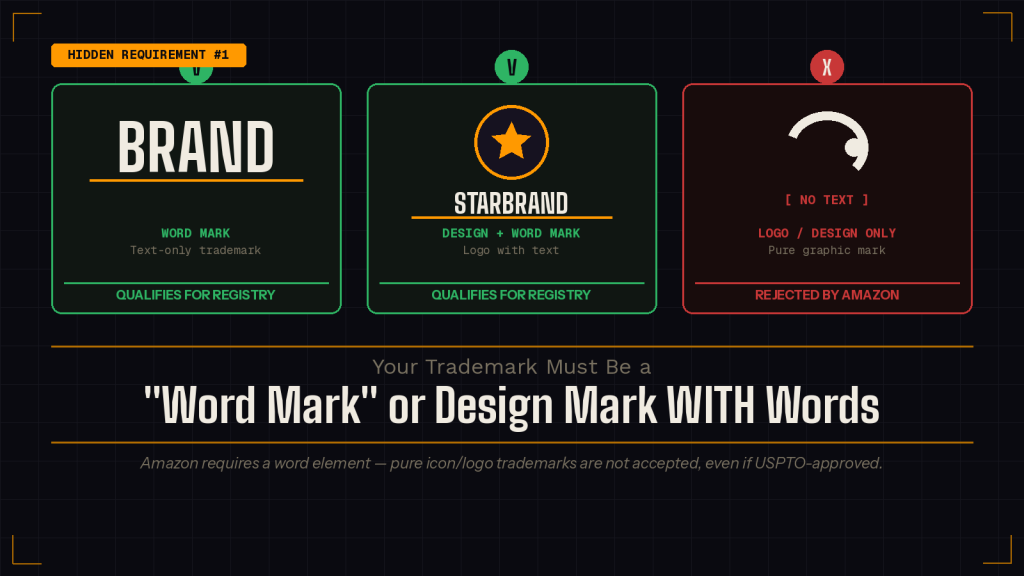
Amazon is very specific about trademark types. Here’s what they accept and reject:
ACCEPTED:
- Standard character marks (plain text trademarks with no design)
- Design marks that include text (logo with your brand name)
REJECTED:
- Pure design marks (logo with no words)
- Sound marks
- Color marks
- Scent marks
- Trade dress
The trap: You filed a logo-only trademark, thinking it protects your brand. The USPTO approved it. But Amazon won’t accept it for Brand Registry because it has no text.
Real example: A seller registered a distinctive mountain logo trademark. USPTO approved it. Amazon rejected it for Brand Registry because the logo contained no readable text. The seller had to file a second trademark application for their company name as a word mark and wait another 8-12 months.
How to avoid this: File a standard character mark (your brand name as text) OR file a design mark that includes your brand name in readable text within the logo.
Hidden Requirement #2: The Trademark Must Actually Appear on Your Products
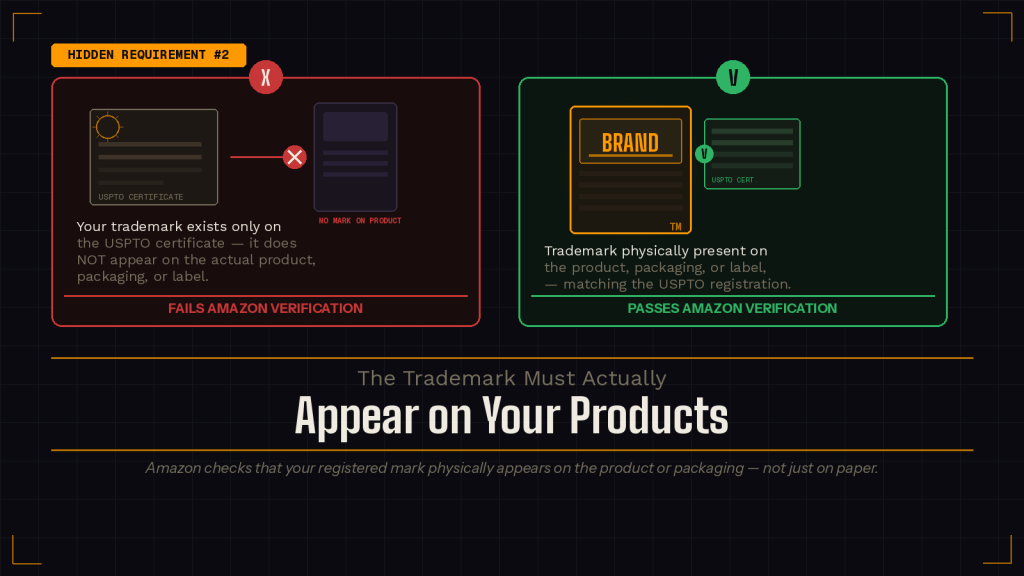
Amazon requires proof that your trademark appears on either:
- The product itself
- Product packaging
- Product labels or tags
They verify this during enrollment by requiring photos showing where the trademark appears.
The trap: You registered your trademark with USPTO using an “intent to use” filing. You got approved and received your certificate. But you haven’t actually started using it on products yet. Amazon rejects you.
Or worse: you filed as “in use” with specimens showing the trademark on your website. USPTO accepted that. But your physical products don’t actually have the trademark printed anywhere. Amazon rejects you.
Real example: A seller filed a trademark for “LUXE HOME” for home decor products. The USPTO specimens showed the trademark on their website. Registration approved. But when they tried to enroll in Brand Registry, their actual products had no trademark on them or on the packaging. Amazon rejected them and required that they add physical branding before enrollment.
How to avoid this: Before enrolling in Brand Registry, make sure your trademark physically appears on your products, packaging, or tags. Take clear photos showing this for the Amazon enrollment process.
Hidden Requirement #3: Your Trademark Can’t Be Too Generic or Descriptive
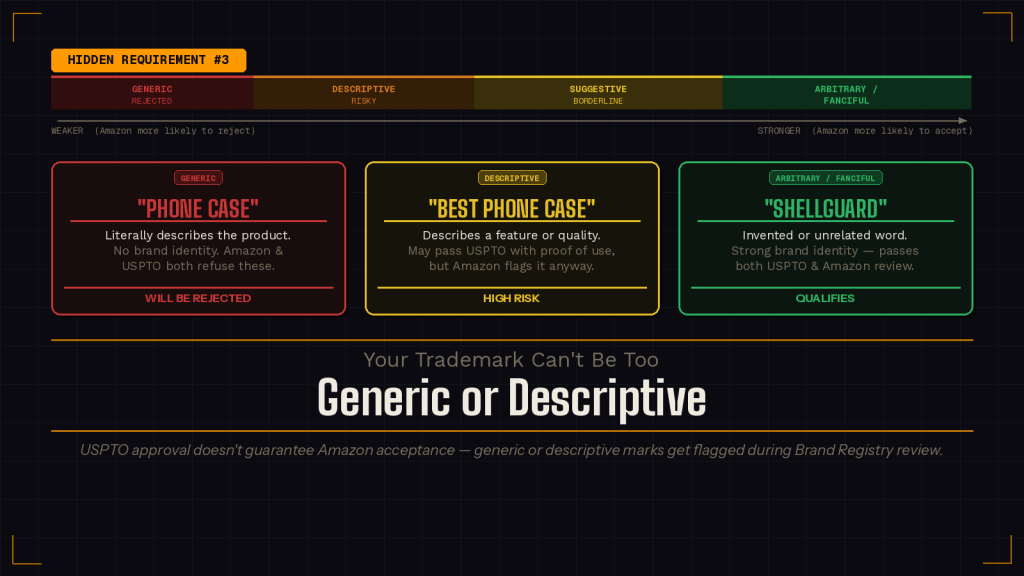
This is where it gets tricky. The USPTO and Amazon use different standards for what’s “too generic.”
The USPTO might approve a somewhat descriptive trademark if you prove acquired distinctiveness. Amazon is stricter.
Amazon’s logic: If your trademark is “Coffee Mugs” for coffee mugs, they don’t consider it a real brand. It’s just a product description. Even if the USPTO approved it, Amazon won’t accept it for Brand Registry.
Trademarks Amazon tends to reject:
- Highly descriptive terms (“Soft Pillow” for pillows)
- Generic industry terms (“Tech Gadgets” for electronics)
- Common phrases (“Best Quality” for any products)
Trademarks Amazon typically accepts:
- Made-up words (“Anker” for electronics)
- Arbitrary terms (“Apple” for computers)
- Suggestive but not descriptive (“Amazon” for retail)
- Distinctive combinations (“Blue Bottle” for coffee)
The trap: You successfully registered a descriptive trademark with the USPTO by proving 5 years of use and acquired distinctiveness. Amazon still rejects it as too generic for Brand Registry purposes.
How to avoid this: Choose a distinctive, non-descriptive trademark from the start. If you’re already stuck with a descriptive mark, you might need to file a second, more distinctive trademark.
Hidden Requirement #4: Pending Trademarks Don’t Qualify (Usually)
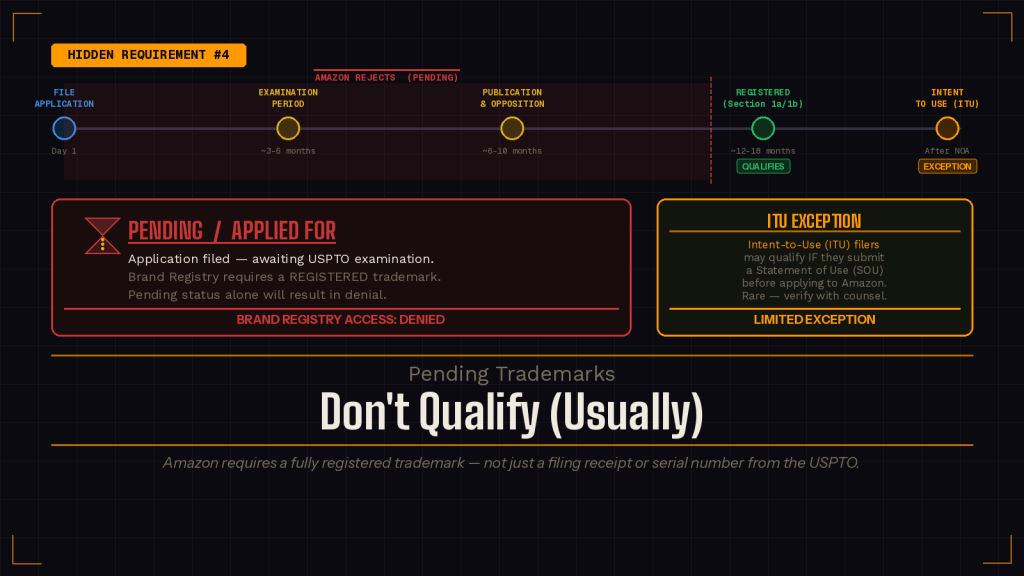
Amazon officially requires an active registered trademark, not just a pending application.
However, there’s a limited exception through the IP Accelerator program.
Normal process:
- File trademark application
- Wait 8-12 months for registration
- Then enroll in Brand Registry
IP Accelerator process:
- File through a participating law firm
- Get enrolled in Brand Registry while the trademark is still pending
- But only certain attorneys participate in this program
The trap: You filed your trademark application. It’s been published, and no one opposed it. Registration is imminent (just waiting for the certificate). You try to enroll in Brand Registry. Amazon rejects you because technically, it’s not registered yet, just allowed.
You have to wait for the actual registration certificate even though approval is guaranteed.
Real example: A seller’s trademark was approved by the USPTO examiner and published with no opposition. They were just waiting for the physical registration certificate to be issued (usually takes 2-3 months after publication closes). They tried to enroll in Brand Registry during this waiting period. Amazon rejected them for not having a registered trademark yet, even though registration was certain.
How to avoid this: Either wait for your actual registration certificate before attempting Brand Registry enrollment, OR file through an IP Accelerator attorney to get early access.
Hidden Requirement #5: The Brand Name You Use on Amazon Must Match Your Trademark
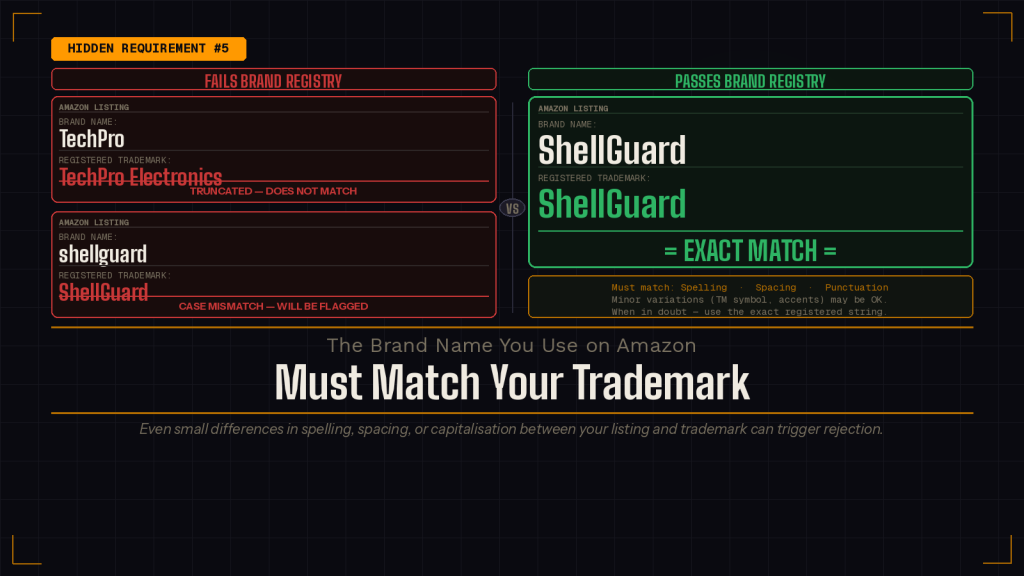
Amazon requires exact or substantial consistency between:
- Your registered trademark
- The brand name you enter during enrollment
- The brand name displayed on your Amazon listings
The trap scenarios:
Scenario 1: Your trademark is “ABC Company,” but on Amazon, you list as “ABC” or “ABC Co.” Amazon might reject this as not matching.
Scenario 2: Your trademark is “XYZ,” but you’re trying to register a variation like “XYZ Pro” or “XYZ Premium.” Amazon rejects it as not matching your trademark.
Scenario 3: You have the trademark for “Blue Mountain Coffee,” but on Amazon, you’ve been selling under “Blue Mountain” alone. Mismatch rejection.
What Amazon checks:
- Does the brand name in your enrollment application match your trademark?
- Does the brand displayed on your products match your trademark?
- Are you using the trademark consistently across your listings?
How to avoid this: Use your exact trademark name as your Amazon brand name. If you want to use variations, you may need to register multiple trademarks.
Hidden Requirement #6: Your Trademark Must Be in the Correct Country
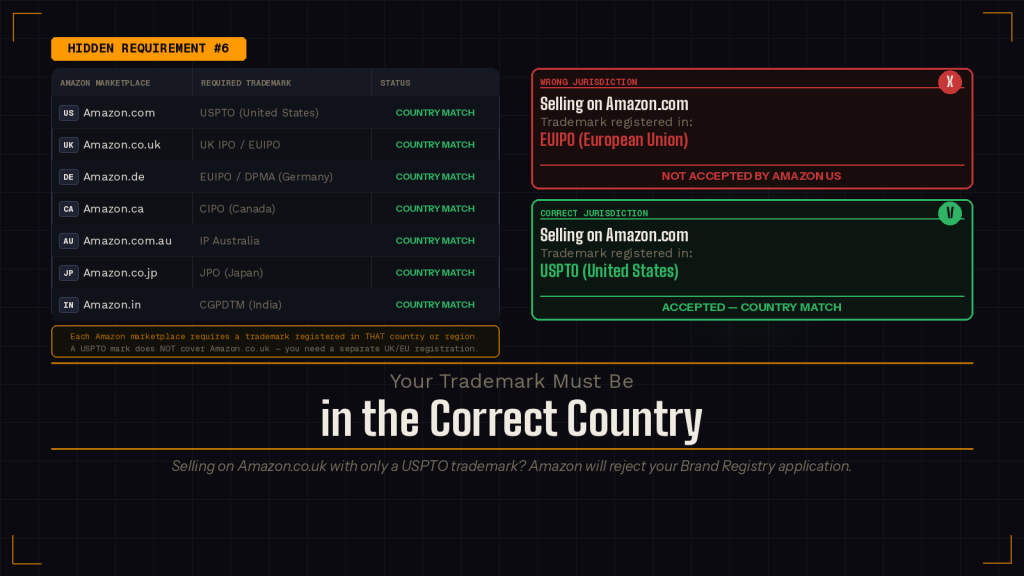
This seems obvious, but trips up international sellers constantly.
Amazon’s rule: You need a trademark registered in the country where you’re selling.
- Selling on Amazon.com (USA)? Need USPTO trademark.
- Selling on Amazon.co.uk (UK)? Need a UK IPO trademark.
- Selling on Amazon.de (Germany)? Need EUIPO or German trademark.
- Selling on Amazon.ca (Canada)? Need a Canadian trademark.
The trap: You have a USPTO trademark (USA), but you’re trying to sell on Amazon.ca (Canada). Amazon rejects your Brand Registry enrollment for Canada because your trademark isn’t registered in Canada.
Or you have a Canadian trademark, but try to enroll in Amazon.com Brand Registry. Rejected because you need a USPTO trademark for the US marketplace.
Real example: A Canadian company had a Canadian trademark. They started selling on Amazon.com. They couldn’t enroll in the US Brand Registry because their trademark was Canadian, not USPTO. They had to file a separate US trademark application and wait 8-12 months.
How to avoid this: File for trademark protection in every country where you plan to sell. For international sellers, this often means:
- USPTO (for Amazon.com)
- UK IPO (for Amazon.co.uk)
- EUIPO (covers all EU Amazon marketplaces)
- Canadian IPO (for Amazon.ca)
- Japan Patent Office (for Amazon.co.jp)
Use the Madrid Protocol for international trademark filing to save costs.
Hidden Requirement #7: Trademark Class Must Match Product Category
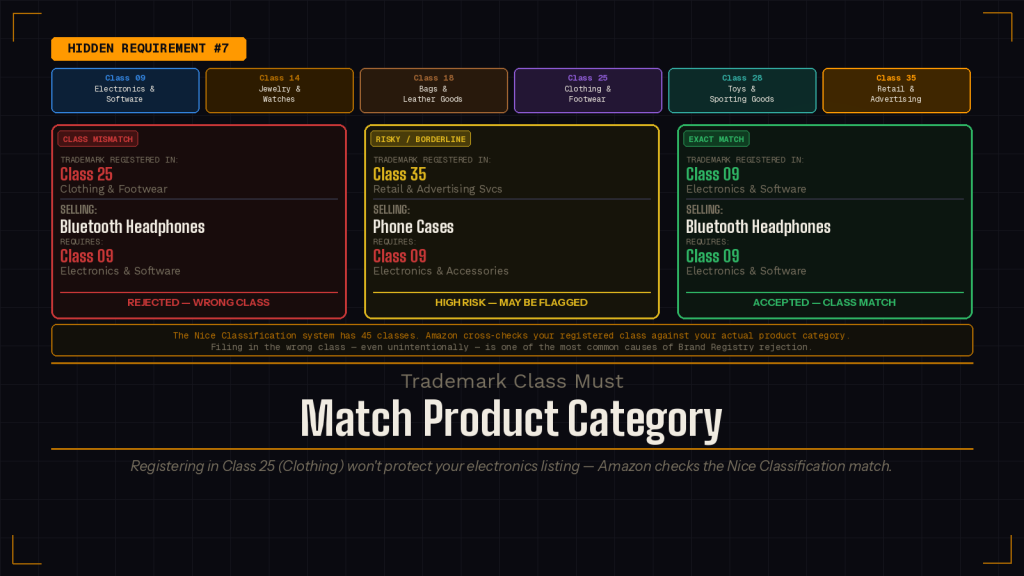
When you file your trademark, you choose specific classes of goods/services. Amazon checks whether your trademark class actually covers what you’re selling.
The 45 trademark classes include things like:
- Class 9: Electronics
- Class 18: Leather goods, bags
- Class 25: Clothing, footwear
- Class 28: Toys, sporting goods
The trap: You registered your trademark in Class 35 (retail services), thinking that covers your Amazon business since you’re “retailing” products.
But you’re selling clothing. Amazon requires your trademark to be in Class 25 (clothing), not Class 35 (retail services).
Why this happens: Many sellers file in the wrong class or use overly broad descriptions that don’t actually cover their specific products.
Real example: A toy seller registered their trademark with a description like “Online retail store services featuring toys.” This falls under Class 35 (services), not Class 28 (goods). When they tried to enroll in Brand Registry, Amazon rejected them because their trademark didn’t actually cover toys as goods, only the retail service of selling toys.
How to avoid this: When filing your trademark application, make sure the goods/services description specifically covers the products you sell, in the correct classes. Work with a trademark registration service to get this right.
The Timeline Problem: When Should You File Your Trademark?
Here’s the chicken-and-egg problem Amazon sellers face:
If you file too early: You file before launching products, use “intent to use” filing, and your trademark gets approved. But you haven’t started selling yet, so you don’t need Brand Registry immediately. By the time you launch, you’re enrolling in Brand Registry without product sales history.
If you file too late: You launch products, build sales, then file your trademark. Now you’re waiting 8-12 months for registration while competitors hijack your listings and counterfeiters steal your sales. You’re vulnerable during this entire period.
The optimal timeline for Amazon sellers:
3-6 months before launch:
- File trademark application (intent to use)
- Order initial inventory with the trademark printed on products/packaging
During trademark examination (months 3-8):
- Launch products on Amazon
- Build sales and reviews
- Gather evidence of use for Statement of Use
When the trademark is approved (months 8-12):
- File Statement of Use with USPTO
- Receive the registration certificate
- Immediately enroll in Brand Registry
This timeline means you’re building your business while your trademark processes, and you can enroll in Brand Registry as soon as you have the registration.
What to Do If Amazon Rejects Your Brand Registry Application?
Step 1: Read the rejection reason carefully
Amazon tells you why they rejected you:
- A trademark doesn’t include text
- Trademark not registered in this country
- The trademark doesn’t match the brand name used
- Can’t verify trademark on products
Step 2: Fix the underlying issue
If the trademark type is wrong: File a new trademark application with text included. Wait for approval.
If the trademark isn’t on products: Add the trademark to your products, packaging, or tags. Take new photos.
If there’s a name mismatch: Either change your Amazon brand name to match the trademark, or file a new trademark matching how you use the brand on Amazon.
If the country is wrong: File a trademark in the correct country. Wait for approval.
Step 3: Reapply to Brand Registry
Once you’ve fixed the issue, reapply. Amazon doesn’t penalize you for previous rejections if the new application meets requirements.
The Multi-Trademark Strategy for Amazon Sellers
Many successful Amazon brands file multiple trademarks:
Primary trademark: Your main brand name as a standard character mark. This is your foundation for Brand Registry.
Design trademark: Your logo. Provides additional protection for your visual branding, even though Amazon doesn’t require it for Brand Registry.
Product line trademarks: If you have distinct product lines under different names, trademark each one. This lets you enroll multiple brands in Brand Registry.
Variation trademarks: “Brand Name Pro,” “Brand Name Elite,” etc. if you use these variations consistently.
Cost consideration: Each trademark costs $250-$350 in USPTO fees plus service fees. But the protection often justifies the investment for serious Amazon sellers.
Brand Registry Benefits Worth the Trademark Investment
Once you’re enrolled in Brand Registry, you get powerful tools:
Listing control: You can edit your product titles, descriptions, and images. Unauthorized sellers can’t change your content anymore.
Report a Violation: Fast-track system to report counterfeiters and copyright infringement. Amazon removes listings within hours instead of weeks.
Automated protections: Amazon’s algorithms automatically detect potential counterfeits and proactively remove them.
Transparency: Track where violations are coming from and see the enforcement actions Amazon takes.
Brand Analytics: See what search terms customers use, how your products rank, and what competitors are doing.
Sponsored Brands: Run ads featuring your logo and up to 3 products, driving traffic to your Store.
Stores: Free custom storefront with your branding, product categories, and brand story.
For most sellers, these tools pay for the trademark investment within months through reduced counterfeiting and better listing control.
The Cost of NOT Having Brand Registry
Without Brand Registry, you face:
Hijackers: Sellers jump on your listings with lower prices, stealing your Buy Box and sales. They often fill with lower-quality products, damaging your brand.
Counterfeiters: Fake versions of your products appear on Amazon. Customers buy them thinking they’re yours, get poor quality, and leave you bad reviews.
Content changes: Anyone can edit your listings. Competitors might change your title, images, or description to favor their own products.
Lost Buy Box: When hijackers undercut your price, you lose the Buy Box (the “Add to Cart” button). Most customers only buy from the Buy Box winner.
Brand damage: Counterfeits and hijackers associate poor quality with your brand name. Your reputation suffers even though you didn’t make those products.
The financial impact: Sellers report losing 20-40% of revenue to hijackers and counterfeiters before enrolling in Brand Registry. For a seller making $500,000/year, that’s $100,000-$200,000 in lost sales.
Compare that to the one-time cost of trademark registration ($300-$1,000) and the choice is clear.
Working with USTML for Amazon Brand Registry Success
At USTML, we help Amazon sellers navigate the entire trademark registration process with Brand Registry specifically in mind.
What we do differently:
Pre-filing consultation: We review your brand name and product plans to ensure the trademark will qualify for Brand Registry before you file.
Class selection: We make sure you’re filing in the correct trademark classes for your specific products.
Proper specimens: We guide you on what specimens to submit, showing your trademark on products, not just websites.
International filing: If you sell on multiple Amazon marketplaces, we coordinate trademark filings in all relevant countries.
Brand Registry support: After your trademark registers, we help with the Amazon Brand Registry enrollment process if needed.
Our Amazon seller success rate: 95% of our clients who follow our guidance successfully enroll in Brand Registry on their first attempt.
Don’t Assume Your Trademark Equals Brand Registry
A USPTO trademark registration is necessary but not sufficient for Amazon Brand Registry.
Before filing your trademark, ask:
- Is this a word mark or a design mark with text?
- Does this trademark cover my actual products (correct classes)?
- Will this trademark physically appear on my products or packaging?
- Is the trademark distinctive enough (not too generic)?
- Am I filing in the right country for my Amazon marketplace?
After registration, verify:
- The trademark matches exactly how I use the brand on Amazon
- I have clear photos showing the trademark on products
- I have all the required documentation for enrollment
Getting these details right the first time saves you from re-filing trademarks and waiting another 8-12 months while your Amazon business stays vulnerable.
We’ll review your Amazon brand strategy and ensure your trademark qualifies for Brand Registry before you spend a dollar on filing fees.
Frequently Asked Questions
Can I enroll in Amazon Brand Registry with a pending trademark?
Generally, no, unless you file through an IP Accelerator attorney. Most sellers must wait for registration.
What if my trademark is registered but not on my products yet?
Amazon requires the trademark to physically appear on products or packaging. Add it before applying for Brand Registry.
Can I use a state trademark for Amazon Brand Registry?
No. Amazon requires federal trademarks (USPTO for the US marketplace, equivalent national registries for other countries).
What if I sell on multiple Amazon marketplaces?
You need separate trademarks in each country. USPTO for Amazon.com, UKIPO for Amazon.co.uk, etc.
How long does Amazon Brand Registry enrollment take?
Usually, 1-7 days if your trademark qualifies and you have all the required documentation ready.
Can I enroll multiple brands in Brand Registry?
Yes, if you have separate trademark registrations for each brand name.