

You’ve got a startup idea. A great name. Maybe even some early customers.
Now someone’s telling you to file for a trademark. But you’re thinking: “I barely have revenue. I’m bootstrapping. Can’t this wait until we’re more established?”
I get it. You’re watching every dollar. Trademark registration feels like something “real companies” do, not scrappy startups still figuring out product-market fit.
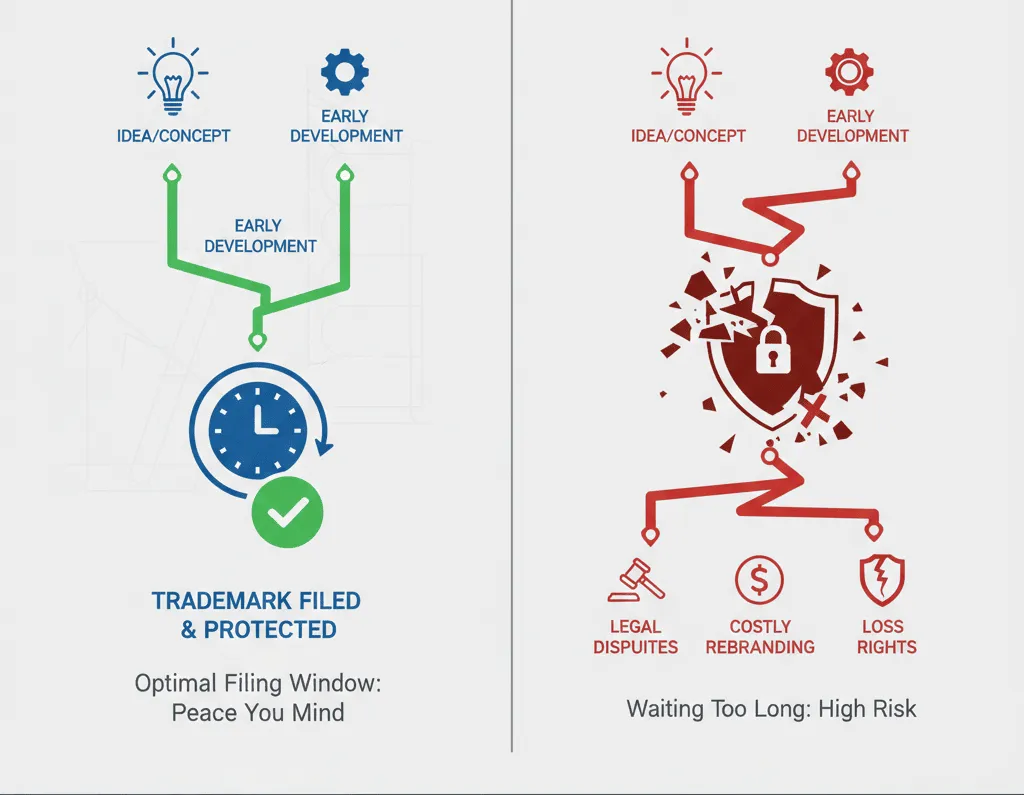
Here’s the problem with that thinking: by the time you feel “ready” for a trademark, someone else might already have it. Or worse, you’ve built your entire brand on a name you can’t legally protect.
Let me walk you through exactly when to file your trademark at each stage of your startup journey, and what it costs you if you wait too long.
The Startup Trademark Paradox
Most founders face this:
Too early: You don’t want to spend money on a trademark before validating your business idea. What if you pivot? What if the startup fails?
Too late: By the time you have traction, competitors notice. Someone files a similar trademark. Now you’re either blocked from registration or facing opposition proceedings.
The sweet spot? Earlier than you think.
Stage 1: Pre-Launch (Just an Idea)
What’s happening: You’ve got a concept. You’re researching the market. You haven’t built anything yet.
Trademark action: Do a free trademark search on the USPTO website.
This takes 20 minutes. Type in your proposed brand name and see if there are obvious conflicts. If you find 10 exact matches in your industry, you know you need a different name before you invest any time or money in branding.
Cost: $0 Time investment: 20-30 minutes
Don’t file yet if:
- You’re not sure about the name
- You haven’t validated the business idea at all
- You’re still in “brainstorming” mode
- You have zero customers or traction
Filing now is premature. The name might change. Save your money.
Stage 2: Serious Validation (Getting Close to Launch)
What’s happening: You’ve settled on a name. You’re building the product. Maybe you have a landing page collecting emails. You’re 2-3 months from launch.
Trademark action: Order a comprehensive trademark search.
This is the critical step most startups skip. You’ve committed to the name enough to build a website, design a logo, and tell people about it. Now you need to verify you can actually own it.
A comprehensive search checks:
- Federal and state trademark databases
- Common law uses (existing businesses with your name)
- Domain registrations and social media handles
- Phonetically similar marks
- Foreign language translations
You’ll get a detailed report showing any conflicts and whether you should proceed, modify, or pivot to a different name.
Cost: $300-$500 Time investment: 3-5 days to get results
This is worth it because:
- You’re about to invest in marketing and branding
- Changing your name now is easy; changing it after launch is expensive
- You need to know if you can get trademark protection before going all-in
Real scenario: A SaaS startup spent $15,000 on branding, website design, and initial marketing. Six months after launch, they got a cease and desist letter from a company using a similar name. They had to rebrand completely. A $500 trademark search would have caught this before they spent a dime on marketing.
Stage 3: Launching Soon (4-8 Weeks Out)
What’s happening: Product is built. Website is live. You’re preparing for launch. Maybe you’re doing beta testing.
Trademark action: File your trademark application based on “intent to use.”
This is the moment. Don’t wait until after launch.
Here’s why: trademark rights in the U.S. are based on “first use in commerce,” but filing an “intent to use” application stakes your claim. If someone else tries to file a similar mark after you, you have priority.
An intent to use application says: “I’m going to use this trademark soon, reserve it for me.”
Cost: $250-$350 USPTO fee + $49-$249 service fee (depending on speed) Timeline: You’ll get a filing receipt immediately with a serial number
Benefits of filing now:
- You establish a priority date before competitors
- You can use the “TM” symbol while pending (shows you’re serious about protection)
- If someone searches trademarks, they’ll see your pending application
- You have 6 months to launch, with extensions available
Don’t wait because: The USPTO takes 3-4 months just to assign an examining attorney. If you wait until after launch to file, you won’t have any protection during those critical early months.
Stage 4: Just Launched (First 3 Months)
What’s happening: You’re live. You have customers. Revenue is coming in. You’re in growth mode.
Trademark action: If you haven’t filed yet, file NOW as “in use.”
You’ve already lost the early priority date, but you need to file before:
- Competitors notice your traction and file similar marks
- You scale marketing (don’t spend $50,000 on ads for a brand you can’t protect)
- You seek investment (investors want to see IP protection)
An “in use” application requires proof that you’re actually using the trademark in commerce. This means:
- Screenshots of your website selling products/services
- Photos of products with your trademark
- Examples of your trademark in advertising
Cost: Same as above ($250-$350 USPTO + service fees) Timeline: 8-12 months to registration (if no issues)
Why this is urgent:
- Every day you wait is a day a competitor could file
- Your brand is now public and searchable
- You’re building brand equity that could be challenged
Real scenario: Two startups launched similarly named apps within months of each other. The one who filed first got the trademark. The second one had to rebrand after investing $100,000 in user acquisition. Their explanation to users? “Legal reasons.” They lost 40% of their user base in the transition.
Stage 5: Early Traction (6-12 Months Post-Launch)
What’s happening: You’ve got product-market fit. Revenue is growing. You’re raising a seed round or scaling marketing.
Trademark action: If you still haven’t filed, you’re in the danger zone.
At this stage:
- Competitors are watching you
- Industry blogs might be writing about you
- Your name shows up in Google searches
- You’re spending serious money on marketing
You NEED federal trademark protection. Not tomorrow. Today.
Also consider:
- Trademark monitoring services to watch for similar filings
- Filing in multiple classes if you’re expanding product lines
- International trademark protection if you’re going global
Cost: Standard filing + monitoring ($200-$500/year for monitoring)
What investors want to see: When you raise funding, investors do IP due diligence. They want to see:
- Trademark application filed or registered
- No pending legal disputes over your brand
- Clear ownership of your IP
Missing trademark protection can kill a funding round or lower your valuation.
Stage 6: Scaling (12+ Months, Strong Revenue)
What’s happening: You’re a real business now. Multiple employees. Significant revenue. Maybe you’re profitable.
Trademark action: If you haven’t filed yet, you’re likely facing problems.
At this stage, three bad things often happen:
Problem 1: Competitor Files First
A competitor saw your success and filed a trademark for a similar name. Now you’re in opposition proceedings trying to defend your common law rights. This costs $5,000 to $15,000+ in legal fees.
Problem 2: Cease and Desist Letter
Someone who filed before you (or has common law rights) sends you a cease and desist. Now you’re choosing between:
- Fighting it (expensive legal battle)
- Rebranding (extremely expensive and disruptive)
- Negotiating a coexistence agreement (still expensive)
Problem 3: You Can’t Enforce Your Rights
You find someone copying your brand, but you don’t have federal trademark registration. Your legal options are limited. You have to prove common law rights in court, which is much harder than showing a trademark registration certificate.
Cost of fixing this late: $10,000 to $100,000+, depending on the situation
Real scenario: A D2C brand hit $5M in annual revenue before filing for a trademark. Turns out, a smaller regional competitor had filed two years earlier. The D2C brand had to rebrand completely, losing $2M in brand equity and another $500,000 in rebranding costs. Their investors were not happy.
The “But We Might Pivot” Excuse
This is the most common reason startups delay filing. “What if we change our name? Won’t we waste the money?”
Here’s the reality:
If you’re serious about the name (website, logo, marketing materials, telling investors), you’re not pivoting the name. You might pivot the product, the target market, or the business model, but the brand name usually stays.
If you do pivot the name: You lose the USPTO filing fee ($250-$350) and service fees. That’s it. Compare this to the risk of building a brand you can’t protect.
Think of it like insurance. You might not need it, but the cost of not having it is catastrophic.
Special Considerations for Different Startup Types
SaaS and Tech Startups
File earlier rather than later. Tech moves fast. Competitors clone successful products constantly. Your brand name is often your main differentiator.
Also consider:
- Filing in multiple countries if you’re global from day one
- Protecting your product name AND company name if they’re different
- Monitoring competitors’ trademark filings in your space
E-commerce and DTC Brands
File before you order inventory. If you have 10,000 units of product with your brand name printed on them, you can’t easily pivot.
Also consider:
- Amazon Brand Registry requires trademark registration
- Counterfeiters target successful DTC brands (you need a trademark to fight back)
- A trademark is essential for DMCA takedowns on marketplaces
Local Service Businesses
File sooner if you plan to expand. You might start as a local coffee shop, but if you’re thinking franchise or multi-location, file federally early.
State trademark registration only protects you in that state. Federal registration gives you nationwide protection.
Marketplace or Platform Startups
File immediately. Your brand is your product. Users need to trust your platform name. Competitors will try to confuse users with similar names.
Also consider:
- Protecting key feature names or taglines
- Monitoring similar platforms in adjacent markets
- International filing if you’re launching globally
The Post-Filing Timeline: What to Expect
Once you file your trademark application, here’s what happens:
Month 1-3: Application is submitted, and you receive a serial number. You can use the “TM” symbol. The application sits in a queue.
Month 3-4: An examining attorney is assigned and reviews your application. They check for conflicts with existing marks.
Month 4-6: You either get approved for publication, or you get an “office action” (rejection or request for clarification).
If you get an office action, you have 6 months to respond. This is where USTML’s office action response service helps. About 40% of applications get office actions, so don’t panic if this happens.
Month 6-8: If approved, your trademark is published for opposition. Anyone who thinks your mark infringes on theirs has 30 days to oppose.
Month 8-12: If no one opposes (most don’t), your trademark registers. You get a registration certificate. Now you can use the ® symbol.
Total timeline: 8-12 months from filing to registration.
This is why filing early matters. If you wait until you “need” the trademark, you won’t have protection for almost a year.
What Does It Cost to File at Each Stage?
Let’s break down the financial reality:
Pre-Revenue Startup
- Comprehensive search: $300-$500
- Intent to use filing: $250 USPTO + $49-$249 service
- Total: $599-$999
This is probably 1-2% of your initial startup capital. Completely worth it.
Post-Launch with Traction
- Same filing costs
- Plus monitoring: $200-$500/year
- Total year 1: $799-$1,499
Still a tiny fraction of what you’re spending on product development or marketing.
Late Filing (Facing Conflicts)
- Office action response: $500-$1,500
- OR Opposition proceeding: $5,000-$15,000
- OR Rebranding: $10,000-$100,000+
Suddenly, that $500 comprehensive search looks like the best money you’ve ever spent.
The USTML Approach for Startups
We work with startups at every stage. Here’s what we recommend:
Stage 1-2 (Pre-launch): Start with our free trademark search tool. If the name looks clear, order a comprehensive search ($500).
Stage 3 (Launch imminent): File intent to use with our Basic or Standard package. Get your priority date locked in.
Stage 4+ (Launched): If you haven’t filed, use our Professional package for same-day filing. Every day matters now.
Ongoing: Add trademark monitoring to catch similar filings early. We track the USPTO database and alert you to potential conflicts.
We price our services for bootstrapped startups. Our basic filing service is $49 + USPTO fees. That’s accessible for even pre-revenue companies.
When Should You File?
Ideal timing: 1-2 months before launch, once you’re committed to the name.
The latest you should wait: Within 3 months of launching. After that, you’re taking a serious risk.
Never file: When you’re still brainstorming names and have zero commitment to launching.
The cost of filing “too early” (if you pivot): $500-$1,000 in wasted fees.
The cost of filing “too late” (if someone else files first): $10,000 to $100,000+ in rebranding or legal fees.
The math is pretty simple.
Ready to Protect Your Startup?
Don’t wait until you have a problem. File your trademark application while you still have a clear path to registration.
USTML specializes in helping startups navigate trademark registration without breaking the bank. We’ve worked with hundreds of early-stage companies through this process.
Call us to discuss your timeline and get a custom quote for your situation.
Your future self (and your investors) will thank you for protecting your brand early.
Frequently Asked Questions
Should I file a trademark before or after I have revenue?
File once you’re committed to the name and plan to launch within 6 months. Revenue isn’t required for “intent to use” applications.
What if I’m still in beta?
Beta counts as “use in commerce” if you’re providing the service to real users (even if free). You can file as “in use” at that point.
Can I file a trademark for a name I’m not using yet?
Yes, with an “intent to use” application. You have 6 months to start using it (with extensions available up to 3 years).
What happens if someone files the same trademark while I’m building my startup?
If they file first, they have priority. This is why filing early matters. The priority date is your claim stake.
Do I need different trademarks for my company name vs. product name?
If they’re different names, yes. Many startups file for both to fully protect their brand.
How much does it cost to file if I’m bootstrapped?
USTML’s basic filing is $49 + $250 USPTO fee = $299 total. We also offer payment plans for early-stage startups.