


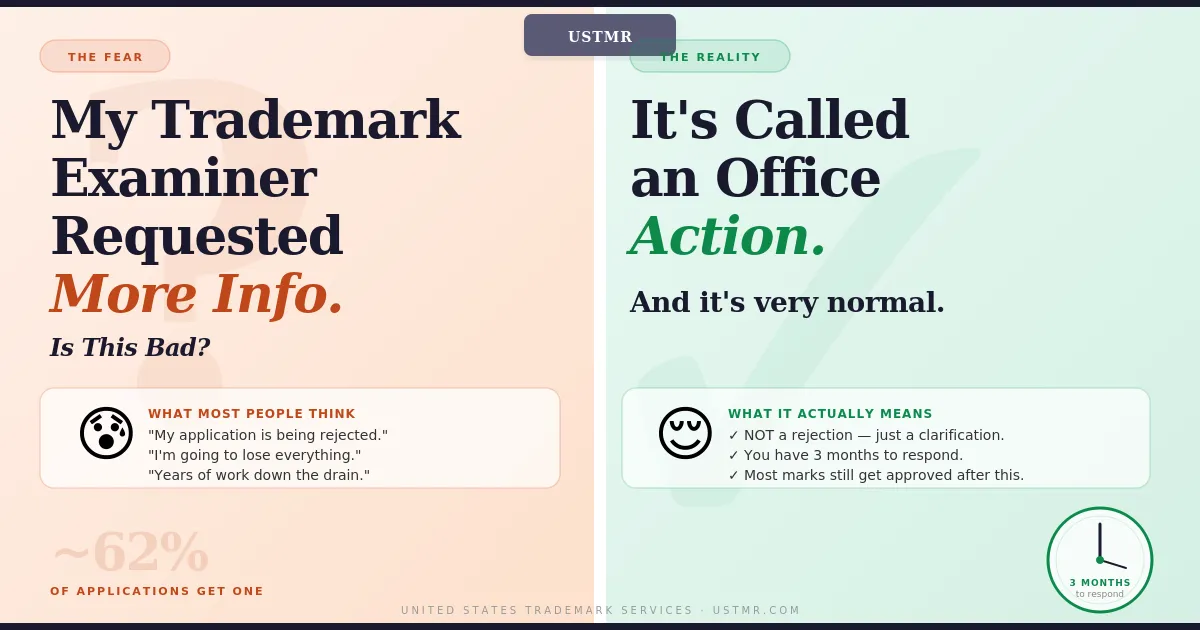
Receiving a request from a USPTO examining attorney is not an automatic crisis. It is a normal part of the examination process. What matters is the type of request, its implications for the application, and how quickly and accurately it is addressed. We respond to office actions every week. Most resolve cleanly. The ones that do not almost always trace back to avoidable mistakes in the original application preparation.
What is an office action?
An Office Action is a written communication from a USPTO examining attorney that identifies issues the applicant must resolve before the registration can proceed. It is not a rejection. It is a formal request for a response.
Office actions come in two types. A non-final Office Action is the first communication raising issues. The applicant has an opportunity to respond and address each point. The examiner issues a final Office Action when they maintain their refusal after the first response. Final Office Actions require either a convincing argument for reconsideration, an appeal to the Trademark Trial and Appeal Board, or abandonment of the application.
Most applicants who receive their first Office Action are receiving a non-final one. That is the more manageable situation, and it is where a well-crafted response can turn the application around.
The Most Common Office Action: Likelihood of Confusion
The most frequent Office Action reason is a Section 2(d) refusal based on the likelihood of confusion with an existing registered mark. The examiner has found a mark in the USPTO database that they believe is similar enough to the applied-for mark to cause consumer confusion.
A likelihood of confusion refusal does not mean the application is over. It means the applicant must argue, with evidence, that confusion is unlikely. The TTAB and courts apply a multi-factor test known as the DuPont factors when evaluating the likelihood. These include the similarity of the marks in appearance, sound, and meaning; the relatedness of the goods or services; the sophistication of the relevant consumers; and whether actual confusion has occurred.
A strong response to a likelihood of confusion, Office Action addresses each relevant DuPont factor with specific arguments and evidence. Generic responses that simply assert the marks are different rarely succeed. Targeted, well-supported arguments often do.
Other Common Office Action Types
- Specimen refusal: The USPTO rejects the submitted specimen because it does not show the mark in acceptable commercial use. The applicant must submit a substitute specimen that meets the requirements.
- Identification of goods and services: The examiner finds the description too vague, too broad, or written in language the USPTO does not accept. The applicant must amend the identification to acceptable terms.
- Merely descriptive refusal: The examiner finds the mark directly describes a feature of the goods or services. The applicant must argue the mark is not merely descriptive or submit evidence of acquired distinctiveness.
- Disclaimer requirement: The examiner requires a disclaimer of an unregistrable component of the mark, such as a descriptive word within a larger mark. Usually straightforward to resolve.
- Surname refusal: The examiner finds the mark functions primarily as a surname. The applicant must submit evidence showing the mark has acquired secondary meaning as a brand identifier.
The Deadline That Cannot Be Missed
Office action response deadlines are hard. The applicant has three months from the issue date to respond, with an optional extension to six months available for a fee of $125 per class. Miss that deadline and the USPTO abandons the application automatically.
The USPTO sends no automatic notification when an Office Action is issued beyond what appears in the TSDR system. Applicants who stop monitoring their application status miss these deadlines more often than any other single failure point.
Our trademark management services include active status monitoring with immediate notification the moment the USPTO sends any communication. Clients never need to check a government portal, hoping nothing slipped through.
When the Office Action Could Have Been Prevented?
The most common office actions, likelihood of confusion, and specimen refusals are largely preventable. A thorough, comprehensive trademark search before filing surfaces conflicting marks before they become refusals. Proper specimen review before submission prevents specimen rejections.
Applications prepared without these steps are applications waiting for an Office Action. We see this constantly with DIY filings and budget service applications where the filer skipped the conflict search or submitted the specimen without review.
We Handle Office Action Responses
At U.S. Trademark Registration (USTML), our trademark filing experts handle Office Action responses as part of our standard USPTO filing services. We analyze the specific refusal, identify the strongest response strategy, prepare the substantive arguments and evidence, and submit the response within the required deadline.
For applications originally filed elsewhere, we also handle Office Action responses as a standalone service. If a response is already needed, contact us directly through our trademark services page with the Office Action details. We assess the situation and tell clients what the realistic options are before any commitment is made.
Frequently Asked Questions
Is a USPTO Office Action the same as a rejection?
No. An Office Action is a formal request from an examining attorney to address specific issues before registration can proceed. A non-final Office Action gives the applicant an opportunity to respond and resolve those issues. The examiner issues a final Office Action only after reviewing the first response and maintaining the refusal.
How long do I have to respond to a USPTO Office Action?
The applicant has three months from the Office Action issue date to respond. Extensions to six months are available for a fee of $125 per class. Missing the deadline results in abandonment of the application.
How do I respond to a likelihood of confusion Office Action?
A successful response argues that confusion is unlikely by addressing the relevant DuPont factors: differences in the marks’ appearance, sound, and meaning; differences in the goods or services; differences in trade channels; and the sophistication of consumers. Evidence supporting each argument strengthens the response significantly.
What happens if I do not respond to a USPTO Office Action?
The USPTO abandons the application automatically when the deadline passes without a response. The agency keeps the filing fee. The applicant loses the priority date from the original filing and must start over with a new application.