

You just started a business. Formed an LLC. You think you’re protected.
Then someone else launches a competing business with the same name. They’re in a different state, so your LLC registration doesn’t stop them. Customers are confused. Your brand is diluted.
Here’s the problem: an LLC and a trademark protect completely different things. Most new business owners don’t understand the difference until it’s too late.
Let me clear up the confusion and show you exactly what each one does, what they cost, and why businesses need both.
What Is an LLC?
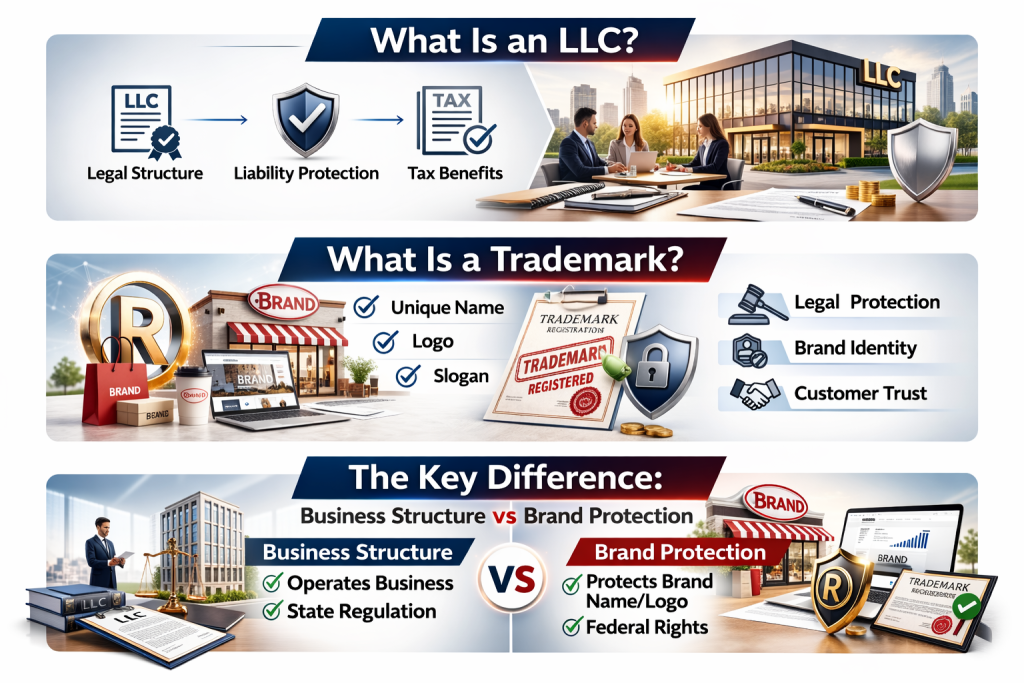
An LLC (Limited Liability Company) is a business structure that protects your personal assets from business debts and lawsuits.
What LLC registration gives you:
- Personal asset protection (your house, car, and savings are safe if the business gets sued)
- Tax flexibility (pass-through taxation or corporate taxation)
- Business credibility
- Legal business entity status in your state
What LLC registration does NOT give you:
- Exclusive rights to your business name nationwide
- Ability to stop others from using similar names
- Brand protection
- Trademark rights
Where you register: Your state’s Secretary of State office
Cost: $50-$500, depending onthe state
Protection scope: Only in the state where you registered (some states offer limited name reservation in other states)
What Is a Trademark?
A trademark is legal protection for your brand identity, including names, logos, slogans, and symbols that identify your business.
What federal trademark registration gives you:
- Nationwide exclusive rights to your brand name/logo
- Legal presumption of ownership
- Ability to sue infringers in federal court
- Use of the ® symbol
- Protection against similar competing marks
- Customs enforcement against counterfeits
What trademark registration does NOT give you:
- Personal asset protection
- Tax benefits
- Business structure
- Protection from business debts
Where you register: United States Patent and Trademark Office (USPTO)
Cost: $250-$350 per class in USPTO fees (plus professional service fees)
Protection scope: Nationwide (and potentially international)
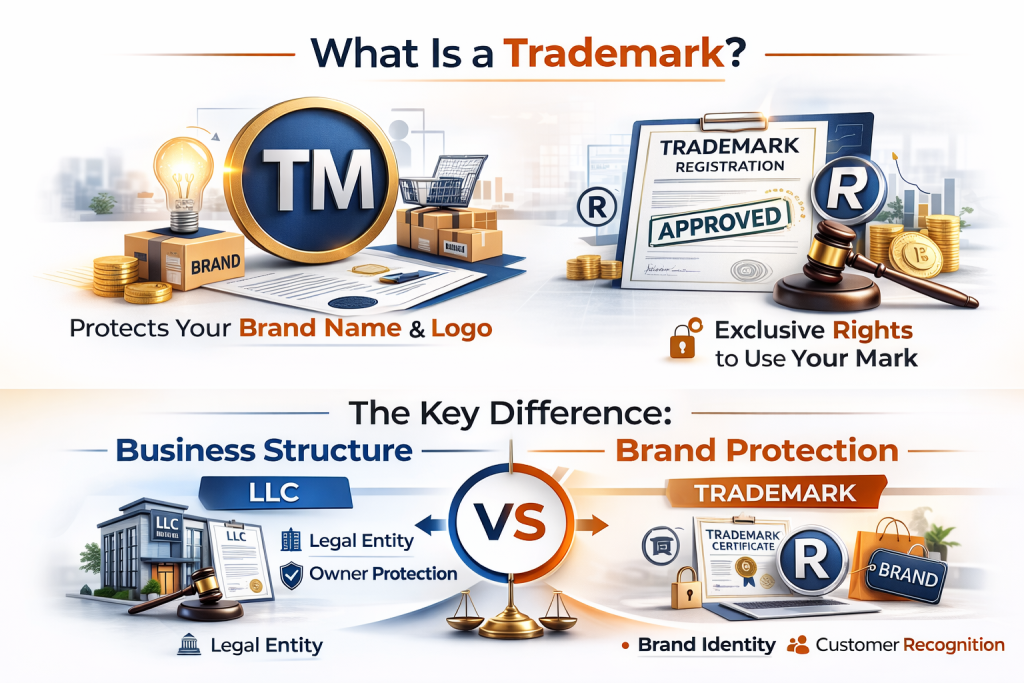
The Key Difference: Business Structure vs Brand Protection
Think of it this way:
LLC = The legal container for your business operations. Trademark = The legal protection for your brand identity
Example: You form “Blue Sky Consulting LLC” in California. This gives you:
- An LLC business structure
- Personal liability protection
- The right to use “Blue Sky Consulting” in California
Someone in Texas formed “Blue Sky Consulting LLC” in their state. This gives them:
- Their own LLC business structure
- The right to use “Blue Sky Consulting” in Texas
Both LLCs are valid. Neither infringes on the other’s LLC registration. But customers are confused. Your brand is diluted.
If you had trademarked “Blue Sky Consulting,“: You’d have exclusive nationwide rights. The Texas business couldn’t use that name even though its LLC is valid. They’d have to choose a different name or face trademark infringement claims.
What Happens If You Only Form an LLC?
Name Conflicts
You’re “Apex Solutions LLC” in Florida. You build a successful consulting business. Five years later, you discover “Apex Solutions LLC” exists in New York, Georgia, and California.
All their LLC registrations are valid. None of them is breaking state law. But your brand is severely diluted. Customers don’t know which “Apex Solutions” is which.
Your options without a trademark:
- Live with the dilution
- Rebrand entirely (expensive and disruptive)
- Try to negotiate with the other businesses (they have no obligation to change)
If you’d trademarked “Apex Solutions,”: You could enforce your trademark rights and require the others to rebrand or face legal action.
Expansion Problems
Your LLC is “Mountain Coffee LLC” in Colorado. You want to expand to Utah, Arizona, and New Mexico.
You discover “Mountain Coffee LLC” already exists in Utah and Arizona. Their LLC registrations block you from using that name in those states.
Your options:
- Use different business names in different states (confusing and expensive)
- Try to buy out the other businesses
- Abandon expansion plans
If you’d trademarked “Mountain Coffee,” You’d have nationwide rights. The other LLCs would need to rebrand or prove they used the name first.
Online Business Complications
You sell products online as “Urban Style LLC.” Your LLC is in Ohio. You ship nationwide.
Someone in Oregon uses “Urban Style” for similar products. They also ship nationwide. Customers leave reviews on the wrong business’s website. Returns get sent to the wrong address.
The problem: Both businesses are operating legally under their state LLCs. Neither has exclusive nationwide rights.
The solution: Whoever trademarks first gets nationwide protection.
What Happens If You Only Get a Trademark?
Scenario: You trademark “Stellar Services” but never form an LLC or corporation.
Issues:
- You’re operating as a sole proprietorship (default business structure)
- Your personal assets aren’t protected
- If the business gets sued, your house, car, and savings are at risk
- You have tax complications
- Less business credibility with banks and investors
The risk: You protect your brand but expose yourself to personal liability.
Example: A client sues your business for $100,000. You have trademark protection (your brand name is safe), but no LLC protection. The client can go after your personal assets.
Why Most Businesses Need Both?
LLC protects you from business liability. A trademark protects your business from brand theft.
Both protections are essential for building a sustainable business.
The ideal sequence:
Form your LLC
- Protects you personally
- Establishes a business entity
- Opens business bank accounts
- Cost: $50-$500
Do a comprehensive trademark search
- Verify your business name is available nationwide
- Check for conflicts before investing in branding
- Cost: $300-$500
File for federal trademark registration
- Secure nationwide brand rights
- Prevent competitors from using similar names
- Cost: $250-$350 USPTO fees + service fees
Maintain both registrations
- LLC: Annual reports, fees vary by state
- Trademark: Section 8 (years 5-6), renewal (every 10 years)
Cost Comparison
LLC Only
- Formation: $50-$500
- Annual maintenance: $0-$800/year, depending onthe state
- 10-year total: $500-$8,500
Protection: Personal assets, limited name protection in one state
Trademark Only
- Filing: $250-$350 per class
- Maintenance (10 years): $650-$850
- 10-year total: $900-$1,200 per class
Protection: Brand name nationwide, no personal liability protection
LLC + Trademark (Recommended)
- LLC formation: $50-$500
- Trademark filing: $250-$350
- Combined maintenance (10 years): $650-$9,350
- 10-year total: $950-$10,200
Protection: Personal assets AND brand name nationwide
The ROI: Compare $950-$10,200 to:
- Cost of rebranding due to name conflict: $10,000-$100,000+
- Cost of personal bankruptcy if business is sued: Potentially everything you own
- Value of exclusive brand rights: Priceless for growing businesses
State vs Federal Protection
State LLC registration:
- Protects the business name in that state only
- Some states offer “name reservation” in other states (limited protection)
- Can’t stop similar businesses in other states
- Can’t enforce against online competitors in other states
Federal trademark registration:
- Protects brand nationwide
- Enforceable in all 50 states
- Covers online and e-commerce use
- Can record with US Customs to stop counterfeit imports
Why this matters for modern businesses: If you sell online, you’re not just competing in your state. You’re competing nationwide. State-level LLC name protection isn’t enough.
Special Cases: When You Might Need Only One?
When LLC Alone Might Be Enough?
- Purely local service business (one physical location, no plans to expand)
- Generic or descriptive business name (can’t be trademarked anyway)
- Very small side business with minimal brand investment
- Business name isn’t critical to success (B2B with contract-based sales)
Example: “Best Plumbing LLC” serving only your local city. The name is too descriptive to trademark, and you have no expansion plans.
When Trademark Without LLC Might Work?
- Solo creator/influencer using your personal name
- Partnership or corporation (other business structures provide liability protection)
- Low-risk service business with no physical products
Example: A consultant operating as a sole proprietor under a trademarked personal brand name. (Though forming an LLC is still recommended for liability protection.)
Common Misconceptions
Myth 1: “My LLC registration gives me trademark rights.”
Reality: LLC registration only gives you the right to use that name in your state for your LLC. It doesn’t give you exclusive brand rights or prevent others from using similar names.
Myth 2: “My trademark protects my business structure.”
Reality: Trademarks protect brands, not business entities. You still need an LLC or corporation for liability protection.
Myth 3: “I can’t trademark my business name if it’s an LLC.”
Reality: You can (and should) trademark your business name even if it includes “LLC” in the legal name. File the trademark for the distinctive part without “LLC.”
Example: Legal business name is “Blue Mountain LLC.” Trademark “Blue Mountain” for your brand.
Myth 4: “If I have a DBA, I don’t need a trademark.”
Reality: A DBA (Doing Business As) is just a name registration, not brand protection. DBAs don’t give you exclusive rights or stop others from using the name.
Myth 5: “Trademark is only for big companies.”
Reality: Any business that wants to protect its brand should consider trademark registration. Small businesses often need it more because they can’t afford expensive legal battles over name conflicts.
How to Decide What You Need?
Ask yourself these questions:
For LLC:
- Do I need personal asset protection? (Almost always yes)
- Do I want tax flexibility?
- Am I taking on any business debt or liability?
- Will I have employees or contractors?
If you answered yes to any: Form an LLC (or corporation)
For Trademark:
- Is my brand name distinctive and important to my business?
- Do I sell products or services beyond my local area?
- Do I plan to grow or expand geographically?
- Do I sell online or ship nationwide?
- Is my industry competitive with similar business names?
- Do I plan to franchise, license, or sell my business?
If you answered yes to 2 or more: File for trademark registration
For most businesses: The answer is both.
The Action Plan
Month 1: Form Your LLC
- Choose your business name
- Check availability with your state
- File Articles of Organization
- Get EIN from IRS
- Open business bank account Cost: $50-$500 Time: 1-4 weeks
Month 1-2: Conduct Trademark Search
- Do a basic free search on the USTML website
- Order a comprehensive trademark search
- Review results and assess conflicts
- Adjust the business name if conflicts are found. Cost: $0-$500 Time: 1-2 weeks
Get a comprehensive trademark search from USTML
Month 2-3: File Trademark Application
- Determine correct trademark classes
- Prepare specimens (if using in commerce)
- Complete USPTO application
- Pay filing fees
- Receive serial number. Cost: $250-$800 Time: 1 day to file, 8-12 months to register
File your trademark with USTML
Ongoing: Maintain Both
LLC:
- File annual reports
- Pay state fees
- Keep good standing
Trademark:
- Monitor for infringement
- File Section 8 (years 5-6)
- Renew every 10 years
Set up trademark monitoring with USTML
Real Business Scenarios
E-commerce Seller
- Needs: LLC (liability protection) + Trademark (brand protection)
- Why: Selling products nationwide online requires brand protection beyond state LLC registration. Product liability requires personal asset protection.
- Cost: $800-$1,500 initial
Local Restaurant
- Needs: LLC (definitely) + Trademark (maybe)
- Why: LLC is essential for liability. A trademark depends on expansion plans. If you might franchise or open more locations, trademark now.
- Cost: LLC $50-$500, Trademark optional ($550-$800)
SaaS Startup
- Needs: LLC/Corporation + Trademark (both essential)
- Why: Tech startups need liability protection and strong brand protection. Investors expect both. Competitors will steal names if unprotected.
- Cost: $800-$1,500 initial
Freelance Consultant
- Needs: LLC (recommended) + Trademark (optional initially)
- Why: LLC protects personal assets from client disputes. A trademark depends on how distinctive and valuable your personal brand becomes.
- Cost: LLC $50-$500, Trademark when needed ($550-$800)
Final Word
LLCs and trademarks serve completely different purposes:
- LLC = Business structure and liability protection
- Trademark = Brand identity and market protection
For growing businesses, especially those selling online or planning to expand, both are essential investments.
Total cost for both: $800-$1,500 initial + ongoing maintenance
Value protected: Your personal assets + your brand equity (potentially worth millions)
The math is simple: Spend a few hundred dollars now or potentially lose everything later.
Ready to protect both your business and your brand? Don’t wait until conflicts arise. Protect what you’re building today.
Frequently Asked Questions
Do I need to trademark my LLC name?
Your LLC name is automatically protected in your state, but not nationwide. You should trademark the distinctive part of your business name for nationwide brand protection.
Can I trademark a name that’s already an LLC in another state?
Maybe. If no one has trademarked it federally, you can file for trademark registration. But if they’ve been using it in commerce, they might have common law rights.
What comes first, LLC or trademark?
Form your LLC first (you need a business entity). Then search and file for a trademark before launching major marketing.
How much does an LLC cost vs a trademark?
LLC: $50-$500 depending on state. Trademark: $250-$800 depending on filing method.
Can someone steal my business name if I only have an LLC?
Yes, they can use the same or a similar name in other states or nationwide if they trademark it before you do.
Do I need a lawyer for an LLC and a trademark?
Not necessarily. Many businesses form LLCs themselves or use online services. For trademarks, professional filing services like USTML offer affordable alternatives to attorneys.
What if I already have an LLC but no trademark?
File for trademark registration ASAP. The longer you wait, the greater the risk that someone else files first or brand conflicts arise.