

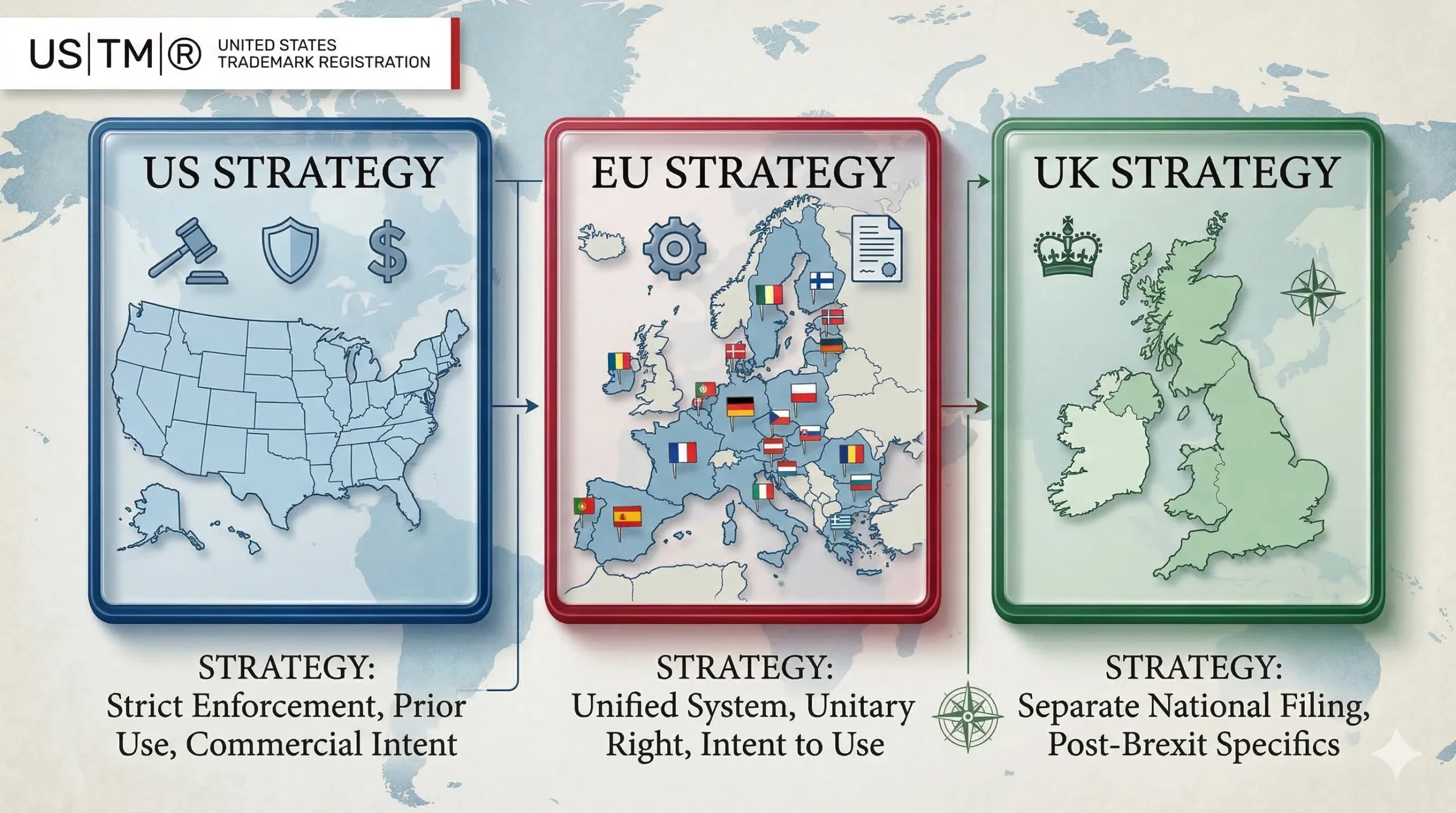
One of the most important things to understand about trademark protection is that it does not travel. A trademark registration in the United States protects your brand. It has no legal effect in the European Union, the United Kingdom, Canada, or anywhere else. If your business operates internationally, or plans to, each market where you want legal protection requires its own registration strategy.
The three most commercially significant trademark systems are relevant for businesses expanding from the United States. One is the US system under the USPTO. Another is the EU system under the European Union Intellectual Property Office. The third is the UK system under the Intellectual Property Office.
Each system operates differently. Each has distinct requirements. The strategic choices you make affect cost, timing, and the strength of your protection in each market.
The United States Trademark System
The USPTO administers federal trademark filing in the United States and operates on a use-based system. This is a key difference between the US and most of the world.
Trademark registration in the US requires actual use in commerce at the time of filing. It can also be based on a bona fide intent to use the mark in commerce.
You cannot register a trademark in the US purely as a defensive measure without any genuine commercial intent. The examination process assesses the likelihood of confusion with existing marks, and the opposition window provides third parties with 30 days to challenge approved applications.
Trademark application services in the US operate within a system that rewards early filers with constructive nationwide priority. Registration fees are per class and range from $250 to $350, depending on the filing form. Examination typically takes eight to twelve months from filing. The total timeline from filing to registration for a straightforward application is generally 12 to 18 months.
Trademark application services in the US operate within a system that rewards early filers with constructive nationwide priority. Registration fees are per class and range from $250 to $350, depending on the filing form. Examination typically takes eight to twelve months from the filing date.
The European Union Trademark System
The EUIPO administers brand protection services in the European Union. The EUIPO stands for the European Union Intellectual Property Office. It is headquartered in Alicante, Spain.
An EU trademark is officially called a European Union Trademark, or EUTM. It provides unitary protection across all 27 EU member states. This protection comes through a single application and a single registration.
The EU system does not require use at the time of filing. You can file defensively for marks you intend to use in the future without any actual commercial activity in the EU. The cost efficiency of the EUTM is significant: one application covers all 27 EU markets simultaneously. The base filing fee covers one class; additional fees apply for each additional class.
The EU system conducts absolute grounds examination, meaning the EUIPO examiner reviews issues like descriptiveness and genericness but does not conduct relative grounds examination against prior marks. This means third parties are responsible for monitoring new applications and filing oppositions if their prior marks are conflicted. The opposition period in the EU is three months after publication.
Online Trademark Services teams working with EU filings note that EUTM registrations are unitary, meaning a successful invalidation action affecting the entire EU can cancel the registration in all member states simultaneously. A mark that has a conflict in one EU member state may be better protected through national registrations in specific countries rather than a single EUTM.
The United Kingdom Trademark System
The UK Intellectual Property Office, also known as the UKIPO, administers Trademark Protection Solutions in the United Kingdom. Following Brexit, EU trademarks no longer cover the UK. Businesses that previously relied on EUTM protection in the UK now need separate UK registrations for UK protection.
The UK system is broadly similar to the EU system in structure. UK trademark applications are examined for absolute grounds and published for opposition. The opposition period in the UK is two months from publication, with possible extensions. Registration fees are competitive with EU fees for single-class filings, though the UK covers only the UK market rather than 27 countries.
One practical advantage of the UK system for US-based businesses is that the UKIPO conducts examinations in English and has experience dealing with international applicants. For businesses already dealing with the USPTO in English, the UK filing process is relatively familiar in structure.
The Madrid Protocol: Streamlining Multi-Country Filings
Trademark management services for businesses filing internationally typically involve the Madrid Protocol, an international treaty administered by the World Intellectual Property Organization that allows trademark owners to file a single international application covering multiple member countries.
The Madrid system requires a trademark application or registration from the applicant’s home country as the basis. A US applicant can use their USPTO application or registration as the basis for filing under the Madrid system, designating any of the 130-plus member countries. The World Intellectual Property Organization processes the single international application. Then it forwards it to the national or regional trademark offices of each designated country, where examiners review it under local law.
The Madrid system significantly reduces the administrative burden and cost of multi-country filing compared to filing direct national applications in each country. If the owner cancels the home country application or registration within five years of the international registration, that action wipes out all Madrid-based international designations.
Strategic Considerations for Building Your International Portfolio
Intellectual property services for international trademark strategy involve prioritizing markets based on commercial activity, competitive risk, and manufacturing or sourcing locations.
File first in the markets where you generate revenue or intend to generate revenue in the near term. Filing costs money, as does managing registrations across multiple jurisdictions. You should typically file for U.S. registration first because U.S. priority can serve as the basis for Madrid Protocol filings in other countries, and the U.S. market is often the largest single market. Sections are administratively complex. Prioritization is essential. You should typically file for U.S. registration first because U.S. priority can serve as the basis for Madrid Protocol filings in other countries, and the U.S. market is often the largest single market.
Consider filing in markets where you manufacture or source your goods, because registering your trademark in those countries helps prevent others from producing counterfeit products.
Consider filing in the EU and UK if you have any European commercial activity, because these are mature, commercially significant markets with active enforcement communities.
Build Your International Brand Protection Strategy
united states trademark registrations and law (USTML) handles international filing strategies for businesses expanding beyond US borders. We work with trusted partners in key markets, manage Madrid Protocol applications, and coordinate multi-jurisdiction filings to ensure your brand is protected where your business operates. Start with a free trademark search in the US and ask about our international filing services.
Frequently Asked Questions
Does my US trademark registration protect my brand in other countries?
No. A US trademark registration provides protection only within the United States. Each country or regional system where you want trademark protection requires its own registration. The Madrid Protocol can simplify multi-country filings, but does not eliminate the need to register in each market.
What is the difference between an EU trademark and a national European trademark?
An EU trademark registered through the EUIPO provides unitary protection across all 27 EU member states with a single registration. National trademarks in individual European countries provide protection only in that specific country. For businesses with broad EU commercial activity, the EUTM is typically more cost-efficient. National registrations may be preferable for businesses with a limited presence in Europe or that face conflicts in one EU country.
Did Brexit affect my EU trademark coverage in the UK?
Yes. EU trademarks registered before January 1, 2021, were automatically converted to equivalent UK trademark registrations at the time of Brexit. EU trademarks filed after that date do not cover the UK. Businesses that previously relied on EUTM protection for UK activities need separate UKIPO registrations for ongoing UK protection.
What is the Madrid Protocol, and how does it work for US businesses?
The Madrid Protocol is an international treaty that allows trademark owners to file a single international application covering multiple member countries. US businesses can use a pending or registered USPTO application as the basis for a Madrid filing, designating any of the 130-plus member countries. Each designated country examines the application under its local law, and the business receives protection in countries that approve the designation.