


Each year, the USPTO receives approximately 30% of trademark applications filed on an intent-to-use basis. That number reflects a straightforward reality: many businesses want to secure their brand before they’re ready to launch. The intent-to-use (ITU) application is one of the most strategic tools in united states trademark registrations and law, making that possible. What it also makes possible, if you’re not paying attention, is losing your application entirely due to a missed deadline that no one warned you was coming.
The intent-to-use (ITU) timeline has defined stages, each with its deadline and filing requirements for trademark registration. Here’s every stage mapped out clearly.
Stage One: Filing the ITU Application
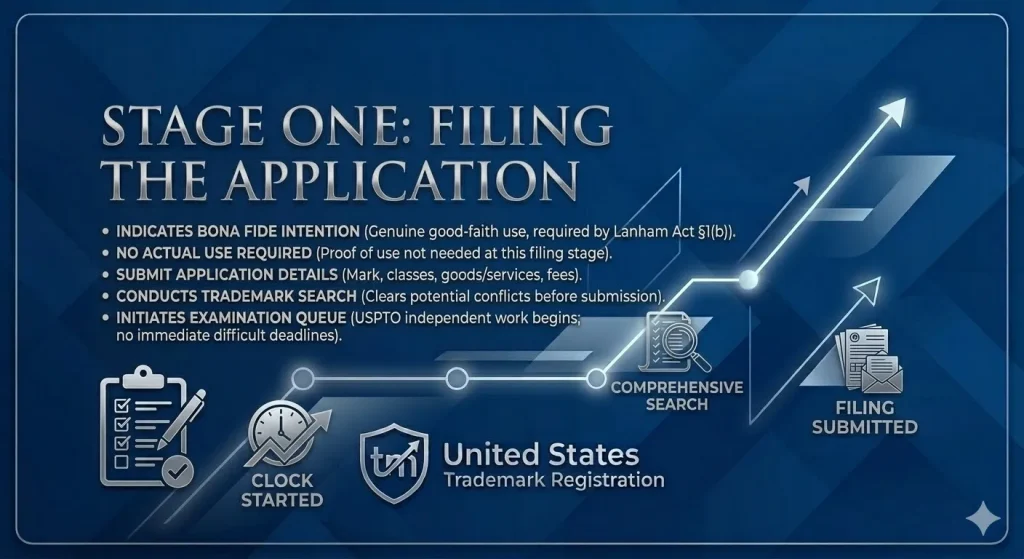
The process starts when you file your trademark application under Section 1(b) of the Lanham Act, indicating a bona fide intention to use the mark in commerce. “Bona fide” is the operative phrase. You must have a genuine, good-faith intention to use the mark in connection with the goods or services you’ve identified, not just a desire to hold the name. Filing without a genuine intention to use is grounds for invalidation.
At the filing stage, you’re not required to show actual use. You submit your mark, identify the goods or services, select your classes, pay the USPTO filing fees, and declare your intent. At this stage, a well-prepared application incorporates a comprehensive free trademark search to resolve any potential conflicts prior to submission.
Federal trademark filing through TEAS Plus (Trademark Electronic Application System Plus) or TEAS Standard (Trademark Electronic Application System Standard) initiates the examination queue. From this point, the clock doesn’t start ticking on any difficult deadlines. The USPTO operates independently, with the first significant deadline still several months away.
Stage Two: USPTO Examination
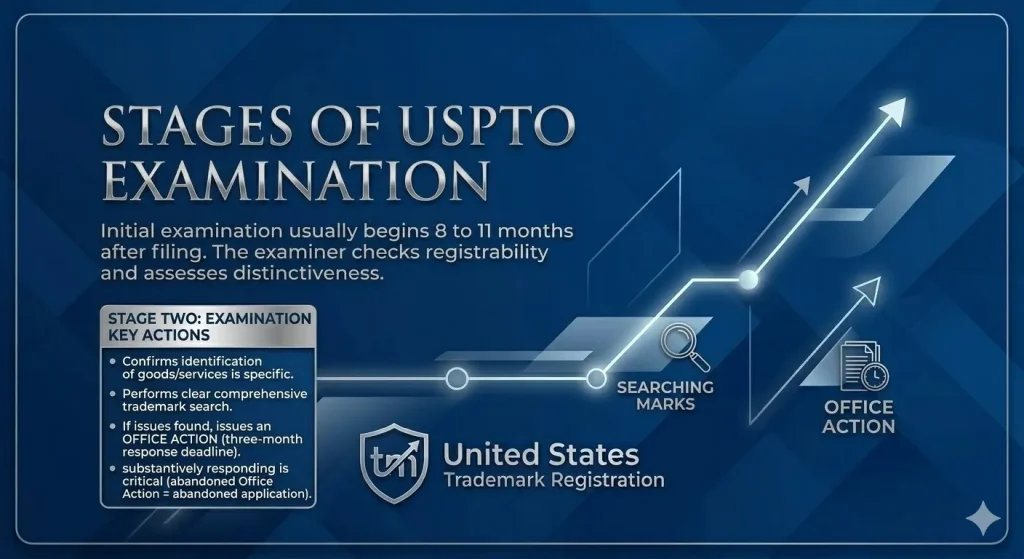
After filing, your application enters the examination queue. As of 2025, the USPTO’s initial examination typically begins 8 to 11 months after filing. The examiner reviews your application for registrability. They check for conflicting marks, assess the distinctiveness of your mark, review your identification of goods and services, and confirm that you met all application requirements.
If the examiner finds issues, they issue an office action. You have three months to respond without additional fees, or six months with a fee for an extension. Responding on time and substantively is critical. An abandoned office action means an abandoned application.
If the examiner approves the application, it moves to publication.
Stage Three: Publication for Opposition
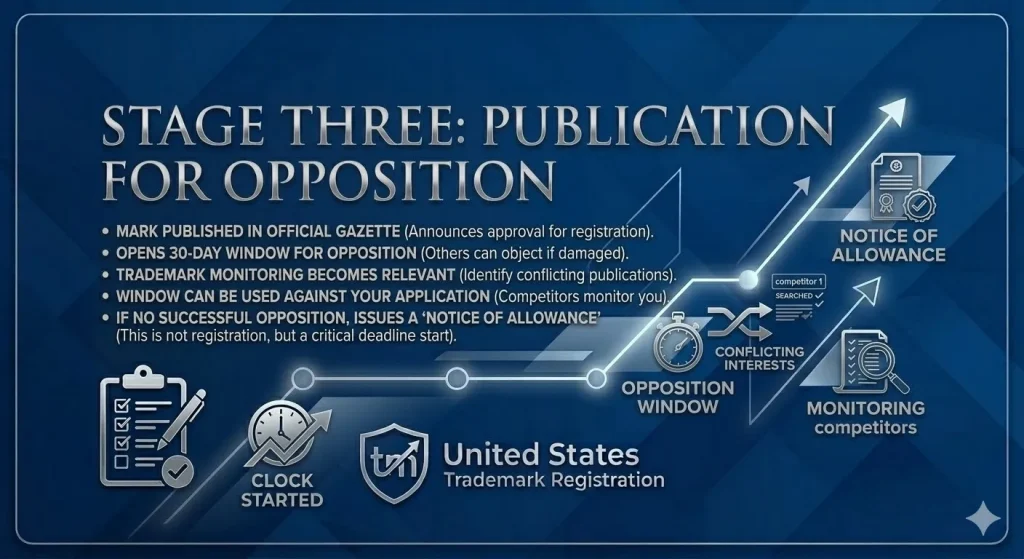
After examination approval, the USPTO publishes your mark in the Official Gazette, the weekly publication that announces trademarks approved for registration. Publication opens a 30-day window during which any party who believes your registration would damage them can file an opposition.
monitoring, which involves keeping track of competitors’ trademark applications, becomes relevant even for ITU (Intent to Use). This is where trademark monitoring becomes relevant even for ITU applicants. Monitoring your competitors’ applications allows you to be aware of any conflicting publications. Others can also use the same window against your application.
If no one opposes your mark within the 30-day window, or if you resolve any opposition in your favor, the United States Patent and Trademark Office (USPTO) issues a Notice of Allowance. This document confirms that your trademark application has met the requirements for registration. This document attests to the fact that your trademark application satisfies the registration requirements. This is not your registration. This date marks the beginning of the most challenging deadline in the Intent to Use (ITU) process.
Stage Four: The Notice of Allowance and the Six-Month Window
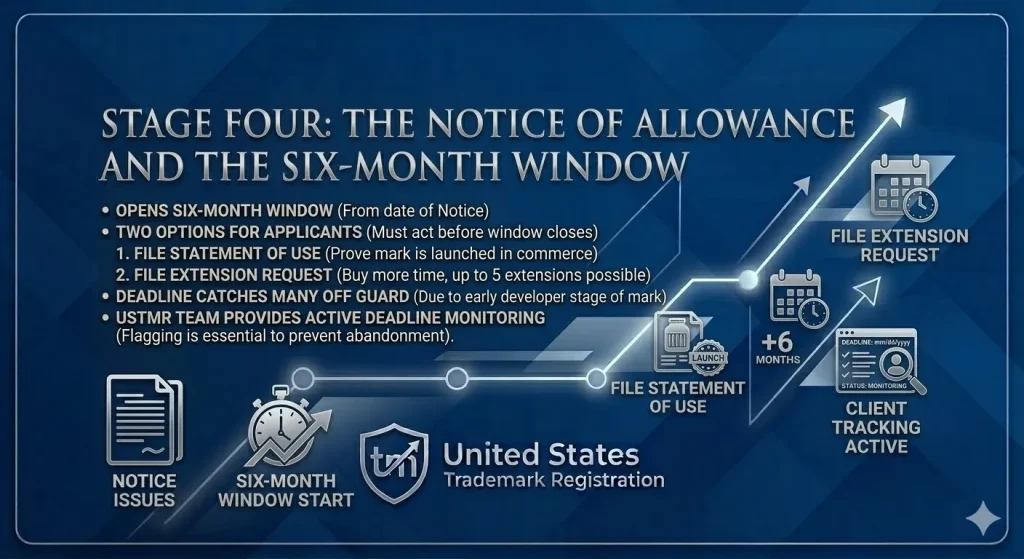
The Notice of Allowance issues after the opposition period closes without a successful opposition. From the date on that notice, you have six months to do one of two things: file a Statement of Use, which is a document proving you’ve launched the mark in commerce, or file an extension request to buy more time.
Most ITU applicants are surprised by this six-month deadline. Many businesses file ITU applications when a product or service is still in development, expecting a reasonable amount of time to get to market. The examination timeline, which can run a year or longer, sometimes creates a false sense of space. By the time the Notice of Allowance arrives, the deadline pressure hits suddenly.
Online trademark services professionals build this deadline into their client tracking systems from the moment an ITU application is filed. Our team at USTML promptly flags the Notice of Allowance upon issuance and immediately starts coordinating the Statement of Use or extension strategy.
Stage Five: Extension Requests
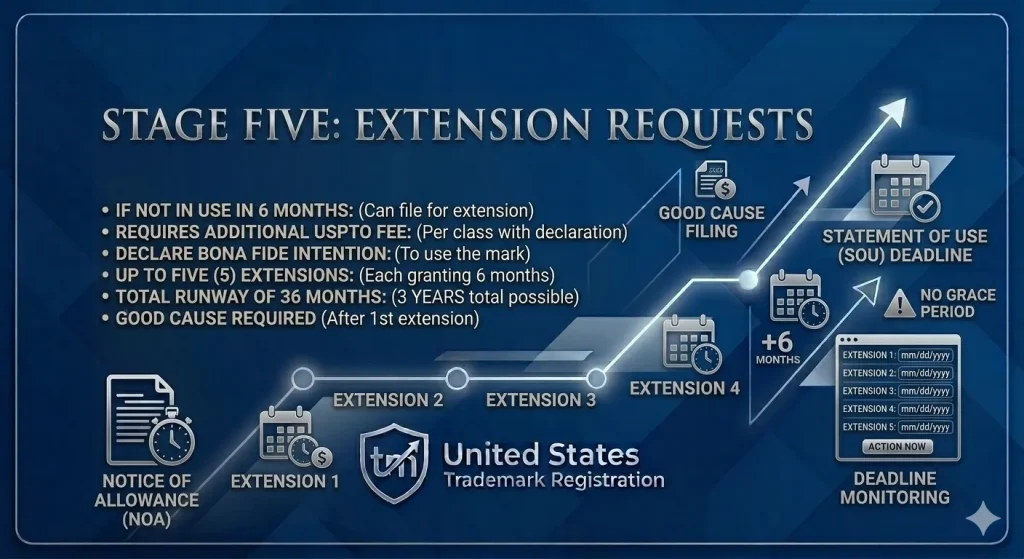
If your mark isn’t in commercial use within six months of the Notice of Allowance, you can request a six-month extension. Each extension costs an additional USPTO fee per class and requires a declaration of continued bona fide intention to use the mark.
You can request up to five extensions, giving you a total potential runway of 36 months from the Notice of Allowance date. Beyond the first extension, you must show good cause for the continued delay. The USPTO (United States Patent and Trademark Office) takes the good cause requirement seriously as the extensions accumulate.
Each extension deadline is as difficult as the one before it. If you miss one, the application will be abandoned with no recovery option and no grace period. Trademark application services that include active deadline management are worth the investment, specifically to prevent this failure point.
Stage Six: Filing the Statement of Use
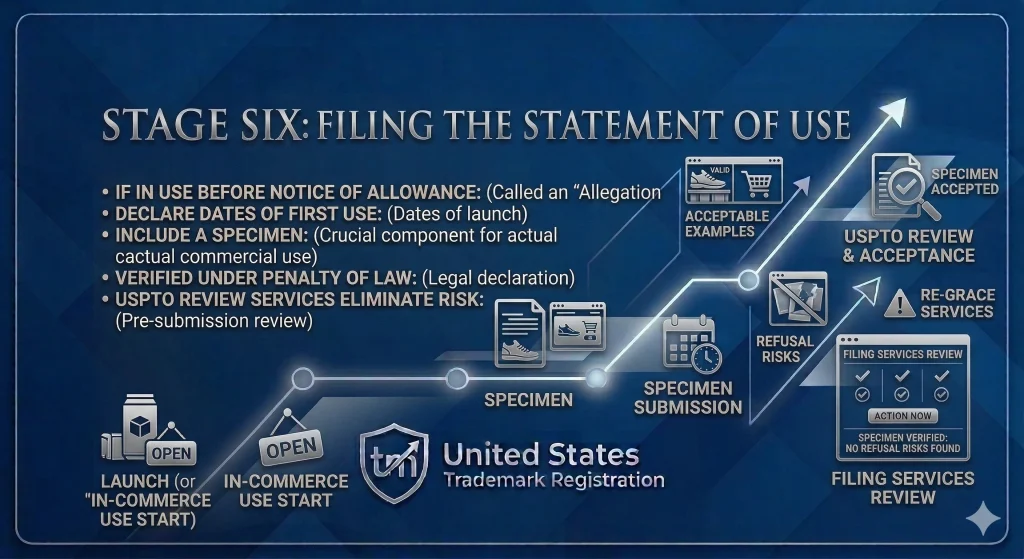
When your mark is in use in commerce, you file the Statement of Use. If filed before the notice of allowance issues, it’s called an “allegation of use.” The Statement of Use declares the dates of first use, includes a specimen showing the mark in actual commercial use, and is verified under penalty of law.
The specimen is the critical component. It must show the mark in genuine use with the goods or services identified in the application. Mockups, staged photos, and promotional samples created for the application itself don’t qualify. USPTO filing services that review your specimen before submission eliminate the risk of a refusal that adds weeks or months to your timeline.
Stage Seven: Registration
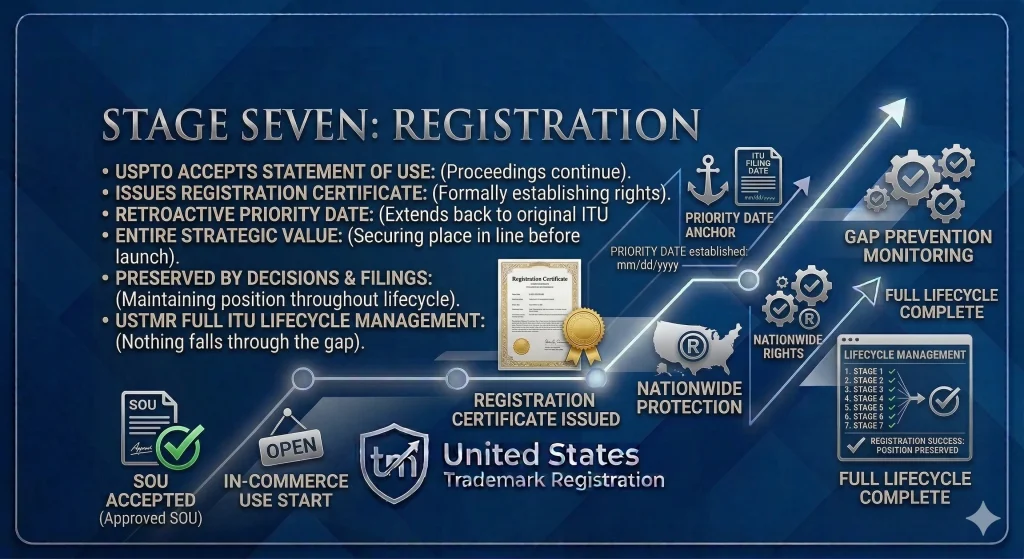
After the USPTO accepts your Statement of Use, the application proceeds to registration. The USPTO issues your registration certificate, formally establishing your trademark rights with a priority date that extends back to your original ITU filing date.
That retroactive priority date is the entire strategic value of the ITU application. You established your place in line the day you filed, before you launched the product, before you were ready to open the business, before anyone else could establish priority in your class. Every subsequent decision and filing has preserved that position.
At USTML, our united states trademark registrations and law Services manage the full ITU lifecycle: the initial trademark search, the application filing, examination monitoring, opposition period tracking, Notice of Allowance response, extension management, Statement of Use preparation, and registration. Trademark protection solutions that span the entire process mean nothing falls through the gap between stages.
The Full Timeline at a Glance
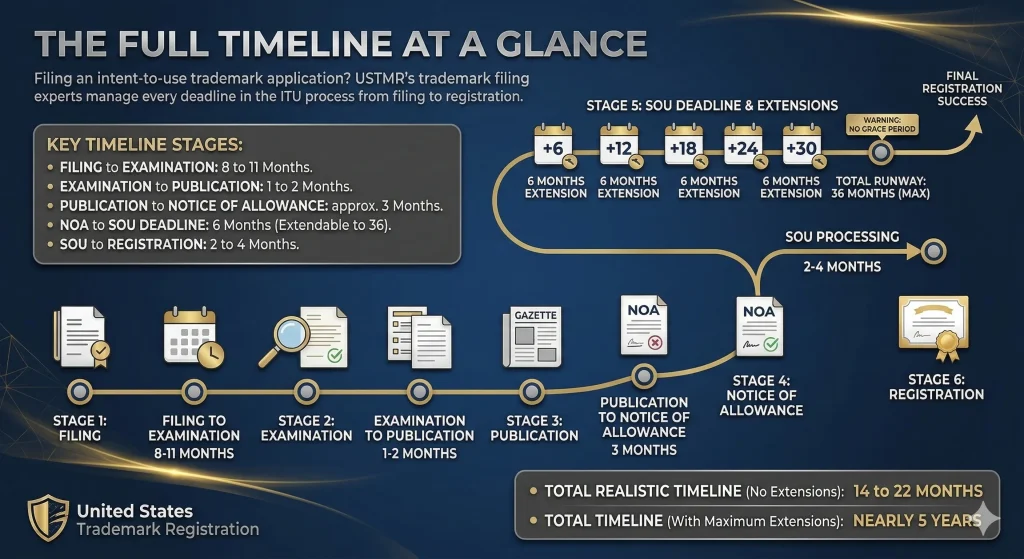
Filing for examination takes 8 to 11 months. The time from examination to publication is 1 to 2 months. Publication to Notice of Allowance: approximately 3 months. Notice of Allowance to Statement of Use deadline: 6 months, extendable up to 36 months. The acceptance of the Statement of Use for registration takes 2 to 4 months.
Total realistic timeline from filing to registration for an ITU application with no extensions: 14 to 22 months. With extensions used to their maximum, that timeline extends to nearly five years from filing.
Filing an intent-to-use trademark application? USTML’s trademark filing experts manage every deadline in the ITU process from filing to registration.
Frequently Asked Questions
What does intent-to-use mean in a trademark application?
An intent-to-use trademark application is filed under Section 1(b) of the Lanham Act when you plan to use a mark in commerce but haven’t yet done so at the time of filing. It allows you to set a priority date for your mark before launching your product or service.
How long does an intent-to-use trademark application take to become registered?
Without extensions, an ITU (intent-to-use) application typically takes 14 to 22 months from filing to registration. That includes the USPTO examination period, publication for opposition, the Notice of Allowance window, and Statement of Use processing. Using extensions to the maximum allowed can extend the total process to approximately five years.
What is the biggest deadline risk in an intent-to-use trademark application?
The six-month window after the Notice of Allowance is the most commonly missed deadline. After examination and publication, which can take over a year, the Notice of Allowance arrives and immediately starts a hard six-month clock. Many applicants aren’t prepared for it.
Can I file an intent-to-use application for a mark I’m not sure I’ll use?
No. The intent-to-use basis requires a bona fide, genuine intention to use the mark in commerce. Filing without that genuine intent, simply to hold a mark or block competitors, is a misrepresentation that can be used to invalidate the registration.
What happens to my priority date if I use extension requests?
Your priority date remains the date you originally filed the application. Extensions don’t change your priority date or weaken your position against later-filed conflicting marks. They simply give you more time to reach the use in commerce that allows the application to proceed to registration.