

We hear this more than we should. A client calls us after signing up with another service. They were promised their trademark would be “done in 30 days.” Eight months later, they are still waiting. Nobody warned them. Nobody explained how this actually works.
That 30-day promise was not technically a lie. The other service filed the trademark application within 30 days. Filing and registering are two entirely different things. The USPTO moves on its own schedule, and no filing service or software changes that.
We tell every client the honest timeline on day one. Here is exactly what trademark registration looks like in 2026, month by month, with no surprises.
The Real Timeline: 8 to 12 Months Minimum
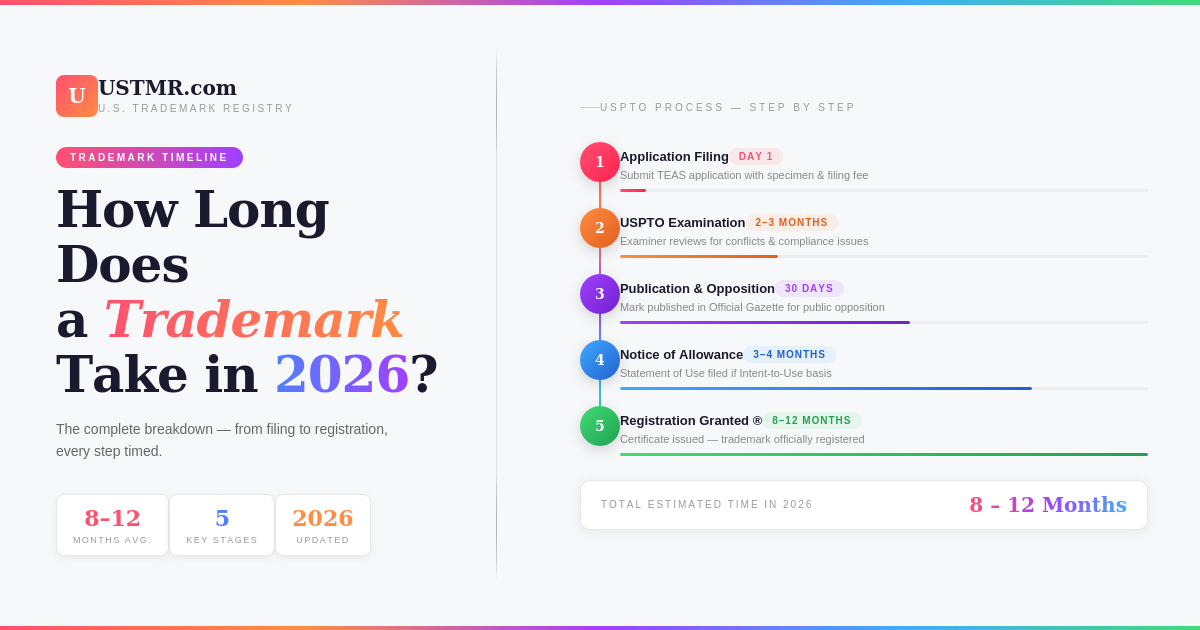
A clean, problem-free trademark registration takes 8 to 12 months from filing to certificate. That is the baseline for a straightforward application with no conflicts and no Office Actions.
Add an office action, and the timeline extends by 2 to 6 months. Add an opposition proceeding, and it stretches further. We have seen simple applications take 14 months and complex ones go well past two years.
The USPTO does not rush for anyone. Current examination wait times run 6 to 8 months after filing before an attorney even reviews the application. Brand owners who plan a business around a 30-day turnaround are setting themselves up for a hard lesson.
Month-by-Month: Where Does the Time Go?
Here is what happens after we submit a federal trademark filing on a client’s behalf:
- Months 1 to 2: The USPTO assigns a serial number and places the application in the examination queue. No visible action yet.
- Months 6 to 8: An examining attorney picks up the file. They check for conflicting marks, classification accuracy, specimen quality, and legal deficiencies.
- Month 8 or 9: The examiner either approves the mark for publication or issues an Office Action flagging problems that need resolution.
- Publication window: The mark publishes in the Official Gazette for 30 days. Third parties can oppose during this period.
- Months 11 to 13: With no opposition and a use-based filing, the USPTO issues the registration certificate. Intent-to-use filers receive a Notice of Allowance first.
That is the fast path. Most applications hit at least one delay somewhere in that chain.
What Stretches the Timeline?
Office Actions are the most common source of delays. An examiner issues one when something in the application needs correction before the mark can advance.
Applicants have three months to respond, with an optional extension to six. Each round adds the full response cycle to the total time. One Office Action typically adds 3 to 6 months. Two push the total past 18 months.
Common triggers include the likelihood of confusion with an existing mark, specimen problems, and vague identification of goods or services. Running a comprehensive trademark search before filing catches most of these before they become formal refusals. Our trademark search service surfaces conflicts and classification gaps early, before they cost clients months of delay.
Oppositions add a separate layer. When a third party challenges the mark during publication, the Trademark Trial and Appeal Board takes over. That process runs on its own timeline and can add a year or more.
Intent-to-Use Applications Take Longer
When a client files before their product or service is commercially available, we file on an intent-to-use basis. It secures an earlier priority date, which matters. It also means the registration takes longer to finalize.
After the USPTO issues a Notice of Allowance, we have six months to file a Statement of Use proving commercial activity has started. Extensions are available up to three years total from allowance. Each extension means additional fees and more waiting.
We advise intent-to-use clients to budget 12 to 18 months minimum. Building a product launch around a registration date is a mistake. Build it around the filing date instead.
“Fast Filing” Services Are Misleading
Many online trademark services lead with speed. Some genuinely file quickly, within 24 to 72 hours. That part is accurate. What those services leave out is that filing speed does not affect the USPTO examination time.
The agency works through applications in the order received. Filing in one day versus two weeks makes no difference to when an examiner picks up the file. Speed matters for priority, not for getting a certificate faster.
Any service suggesting that fast filing means fast registration is misleading its clients. We see the fallout from that every week.
What You Control and What You Do Not?
Some of the timeline is fixed. Other parts depend entirely on preparation.
Within your control:
- Application quality: accurate descriptions, correct classification, solid specimen
- Running a proper search before filing to reduce conflict risk
- Responding to office actions promptly when they arrive
- Filing on the right basis from the start, use-based or intent-to-use
Outside your control:
- USPTO examination queue times, which shift with application volume
- Whether an examiner identifies a conflict with an existing registration
- Whether a third party opposes the mark during publication
- How the Trademark Trial and Appeal Board handles any dispute
We focus on what is controllable. A clean application, a vetted specimen, and accurate classifications reduce Office Action risk. Every deficiency left unfixed at filing is a potential delay waiting to happen.
How to Check Your Trademark Application Status?
The USPTO’s Trademark Status and Document Retrieval system, TSDR, shows real-time status for any application using the serial number assigned at filing. Updates appear within days of any examiner action.
Checking every 3 to 4 weeks is reasonable. Office Action deadlines are strict, and a missed response window can result in abandonment.
When clients work with us, we monitor status and flag every deadline. Nobody should be refreshing a government portal alone and hoping nothing slipped through.
We Give You the Realistic Timeline, Not the One You Want to Hear
Every client who comes to us after a bad experience with another service says the same thing: nobody told them the truth upfront. Months of misaligned expectations damage launch planning, investor conversations, and business decisions that depend on registered intellectual property.
At U.S. Trademark Registration (USTML), we start every engagement with a straight answer on the timeline. No 30-day promises. No fine print. Just an accurate picture of what the USPTO filing process looks like for the specific application being filed.
Our trademark registration services cover the full process from application prep through registration, with status monitoring and Office Action support built in. We stay with clients at every step, and we tell them exactly what is coming before it arrives.