

You’re about to file for trademark registration. You’ve got your brand name picked out, your logo designed, and you’re ready to make it official.
But first, someone told you to do a trademark search. Smart advice.
So you head to the USPTO website, type your brand name into their free search tool, hit enter, and… nothing shows up. Great! Your trademark is available, right?
Not so fast.
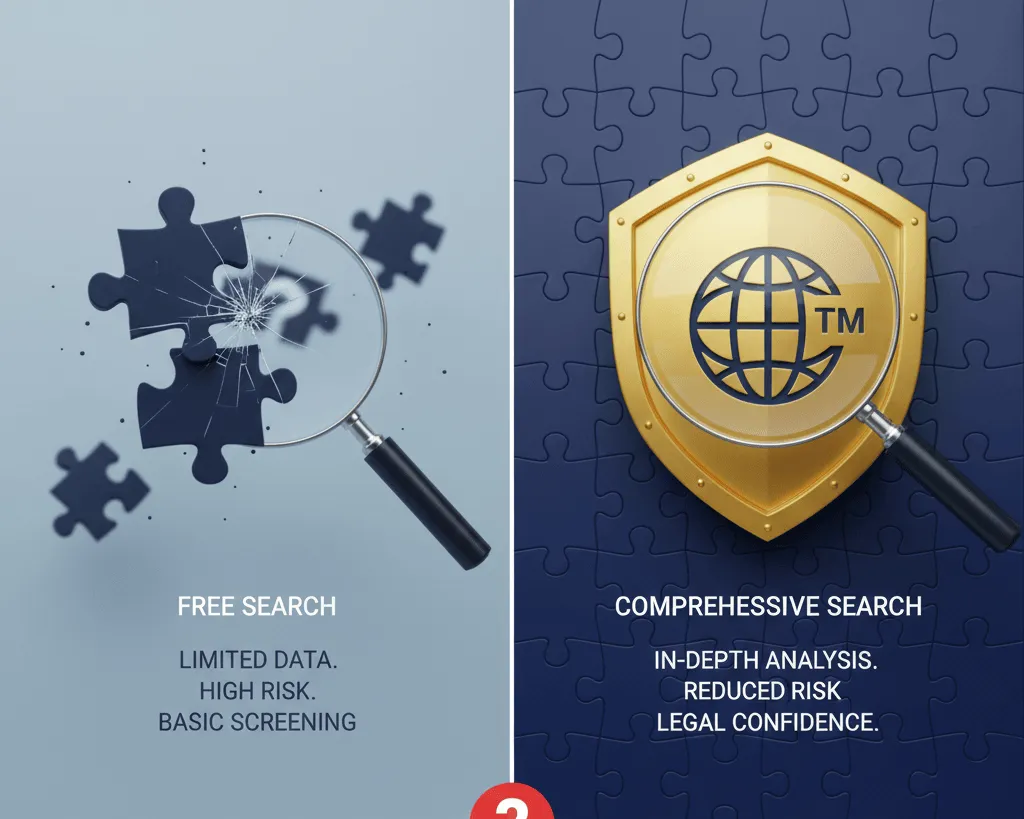
That free trademark search just scratched the surface. And the difference between a surface search and a comprehensive trademark search could cost you thousands of dollars and months of wasted time.
Let me show you exactly what you get with each option, and more importantly, what you’re missing.
What Is a Free Trademark Search?
The USPTO offers a database called the Trademark Electronic Search System (TESS). It’s free, it’s accessible to anyone, and it searches the federal trademark database.
You can search by:
- Trademark name (word marks)
- Design elements (logo searches)
- Owner name
- Serial or registration number
When you search, you’ll see active registered trademarks, pending applications, and some abandoned marks.
Sounds comprehensive, right? Here’s the problem.
The 5 Massive Gaps in Free Trademark Searches
1. You Only See Exact or Very Similar Matches
The USPTO search tool looks for trademarks that match what you typed. If you search for “Blue Mountain Coffee,” you’ll find other trademarks with those exact words.
But you won’t easily find:
- BluMountain Coffee (phonetic similarity)
- Blue Mtn Coffee (abbreviations)
- Azul Mountain Coffee (“Blue” in Spanish)
- Mountain Blue Coffee (word order variations)
These could all block your trademark application. The USPTO examiner will catch them during review. You won’t, not with a basic free search.
2. Common Law Trademarks Are Invisible
Here’s something most people don’t realize: you don’t need to register a trademark to have trademark rights.
If a business has been using a name in commerce, they have “common law” trademark rights in its geographic area. They can oppose your federal registration or sue you for infringement.
The free USPTO search shows ZERO common law trademarks because they’re not registered anywhere. You’d need to search:
- Business name registrations in all 50 states
- Domain name databases
- Social media handles
- Industry directories
- Local business listings
That’s hundreds of databases the free search doesn’t touch.
3. State Trademark Registrations Don’t Appear
Every state has its own trademark registration system. A business might register its trademark in California or Texas without bothering with federal registration.
If their state trademark is in the same industry as yours, that’s a problem. The USPTO might not reject your application because of it, but you could face a lawsuit from that state-level owner.
The free search? It doesn’t check any state databases.
4. Pending Applications in “Dead Zones”
When someone files a trademark application, there’s a gap between filing and publication (usually 2-4 months). During this time, the application exists but isn’t searchable in the public database yet.
If you do your free search during this window, you’ll miss recently filed applications that could conflict with yours.
You file. They publish first. Now you’re both in line for similar trademarks, and the USPTO has to sort it out through opposition proceedings. That’s expensive and time-consuming.
5. International Trademarks Aren’t Included
Planning to expand globally? Or maybe you’re just selling online, and customers could be anywhere?
The USPTO database doesn’t show trademarks registered in other countries. If you’re filing for “Milano Coffee” without checking European databases, you might not discover the Italian coffee company that’s been using that name since 1998.
This becomes an issue when you try to expand or when you face opposition from an international trademark owner.
What Does a Comprehensive Trademark Search Actually Include?
A proper, comprehensive trademark search conducted by professionals covers all those gaps:
Federal Database (But Smarter)
Professional search tools don’t just look for exact matches. They use:
- Phonetic algorithms (Blue = Blu = Bleu)
- Translation databases (Blue = Azul = Blau)
- Design code searching for logos
- Classification analysis (are similar marks in related industries?)
The search considers how the USPTO examiner will review your mark, not just how a basic keyword search works.
State Trademark Databases
A comprehensive search checks all 50 states for registered trademarks that could conflict with yours. This is especially critical if you do business regionally or if your industry has strong local players.
Common Law Research
This is the labor-intensive part. Professional searches look for unregistered trademark use through:
- Secretary of State business name databases
- Domain registrations (.com, .net, .biz, industry-specific)
- Social media handles (Instagram, Facebook, Twitter, LinkedIn, TikTok)
- Industry directories and trade publications
- News articles and press releases
- Patent and copyright databases
If someone’s been using your brand name for their business, even without registration, a comprehensive search will find it.
Pending Applications and Recent Filings
Professional search services have access to the most current USPTO data, including applications filed within the last few days. This catches those “dead zone” applications that don’t show up in public searches yet.
International Databases
If you have any plans for international business, a comprehensive search is required:
- WIPO Global Brand Database (international trademarks)
- EU Intellectual Property Office (EUIPO)
- UK Intellectual Property Office
- Canadian Trademarks Database
- Major market databases (China, Japan, Australia, etc.)
Likelihood of Confusion Analysis
Here’s what really sets comprehensive searches apart: a professional doesn’t just list similar trademarks. They analyze whether those marks are likely to cause “likelihood of confusion” with yours.
This analysis considers:
- Visual similarity (how the marks look)
- Phonetic similarity (how they sound)
- Meaning similarity (what they convey)
- Industry overlap (are you selling related products?)
- Channel overlap (same customer base?)
- Strength of the existing mark (is it famous or distinctive?)
You get a legal opinion on your trademark’s viability, not just a list of results.
Real Cost Comparison
Free USPTO Search
Cost: $0 Time Investment: 1-3 hours if you know what you’re doing Databases Covered: 1 (federal only) Risk Level: High
You might miss conflicts that surface later, resulting in:
- Application rejection (wasted $250-$350 USPTO fee + service fees)
- Opposition proceedings ($3,000 to $10,000 in legal fees)
- Cease and desist letters after you’ve launched
- Rebranding costs ($10,000 to $100,000+)
DIY Multi-Database Search
Cost: $100-$300 (access to various paid databases) Time Investment: 8-15 hours Databases Covered: 5-10 Risk Level: Moderate
Better than free, but you’re still:
- Possibly missing nuanced conflicts
- Not getting legal analysis
- Potentially misinterpreting similarity
Professional Comprehensive Search
Cost: $300-$500 through a service like USTML Time Investment: 0 hours (we do it for you) Databases Covered: 50+, including federal, state, common law, and international Risk Level: Low
You get:
- Full report of all potential conflicts
- Legal analysis of the likelihood of confusion
- Recommendations on how to proceed
- Peace of mind before spending money on filing
When is Free Search Enough?
I’ll be honest: there are situations where a free search might be sufficient.
You can probably rely on a free search if:
- Your trademark is extremely unique (made-up word with no meaning)
- Your industry is very niche with few competitors
- You’ve already been using the trademark for years without issues
- You’re only doing business locally and have no growth plans
But here’s the thing: if your brand matters to your business (and it almost always does), why risk it?
When You Absolutely Need a Comprehensive Search?
Don’t skip the comprehensive search if:
- You’re investing significant money in branding, inventory, or marketing
- Your brand name is descriptive or uses common words
- You’re in a competitive industry (tech, fashion, food, consulting)
- You plan to seek investment or sell your business
- You’re launching a product nationally or internationally
- Your business model depends on brand recognition
The cost of a comprehensive search is a rounding error compared to the cost of rebranding after a trademark conflict.
What USTML’s Comprehensive Search Includes?
When you order a comprehensive trademark search from USTML, here’s exactly what you get:
Complete Database Coverage
- USPTO federal database (all classes)
- All 50 state trademark databases
- Common law research (business names, domains, social media)
- Pending applications and recent filings
- International trademark databases
Professional Analysis
- Likelihood of confusion assessment
- Industry-specific risk evaluation
- Recommendations on how to proceed
- Alternative branding suggestions if conflicts exist
Detailed Report
- Summary of findings
- List of all potentially conflicting marks
- Visual comparisons for logo conflicts
- Legal opinion on your trademark’s strength
- Next steps guidance
Fast Turnaround
Most comprehensive searches are completed within 3-5 business days. You get answers quickly so you can move forward with confidence.
Cost: Starting at $500 (compare that to $10,000+ in rebranding costs)
The Trademark Search Process: What to Expect?
1. Initial Free Search (You Can Do This)
Go ahead and do the free USPTO search yourself. This gives you a quick gut check. If there are 15 exact matches for your brand name, you probably need to rethink your name before paying for a comprehensive search.
2. Order Comprehensive Search (If Free Search Looks Clear)
Once the free search doesn’t show obvious conflicts, order a professional comprehensive search. This is where you get the real due diligence.
3. Review the Report
A good comprehensive search report will be 20-50 pages. It includes:
- Executive summary (can you move forward or not?)
- Detailed findings with explanations
- Visual examples of conflicting marks
- Risk assessment for each potential conflict
4. Make Your Decision
Based on the report, you’ll decide to:
- Proceed with filing (no significant conflicts found)
- Modify your trademark (minor conflicts that can be addressed)
- Choose a different trademark (too many conflicts or high risk)
5. File Your Application
If the comprehensive search gives you the green light, you’re ready to file your trademark application with confidence. You know you’ve done your homework and minimized risk.
Common Mistakes People Make With Trademark Searches
I Googled My Brand, and Nothing Came Up
Google isn’t a trademark search. It doesn’t search the USPTO database systematically or search state registrations. It will not search abandoned applications. Google is a starting point, not a trademark clearance tool.
My Domain Name Was Available, So the Trademark Must Be Too
Domain availability has nothing to do with trademark availability. You can buy BlueApple.com even if someone owns a federal trademark for “Blue Apple” coffee shops.
I Searched One Category and Didn’t Find Anything
Trademarks are filed in different classes based on goods and services. Your “Blue Mountain” clothing line might not conflict with “Blue Mountain” software, but it definitely conflicts with “Blue Mountain” t-shirts. You need to search related classes, not just your exact category.
The Free Search Showed Abandoned Trademarks, So I’m Clear
Abandoned doesn’t always mean dead. The owner might still be using the trademark under common law rights. Or they might have let the registration lapse, but still have enforceable rights. Never assume abandoned means available.
What Happens If You Skip the Search Entirely?
Some people file trademark applications without any search at all. Here’s what typically happens:
Scenario 1: Immediate Rejection The USPTO examiner finds a conflicting mark during their review (3-4 months after you file). Your application gets rejected. You’ve wasted the USPTO filing fee ($250-$350) plus any service fees you paid.
Scenario 2: Publication and Opposition. Your application makes it through the examination and gets published for opposition. Then the owner of a similar trademark opposes your registration. Now you’re in opposition proceedings, which cost $3,000 to $10,000+ in legal fees.
Scenario 3: Registration, Then Lawsuit. Your trademark gets registered, you launch your business, and six months later, you get a cease and desist letter from someone who’s been using a similar mark. Now you’re facing potential trademark infringement claims, even though you have a registration.
All three scenarios are expensive. All three are avoidable with a proper search.
Trademark Searches: How Can You Build a Solid Foundation?
The free USPTO search is a starting point, not a finish line. It tells you if any obvious federal registrations would immediately block your trademark.
But building a business on “no obvious conflicts in one database” is like building a house on sand. You need a solid foundation.
A comprehensive trademark search gives you that foundation. For $300 to $500, you get:
- Coverage of 50+ databases
- Professional analysis of conflicts
- Legal opinion on your trademark’s strength
- Confidence to invest in your brand
Compare that to the cost of:
- Rejected trademark application: $500+ in wasted fees
- Opposition proceedings: $3,000 to $10,000
- Rebranding after launch: $10,000 to $100,000+
- Lost business reputation: Priceless
The choice is pretty clear.
Ready to Search Your Trademark the Right Way?
USTML offers both free trademark search tools on our website for quick checks and comprehensive trademark search services for full due diligence.
Not sure which you need? Reach out, and we’ll walk you through your options based on your specific situation.
Don’t risk your brand on a free search alone. Get the comprehensive clearance you need before investing in trademark registration.
Frequently Asked Questions
How long does a comprehensive trademark search take?
Most professional searches are completed within 3-5 business days. Rush options may be available for urgent needs.
Can I do a comprehensive search myself?
Technically, yes, but it requires access to multiple paid trademark databases and expertise in trademark law to interpret the results correctly. Most business owners find it more cost-effective to hire professionals.
What if the comprehensive search finds conflicts?
You’ll get recommendations on whether to proceed, modify your trademark, or choose a different name. Sometimes conflicts are minor and manageable. Sometimes they’re deal-breakers.
Do I need an international search if I only do business in the US?
Not initially, but if you have any plans to expand internationally or sell online to global customers, it’s worth checking major international databases.
How much does a comprehensive trademark search cost?
Professional comprehensive searches typically range from $300 to $500. This covers federal, state, common law, and basic international searching with legal analysis.