

The food and restaurant industry loses more trademark disputes than almost any other sector. Not because the businesses are careless, but because the rules around what qualifies for protection in this space are widely misunderstood. Restaurant owners, food brand founders, and hospitality entrepreneurs make the same classification, naming, and filing mistakes repeatedly. Most are avoidable with basic knowledge of how Restaurant trademark registration services handle food and service industry filings.
Here is what the industry consistently gets wrong.
Confusing a Business Name Registration With Trademark Protection
State business name registration, LLC formation, and DBA filings do not create trademark rights. This misconception is more common in the restaurant industry than anywhere else, possibly because local businesses feel their state registration is sufficient for their market.
A state-registered business name gives the right to operate under that name in one state. It does not stop a competitor in another state from using the same name. It does not prevent a national chain from expanding into the local market with a confusingly similar brand. Only a federal trademark registration through the USPTO provides nationwide protection.
This distinction becomes painful when a restaurant that has operated successfully for years discovers a larger chain has registered a similar name and now has the superior legal claim. Federal trademark registration filed early would have established priority before the conflict developed.
Trying to Trademark Menu Items and Recipes
Trademark law does not protect individual menu items or recipes. A dish name on a menu is not a trademark. A recipe is not a trademark. Menus are generally considered functional and informational rather than brand-identifying.
There are exceptions. A restaurant brand that has built significant consumer recognition around a specific named dish, where the name functions as a source identifier rather than just a description, may have grounds for trademark protection. That is a narrow category and requires evidence of acquired distinctiveness.
What trademark law does protect in the food space: the restaurant name itself, a distinctive tagline or slogan used in marketing, a logo associated with the brand, and the brand name applied to packaged food products sold at retail. Focusing protection on these elements is where intellectual property services for food businesses deliver real value.
Getting Classification Wrong
The USPTO uses an international classification system. Food businesses need to file in the right class or classes for their actual operations. Getting this wrong means the registration does not cover what the business actually does.
- Class 29: Processed foods including meat, fish, dairy, preserved fruits and vegetables, eggs, oils and fats
- Class 30: Coffee, tea, cocoa, flour, bread, pastries, confectionery, sugar, spices, condiments
- Class 32: Beers, non-alcoholic beverages, fruit juices, mineral waters
- Class 33: Alcoholic beverages except beer
- Class 43: Restaurant services, catering, food and drink provision, temporary accommodation
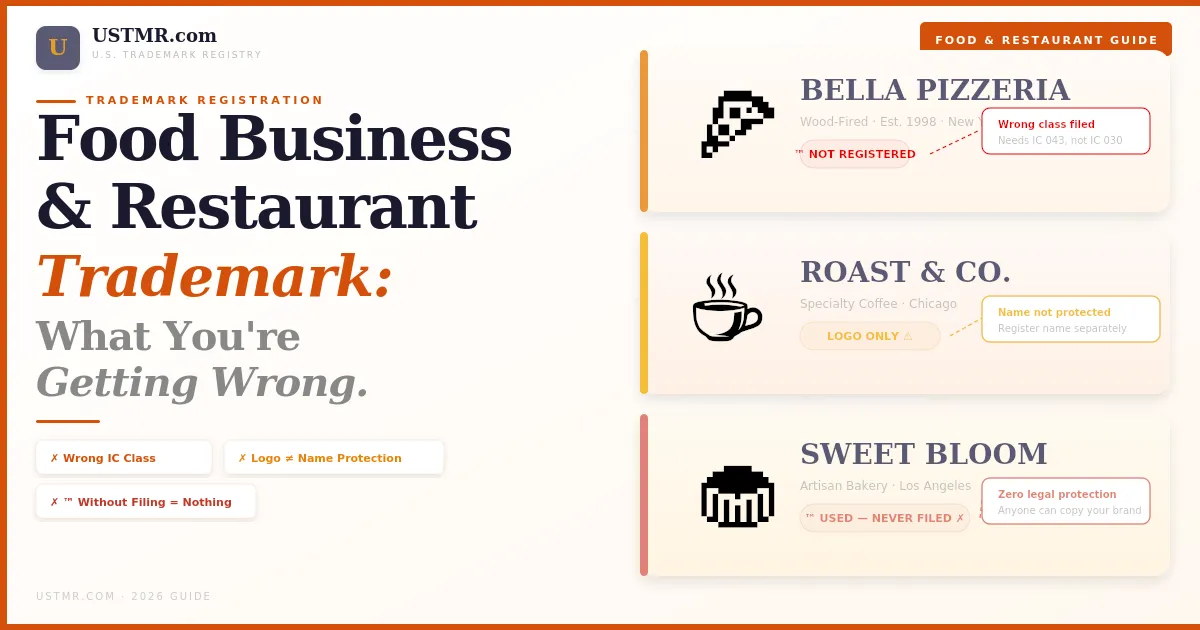
A restaurant that only files in Class 43 for restaurant services but also sells packaged sauces at retail needs a separate filing in the appropriate food goods class. Each class requires a separate USPTO fee. Missing a class leaves part of the business unprotected.
Geographic and Descriptive Name Problems
Restaurant names frequently reference location or describe the cuisine. “Chicago Deep Dish,” “Authentic Thai Kitchen,” “Fresh Mediterranean Grill.” These names run directly into the USPTO’s descriptiveness and geographic refusal categories.
Names that primarily describe where the food comes from, what type of cuisine is served, or the style of preparation face rejection or significantly weakened protection. A restaurant named after its city or its cuisine type will struggle to register that name alone.
The fix is usually adding a distinctive element. A stylized logo, an invented word combined with the descriptive term, or a name that suggests the experience without directly describing it all offer better trademark prospects. Our trademark filing experts assess naming strategy before filing so clients are not surprised by a descriptiveness rejection six months in.
Waiting Until the Restaurant Is Established
Many restaurant owners wait years before thinking about trademark protection. By then, the brand has real value, a loyal customer base, and a reputation worth protecting. It also means competitors have had years to file similar marks that now create conflicts.
Filing intent-to-use before opening, or filing use-in-commerce as soon as the restaurant opens, establishes a priority date that precedes later filers. The cost of filing early is fixed. The cost of a rebrand after years of operation, branded merchandise, signage, and customer recognition is not.
Franchising Without Proper Trademark Coverage
Food businesses that franchise or license their concept without a registered trademark are building on an unstable foundation. Franchise agreements without underlying trademark registrations are legally fragile. Franchisees in different states rely on the franchisor’s trademark rights. Without a federal registration, those rights are geographic and limited.
Any food business considering franchising, licensing, or expansion beyond its original location needs federal trademark registration in place before those conversations begin.
We Handle Food and Restaurant Trademark Filings Correctly
At united states trademark registrations and law (USTML), our trademark management services cover the full range of food and restaurant industry needs. We assess naming strategy, identify the right classification across goods and service classes, prepare applications that address the specific pitfalls this industry faces, and monitor for conflicts after registration.
Our Restaurant brand protection services for food businesses include a thorough, comprehensive trademark search across all relevant classes before filing. That search surfaces conflicts and classification issues before they become expensive problems.
Start with our free trademark search to see where the brand name stands. Then our trademark registration services handle the rest from classification through the registration certificate.