

The US Trademark law does not exist in a textbook. Disputes build it. The most important legal principles come from cases where two parties have genuinely competing interests and courts must make difficult decisions.
Understanding these landmark decisions helps brand owners make better decisions about their own trademarks. Each of the following cases established or clarified a principle that affects trademark registrations and enforcement today.
Case 1: Jack Daniel’s Properties vs. VIP Products (2023)
What happened
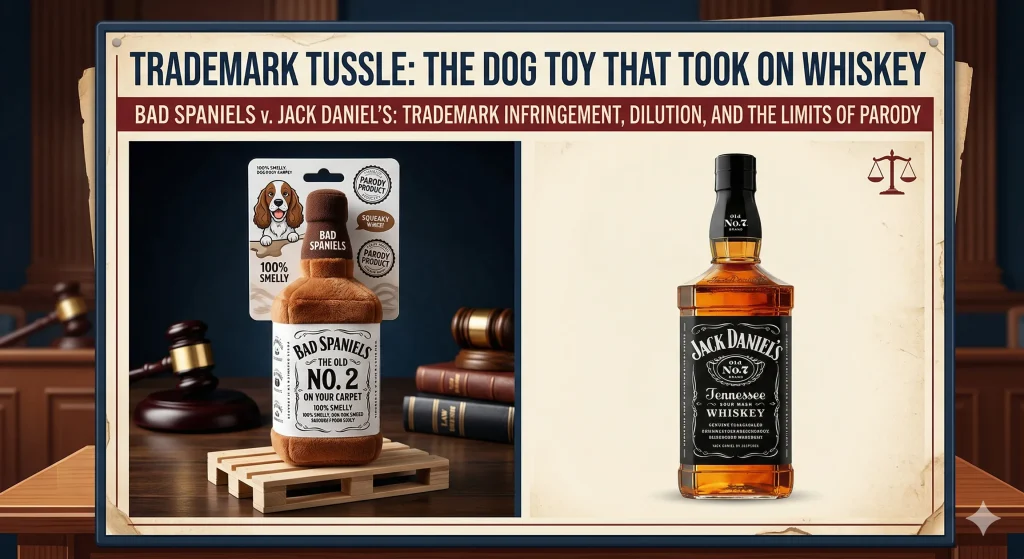
VIP Products created a dog toy called “Bad Spaniels” to parody the Jack Daniel’s bottle. The company designed the toy with similar packaging, replaced the trademark elements with humorous alternatives, and turned the famous phrase into a crude joke about dog waste. It marketed and sold the product as a novelty item.
Jack Daniel’s sued for trademark infringement and trademark dilution. VIP Products argued that the toy was protected by the First Amendment as parody and humorous expression. Lower courts disagreed on the outcome, and the Supreme Court ultimately heard the case.
What the Supreme Court decided
In 2023, the Supreme Court ruled on the use of another brand’s trademark as a designation of source. If a product sells under a mark that resembles another’s trademark, it does not get automatic First Amendment protection. Humor or parody does not provide this protection.
The court remanded the case for further analysis. However, it established a key principle: you cannot shield the use of a competitor’s trademark. Even not as your own mark from infringement analysis simply by adding humor.
What it means for brand owners
Parody is not a blanket defense to trademark infringement. If a competitor’s product uses your trademark in a way that functions as a source identifier, humor does not eliminate the legal risk. Conversely, brand owners cannot suppress all commentary or humorous references to their marks. The distinction is in how the mark is being used.
Case 2: Christian Louboutin vs. Yves Saint Laurent (2012)
What happened
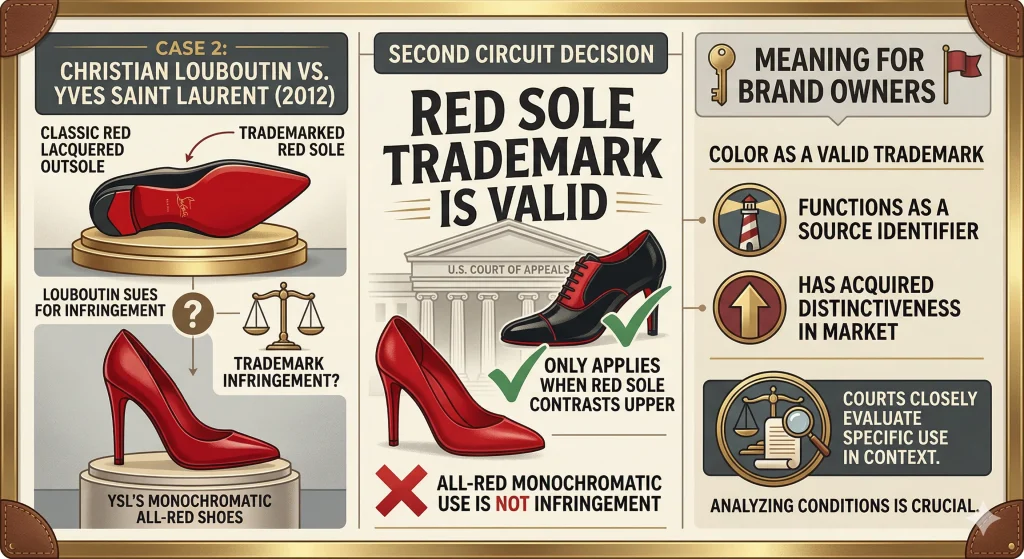
Christian Louboutin had registered the red lacquered outsole as a trademark for its luxury high-heel shoes. The registration had been in place since 2008 and was associated with the brand at the highest level of fashion. Yves Saint Laurent released a collection of monochromatic shoes in which the entire shoe, including the sole, was red.
Louboutin sued for trademark infringement. YSL argued that a single color cannot be trademarked in the fashion industry, where color is functional in the sense of being an aesthetic element that competitors need access to.
What the Second Circuit decided
The Second Circuit Court of Appeals ruled that Louboutin’s red sole trademark is valid. However, it only applies when the red sole contrasts with the upper part of the shoe. When the entire shoe, including the sole, is the same color, the red sole trademark does not apply. There is no contrast to serve as a source identifier. YSL’s all-red shoes did not infringe.
What it means for brand owners
Color can be a valid trademark when it functions as a source identifier and has acquired distinctiveness in the market. Color trademark protection often seems broader than it is. Courts closely evaluate whether a specific use of color in a particular context actually creates the consumer association the trademark should protect. Brand owners considering color-based trademark protection should carefully analyze the conditions under which the color functions as their brand identifier.
Case 3: Apple Corps vs. Apple Computer (settled 2007)
What happened
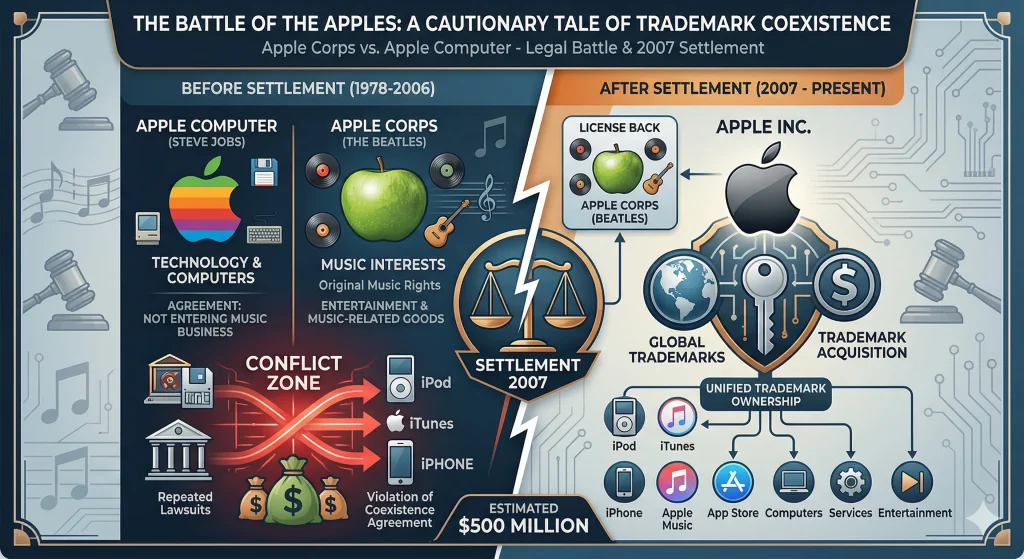
Apple Corps, the company founded by the Beatles to manage their musical interests, registered the Apple trademark in the UK and internationally. The registration covered entertainment and music-related goods and services. When Apple Computer launched in 1977, the companies entered into agreements. Under these agreements, Apple Computer agreed not to enter the music business.
As Apple Computer evolved into Apple Inc. and launched the iPod, iTunes, and eventually the iPhone, Apple Corps argued repeatedly that the technology company had violated the coexistence agreement by entering music distribution. Multiple legal proceedings over several decades addressed the boundaries of what each company could do under their trademarks.
What the settlement established
Apple Inc. ultimately acquired all Apple-related trademarks from Apple Corps in 2007 for a reported 500 million dollars, ending the dispute. Apple Corps then licensed back the rights it needed for its own operations.
What it means for brand owners
Parties must draft coexistence agreements and consent arrangements with extraordinary precision. They must clearly define what each party can and cannot do, especially in industries where business activities can expand unpredictably over time. An agreement written in 1981 about what a computer company could do could not have anticipated the realities of digital music distribution in 2003. Future-proofing coexistence agreements requires thinking carefully about how technologies and industries evolve.
Case 4: Matal vs. Tam (2017)
What happened
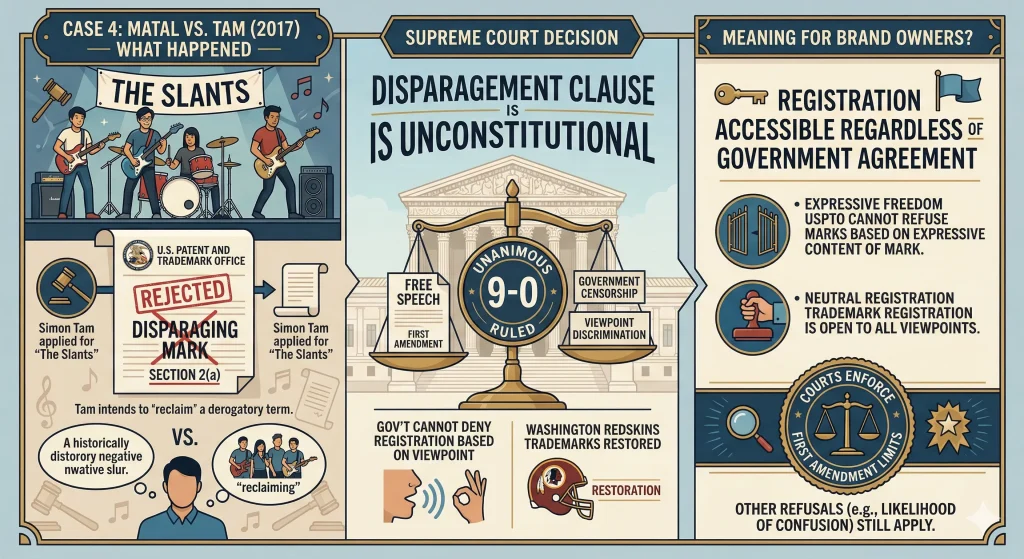
Simon Tam, the founder of an Asian-American rock band called The Slants, applied for a federal trademark registration for the band’s name. The USPTO rejected the application under Section 2(a) of the Lanham Act, which prohibited the registration of marks that may disparage persons, institutions, beliefs, or national symbols.
Tam argued that the band had adopted the term reclamatorily, intending to reclaim a historically derogatory term. The USPTO’s rejection stood through several appeals until the Supreme Court heard the case.
What the Supreme Court decided
The Supreme Court unanimously ruled that Section 2(a)’s disparagement clause was an unconstitutional restriction on free speech. The government cannot deny trademark registration based on the viewpoint expressed by the mark. The decision produced immediate practical consequences. It also allowed the Washington Redskins, later renamed the Commanders, to restore trademark registrations that the same provision had previously canceled.
What it means for brand owners?
The First Amendment limits how far the USPTO can go in refusing registrations based on the expressive content of a mark. While the USPTO can still refuse marks for other reasons, including descriptiveness, likelihood of confusion, and functionality, it cannot refuse based on the viewpoint or message expressed by the mark. This case established that trademark registration is accessible regardless of whether the government agrees with the message the mark conveys.
Case 5: Two Pesos vs. Taco Cabana (1992)
What happened
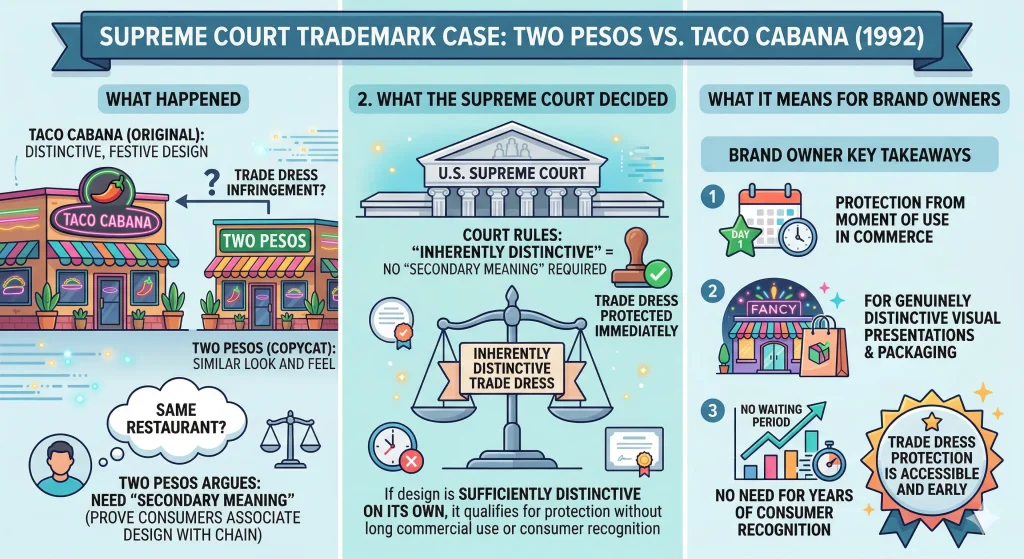
Taco Cabana was a fast-food chain in Texas known for its distinctive, colorful, festive restaurant design. When Two Pesos opened similar-looking restaurants that copied the overall look and feel, Taco Cabana sued for trade dress infringement. Two Pesos argued that trade dress protection requires proof of secondary meaning. In other words, they claimed that you must show consumers associate the design with a specific restaurant chain before the law will protect it.
What the Supreme Court decided
The Supreme Court ruled that inherently distinctive trade dress does not require proof of secondary meaning to receive trademark protection. If the overall look and feel of a restaurant, product, or packaging is sufficiently distinctive on its own, it qualifies for trade dress protection immediately, without needing to establish consumer recognition through long commercial use.
What it means for brand owners
Inherently distinctive trade dress, the overall commercial appearance of a business or product, can be protected from the moment it is used in commerce, not just after years of use build up consumer recognition. For brands with genuinely distinctive visual presentations, packaging, or restaurant/retail environments, this case established that those presentations deserve protection without a waiting period.
What these cases mean for your brand today?
- Humor and parody are not blank checks. If a competitor uses your brand name as a product identifier, even in a joking context, trademark law still applies.
- Color can be a trademark, but the scope of protection depends on how the color functions as a brand identifier in specific context.
- Coexistence agreements must account for future industry evolution, not just current business activities.
- The government cannot refuse your trademark registration based on the message or viewpoint your mark expresses.
- Distinctive trade dress, the overall look and feel of your brand presentation, can be protected from first use without waiting for consumer recognition to develop.
Frequently asked questions
Can I sue a competitor for using my brand name in a funny context?
It depends on whether they are using your trademark as a product identifier versus simply referencing your brand in commentary or humor. The Jack Daniel’s case established that humor does not automatically exempt use from trademark analysis. A trademark attorney can evaluate the specific situation.
Can I trademark my restaurant or store’s distinctive interior design?
Yes, under the trade dress doctrine established in Two Pesos. If the interior design is sufficiently distinctive and non-functional, it can be registered as trade dress. The design must serve as a source identifier, not merely a functional or aesthetic choice.
Is a color trademark hard to obtain?
Yes. The USPTO requires substantial evidence that the color has acquired distinctiveness, meaning consumers associate the specific color with your brand in your industry. Single-color trademarks typically require years of exclusive, consistent commercial use along with consumer recognition evidence before the USPTO will approve the registration.
How does the Matal vs. Tam decision affect my trademark application today?
If the USPTO refuses your application on grounds that the mark is disparaging or offensive, that refusal basis has been eliminated by this decision. However, the USPTO can still refuse marks for other reasons, including likelihood of confusion with existing marks, descriptiveness, and functional features.
What can I do if a competitor is copying the overall look of my brand or store?
Trade dress infringement is a recognized cause of action under the Lanham Act. If your business’s overall commercial appearance is distinctive and has been copied in a way that creates consumer confusion, you may have grounds for a trade dress infringement claim. united states trademark registrations and law (USTML) can connect you with trademark counsel to evaluate your situation.
| Your brand deserves the same protection these companies fought for, united states trademark registrations and law (USTML) helps brand owners build legal protection before disputes arise. A registered trademark gives you the standing to act when someone copies your brand identity. Protect your brand before a dispute forces your hand: ustml.com/trademark-registration/ |